• Film Festival link to see just the AIFF 2009 posts.
UFAQ's link for guide to specific posts and/or information about the festival and why I'm blogging it.
• Click the AIFF link to go the Festival website.

Sunday, November 30, 2008

The Fish Fall in Love - Another Iranian Film about a Woman Owned Restaurant

We saw an Iranian film at Out North last night The Fish Fall In Love (Mahiha Ashegh Mishavand) by Ali Raffi. The main focus was a restaurant run by a woman and her female helpers. It was a delightful film - it was good we ate before we went because the food looked fantastic. (There's a trailer for the movie in the link. J wanted to go eat after the movie at the seaside fish shack in the trailer. Me too. But that is NOT the main restaurant in the movie.)

We recently saw another Iranian film -Border Cafe - with a woman owning a restaurant. I don't want to jump to conclusions based on two films, but given how few Iranian films we get to see, I'm guessing this is more than a coincidence. Both films took place far outside Tehran. In the first film, a woman starts the restaurant after her husband dies and she doesn't want to move into her brother-in-law's compound. In last night's movie, the woman starts the restaurant when her beau disappears, and she apparently (since that wasn't shown) moved into his abandoned house where she has the restaurant until he reappears some 20 years later (which is where the movie begins.)

As I said when I wrote about Border Cafe, while Iran is a major topic of our national foreign policy makers, Americans have precious little contact with what is going on in Iraq. These two films, by Iranian film makers, give us a relatively non-political glimpse of life in Iran today. I think most Americans would be surprised at how 'normal' things look. I think about when we were in China. I heard the story about how the Chinese government began allowing American films on television reasoning people would see how violent and decadent the US was. Well, viewers saw the gangsters and druggies, but they also saw inside people's houses and that everyone had a car. These films give a similar view into Iran.

Stumble Upon Toolbar

Fresh Snow

We've had more snow since I cleared the driveway Wednesday.Yesterday the snow plows cleared the street and I had to do a little more shoveling - not a good idea - to get the van off the street and into the driveway. Since then we've gotten a few more inches. Here's the deck - then and now -

and the trees in the back yard. There are still a few stubborn leaves.

Stumble Upon Toolbar

Saturday, November 29, 2008

OK The Film Festival's Complete Website is Now UP

Rand has been working pretty hard to get the 'real' website up. From what I can gather, the person who was going to do it, didn't, and so Rand ended up creating it in the last couple of days. It's a big improvement over the early abbreviated version. It isn't as aesthetically pleasing as we might like, but all the information you need is there, with easy navigation, and lots of links. And if you find any important glitches let Rand know.

Here's the AIFF Main Link. On the other pages, for now, you have to go all the way down to the bottom to get back to the links.

The eagle-eyed might notice that this blog is linked on their main page. What's up with that? Well I blogged the festival last year and they liked what I did and asked if I would be the official blogger. They promised me I could say what I wanted, but I decided it was better to blog on my own and then if I write something that upsets one of the film makers, the Festival isn't responsible. They also threw in a free pass for me this year.

I probably won't say anything terrible about a film, but I did rant about one film last year that I thought was exploiting its subject as well as boorishly demeaning a whole country. I mentioned in an earlier post that if I sound a little promotional at times, it's only because I like films and I like the kinds of quirky films that show up at festivals, so I want as many people to know about the festival as possible so the festival will continue. Will I fudge on what I write to get people out? No way. There are plenty of people in Anchorage who like films. They're my main target. To get them out of the house in the dark December chill when inertia tugs heavily if they even think about leaving the house. But if others who normally don't go out to films hear about a movie on a topic they're into, that's good too.

And maybe if enough people come in from the Valley, they can work with the organizers to have a Valley venue too next year.

Stumble Upon Toolbar

Friday, November 28, 2008

Minor Quake

The house just moved a bit. I'd guess it was under 3.5, but it all depends on how far away it was and how deep down.
-----------------------------------------------
[Update: Saturday, 1pm]: When I looked at the link on the 3.5, it said


Less than 3.5   Generally not felt, but recorded.


which meant that I was probably wrong. So I just checked and found this:


So today I found all this on the USGS (United States Geologic Survey) site:


So it was about 150 miles north (as the raven flies).

It was a bit unnerving to see all the recent earthquake activity in Alaska. Most of this we never feel in Anchorage. Alaska is just to the right of the middle near the very top with all the little red and orange boxes.

Stumble Upon Toolbar

Anchorage International Film Festival -Special Workshops

There will be four special workshops at the Film Festival - all on the weekends. The workshops, from my experience, give you a chance to hear directly from the film makers and get a behind-the-scenes view of the movie. Sort of like the extra material on DVD's except it's real life and you can ask questions. Going to a workshop may mean you miss films playing at the same time, but catching up via dvd or even Youtube in the future is probably easier than getting a chance to interact live with the film makers themselves.


The workshops are $7 each. If you have an "all films and events" pass, you're covered.

Sunday, December 7, 2pm, Out North:

[All images can be enlarged by double-clicking on them.]


Andrew MacLean, an Inupiaq filmmaker, a local boy with a Sundance Prize, will talk about how he made the film Sikumi. The film itself will be shown

  • Saturday December 13 at the Bear Tooth at 12:45 pm in the program "Snowdance Shorts" - a collection of Alaska related short documentaries.

I would hope that Alaska Native parents especially can take advantage of this opportunity to bring their kids. Role models are really important and there aren't that many opportunities to see prizing winning Alaska Native film makers (or any prize winning film makers for that matter.)

Photo of Andrew McLean from Native Works. There's also a bio there.


Friday, December 12, 8pm Out North:

Local talent time. Lots of people now have video cameras - even if it's just the one on your digital camera. So spend some time and make a short video during the conference. What can you lose? Watch for the instructions one week from today - Friday, December 5 - on the AIFF website.


Saturday December 13 11am, Out North:

I haven't seen any of the films, so I can only go by the titles and descriptions. But "The Last Days of Shishmaref"* sounds like a film that all Alaskans should watch. I bumped into a woman Monday who is studying the moving of Alaskan villages due to global warming problems and this sounds like an issue we haven't even begun, as a State, to understand. The movie itself will be shown twice:
  • 12/7 Sun 6:15pm Bear Tooth
  • 12/13 Sat 12:30pm Fireweed Theatre
So, if you go to the first showing, you'll have questions to ask Jan Louter, and can still catch the second showing if you want to see it again.


*The picture of Loutan is from the site linked above. The website is worth checking out, almost a whole project of its own, including blog excerpts like this one:

This makes me think a little about the criticism I read about Claude Lévi-Strauss:
It is perfectly true that an experienced anthropologust, visiting a "new" primitive society for the first time and working with the aid of competent interpreters, may be able, after a stay of only a few days, to develop in his own mind a fairly comprehensive "model" of how the social system works, but it is also true that if he stays for six months and learns to speak the local language very little of that original "model" wll remain.
The awe and amazement one feels on coming into a completely foreign environment can have one filling in the missing details with our own preconceptions; the quote from Jan's blog does have that amazed and dazzled tone to it. On the other hand, outsiders see things others don't see, and so they also can contribute meaningfully to the conversation. And relatively few urban Alaskans have been to Alaskan villages so this film should give us a peek at Shishmaref through the eyes of a Dutchman.

Saturday, December 13 3pm Out North

I was wondering if this might not be interesting for kids so I googled Jeff Chiba Stearns and got to his MySpace page. [The picture on the right is from his meditating bunny site.] These links took me into many different directions. Jeff has a number of incarnations including snowboarder. If I understood it right, he's a neighbor - he lives in British Columbia. Here's the trailer for one of his animated films, What Are You Anyways?


At the film festival, his short animation, Yellow Sticky Notes, will be shown in a late evening collection called "Love and Pain, Short Films for Adults"
  • December 12 Fri 10:10pm • Bear Tooth [Not sure where I got this, the right times are below]
  • Wednesday, December 10 at 5:30 PM - Anchorage Museum

  • Saturday, December 13 at 12:30 PM - Anchorage Museum (Jeff will be at this showing)

I've sent Jeff an email to see if the workshop will be appropriate for kids. When I hear from him, I'll let you know.

[Update Saturday Morning: Jeff emailed back that yes, children are welcome:

"The animation workshop is geared toward all ages. So, yes, suggesting it would be great for kids is good. I always gage the direction of my workshops by the range of ages in the audience. I think the kids should be over the age of 8 since I will get a bit technical and really young kids will get bored. The workshop is geared towards teenagers and adults, too."
There's an interview with Jeff at Vancouver Animation where he talks about Yellow Sticky Notes, the film showing in Anchoage.]

Lots to keep us all pretty busy.

Stumble Upon Toolbar

Claude Lévi-Strauss One Hundredth Birthday - Happy Birthday!

Today - November 28, 2008 - is finally the day Claude Lévi-Strauss turns 100. And yes, he is still alive. I've tried during this last week to offer a glimpse of what he's written and what others have said about him. It's stayed on the fairly heavy said, so for today, here's something everyone can relate to. This takes place in 1941 (I think) when he arrived in the US to teach at Columbia University.

...I arrived in the spring and classes were already over. I went to introduce myself at the New School where I was told all of a sudden, "You can't posibly call yourself Lévi-Strauss. Here you'll say your name is Claude L. Strauss." I asked why, and they said, "The students would find it funny." Because of the blue jeans! So for several years I lived in the States with a mutilated last name.

Every since, this unfortunate coincidence has continued to haunt me. Like a ghost! Hardly a year goes by without my receiving, usually from Africa, an order for jeans. Shortly after 1950, in Paris, a total stranger came to my door, saying he sold fabric. He had found my name in the telephone book and wanted to propose my name for a pants factory. I objected, saying my position at the university and as a scholar was incompatible with that sort of undertaking. He told me not to worry and explained that the affair would never see the light of day, all he would have to do was suggest it. "Rather than lose exclusive rights to their brand-name, the company would pay handsomely to halt the project. All we would have to do is split the proceeds." I declined.

A few years ago I was at Berkeley as a visiting professor. One evening my wife nd I wanted to have dinner in a restaurant where we didn't have reservations. There was a line. A waiter asked for our name so he could call us when our turn came. The moment he heard it, he asked, "The pants or the books?"

One has to admire the level of education of the waiters in California, for in Paris, when my wife leaves her name in a store for an order and people exclaim because it is such a well-known name, it's always because of the pants, never the books
From Claude Lévi-Strauss and Didier Eribon (1988) Conversations with Claude Lévi-Strauss
Chicago: University of Chicago Press, p. 30

The rest of the posts in honor of Lévi-Strauss' birthday are here.

I've seen almost nothing in the mainstream media about this 100 birthday. Googling today, I did find this audio report on National Public Radio.

[Update 9:30pm: Anthropologi has a list of web tributes to Lévi-Strauss.]

Stumble Upon Toolbar

Thursday, November 27, 2008

Coup Coming in Thailand?

The ADN finally had a picture of the protests in Thailand on the front page of the B section yesterday. I guess Alaskans could be affected by the Bangkok airport being shut down so they thought it was news.

For those who want to know more about what's happening, Bangkok Pundit keeps a running account with links to news sources:

A Coup in the Works?

Posted by Bangkok Pundit | 11/27/2008 03:08:00 PM [remember they are about 16 hours ahead of Anchorage, so this report is about an hour old as I'm posting]

Thai Rath reports that PPP MPs believe there will be a coup tonight and are going to mobolise "red shirts". Also, that all 6 coalition parties agreed to use legal measures against the PAD who have broken the law to try to provoke a coup. PPP MPs have promised to mobolise not less than 20,000 persons per MP.


In Bangkok, MPs from the coalition parties will ask people to bring their cars on the streets or taxis to close roads to prevent a coup. The coalition parties believe a coup will happen tonight..

They are also going to release details of the financial backers of the PAD especially Bangkok Bank and Kasikorn bank. They will need to ask society's questions and explain to the people why they shouldn't withdraw their money. They will also opppose the purchase of goods from PAD supporting companies. They believe there will be no bloodshed.

Surapong has disclosed that 33 MPs have written a letter to the PM to fire Anupong. He says there is a "smell" of a coup in the air.

Stumble Upon Toolbar

Wednesday, November 26, 2008

He Said, She Said

The ADN reported the other day on the disagreement about who will become mayor when Mark Begich steps down to become US Senator:

But chairman Matt Claman and vice-chair Sheila Selkregg have very different recollections of commitments that may or may not have been made at a private meeting in April that led to their leadership positions.
I know both these people and think they're both good mayoral material though with very different strengths. I also learned a long time ago, that what I thought I said and what my wife thought I said (and the same about what she said) are often miles apart.

One communication model identifies several places where the message can go wrong.

1. There's the sender
2. The sender has to create a message (the idea he wants to get to the receiver)
2. The message has to go through a medium or two (maybe just a shrug of a shoulder or raising of an eyebrow, or an actual formal language with words which then have to be conveyed through speech, an email, a note, etc.)
3. Then the receiver has to interpret the message she receives.

Each step of the way is fraught with potential problems.
  • Has the sender really figured out what idea he wants to send, or is it still a vague idea?
  • Has the sender translated it into a clear message? If the message is verbal, are the words chosen and organized unambiguously?
  • Does any of the message get lost in the medium through which it is sent? Is the ink smeared? Does the tone of voice send a different message than the content?
  • Finally, does the receiver use words the same way as the sender? How does her mental filtering system modify the meaning of the message?
It's very possible that they are both 'right.' The message that he 'sent' may well be what he said it was and, the message she received may also be what she said it was. But when two people, even two good people, strongly want the same thing, their communications may get skewed. Or worse.

I hope they can both put this all in perspective. We need another good mayor. And an assembly that can work closely with the mayor, but also stand up to the mayor when necessary. Good luck to the both of them and to all of us.

Stumble Upon Toolbar

Driveway's Good, My Back Isn't


There were several new inches of snow this morning and I went out to clear the driveway. Our new neighbors had already shoveled the sidewalk all the way to our driveway! I like these neighbors. The snow was soft and dry and it was easy to clear, but I could also feel a little stitch in my lower left back. I put ice on it as soon as I got in, but I'm still walking funny. The deck in back is going to have to wait. But it's pretty and if I don't clear it now, there won't be any cars driving on it to make it much harder to clear later.


The table is open for tomorrow and J has a turkey hiding in our refrigerator. Being mostly vegetarian means that Thanksgiving is still turkey. But she did get another range grown organic bird. If you want the organic spiel, with video, you can look at last year's turkey post.

Stumble Upon Toolbar

Tuesday, November 25, 2008

Anchorage International Film Festival - New Website Coming Soon

I talked to Michele at the Anchorage International Film Festival today. I was concerned about the website. Yes, she knew, and they are feverishly working on the new website. The current website will disappear and the new one will take its place Wednesday or Thursday. So be patient.

I also learned why there were blank pages in the program guide. That's what they sent to the Press and the blanks were for advertising. So, the complete program is already available as a downloadable PDF at the current AIFF site, or in readable form in my last post, and when the next Anchorage Press comes out, probably Thursday. That gives you a week to plan what movies you want to see.

Stumble Upon Toolbar

Monday, November 24, 2008

Anchorage International Film Festival Program Guide and Tickets

This week's Press should have the whole AIFF program in it. But for those of you who want it early, there's a peek below. Of course you can get your PDF copy from the website I downloaded it last week and again today, but I can't seem to get the bottom of page 11 or pages 12, 14, or 16. Fortunately, the critical page is 15 which has the week's schedule.


Ticket Prices:


The price is $7 for most screenings.(See the program guide for special prices on classic movies, family matinees and Snowdance shorts.)

A six-pack punch card good for any six screenings is also available for $36.

Special event tickets for the opening night gala, Martini Matinee and the Golden Oosikar Awards are available at the venues the day of the event.

Passes:
All Events Pass is $75 includes all the films and special events.
All Films Pass is $60.

Advance Passes Punch card Purchases

Purchase your festival passes or punch cards in advance or during the festival at the Bear Tooth Theatrepub, AMIPA or www.anchoragefilmfestival.org.

Note: AMIPA is on the 3rd floor of the UAA Library. I can't find the link on the website for purchasing tickets.

The Anchorage Museum at Rasmuson Center and Regal Fireweed will also sell passes and punch cards during the festival's run.


Note again: Pages 11, 12, 14, and 16 are missing. You can enlarge the pages with down arrow on the right. You can also print the pages full size. I'm posting the top of page 11 (I had to delete 11 for it to work with Scribd] below.
Anchorage International Film Festival 2008 Online Guide

Get your own at Scribd or explore others: Culture Alaska Movies


Top of Page 11 - Double Click to enlarge

A lot of people have done a lot of volunteer work to make this film festival possible so go through the program and find something you like. If you're going to see at least ten films (that's one per day, or several bunched up on the weekends) then get the All Film Pass for $60 (and save $10).

There's also stuff for kids.

Disclaimer: I'm not affiliated with the Festival. They liked how I blogged last year's festival and they've given me one free All Film Pass. They may even link to here, but I otherwise I'm just a film lover who's pushing the festival in general so that we have enough attendance that this becomes a regular event.

Stumble Upon Toolbar

Claude Lévi-Strauss One Hundredth Birthday - Post 7: Friendly Ciriticism

[All my Lévi-Strauss Birthday posts are here.]
None of these Lévi-Strauss posts are intended to be accurate reflections individually or as a whole. They are basically snippets from a small pile of books and from websites that I find interesting and perhaps someone else will too.

From Edmund Leach (1970) Claude Lévi-Strauss, New York: Viking Press, pp. 11-13


This search for "fundamental properties" is a recurrent theme in all Lévi-Strauss' writings, but it is not just a matter of antiquarian curiosity. The point is rather that what is fundamental and universal must be the essence of our true nature, and we can use an understanding of that nature to improve ourselves:
The second phase of our undertaing is that while not clinging to elements from any one particular society, we make use of all of them in order to distinguish those principles of social life which may be applied to reform our own customs and not those of customs foreign to our own. . . . Our own society is the only one which we can transform and yet not destroy, since the changes which we should introduce would come from within. (Tristes Tropiques, pp. 391-92)
As this passage shows, Lévi-Strauss is a visionary, and the trouble with those who see visions is that they find it very difficult to recognize the plain matter-of-fact world which the rest of us see all around. Lévi-Strauss pursues his anthropology because he conceives of primitive peoples as "reduced models" of what is essential in all mankind, but the resulting Rousseau-like noble savages inhabit a world very far removed from the dirt and squalor that are the field anthropologist's normal stamping ground.

This is important. A careful study of Tristes Tropiques reveals that, in the whole course of his Brazilian travels, Lévi-Strauss can never have stayed in one place for more than a few weeks at a time and that he was never able to converse easily with any of his native informants in their native language.

There are many kinds of anthropological inquiry, but Malinowski-style intensive field work employing the vernacular, which is now the standard research thechnique employed by nearly all British and American social anthropologists, is an entirely different procedure from the careful but uncomprehending description of manners and customs, based on the use of special informants and interpreters, which was the original source for most of the ethnographic observations on which Lévi-Strauss, like his Frazerian predecessors, has chosen to rely.

It is perfectly true that an experienced anthropologust, visiting a "new" primitive society for the first time and working with the aid of competent interpreters, may be able, after a stay of only a few days, to develop in his own mind a fairly comprehensive "model" of how the social system works, but it is also true that if he stays for six months and learns to speak the local language very little of that original "model" wll remain. Indeed, the task of understanding how the system works will by then appear even more formidable than it did just two days after his first arrival.
Well, I certainly can relate to this. When I had been in Thailand six months, I thought I was just figuring it all out. But after after a while, the longer I stayed, the less I knew. Not because I actually knew less, but because my awareness of what I didn't know was growing at a much faster pace than what I did know.

Lévi-Strauss himself has never had the opportunity to suffer this demoralizing experience, and he never comes to grips with the issues involved.

In all of his writings Lévi-Strauss assumes that the simple, first stage "model" generated by the observer's first impressions corresponds quite closely to a genuine (and very important) ethnographic reality - the "conscious model" which is present in the minds of the anthropologist's informants. In contrast, to the anthropologists who have had a wider and more varied range of field experience, it seems all too obvious that this initial model is little more than an amalgam of the observer's own prejudiced presuppositions.

On this account many would argue that Lévi-Strauss, like Frazer, is insufficiently critical of his source material. He always seems to be able to find just what he is looking for. Any evidence, however dubious, is acceptable so long as it fits with logically calculated expectations; but wherever the data runs counter to the theory Lévi-Strauss will either bypass the evidence or marshal the full resources of his powerful invective to have the heresy thrown out of court. So we need to remember that Lévi-Strauss' prime training was in philosophy and law; he consistently behaves like an advocate defending a cause rather than a scientist searching for ultimate truth.

But the philosopher is also a poet. William Empson's Seven Types of Ambiguity (1933) belongs to a class of literary criticism which is wholly antipathetic to contemporary structuralists, but none the less it makes excellent introductory reading for any would-be student of Lévi-Strauss. Lévi-Strauss has not actually published poetry, but his whole attitude to the sounds and meanings and combinations and permutations of language elements betrays his nature. His grand four-volume study of the structure of American Indian mythodoly is not entitled Mythologies but Mythologiques - the "logics of myth" - and the object of the exercise is to explore the mysterious interconnections betweeen these myth-logics and other logics. This is poet's country, and those who get impatient with the tortuous gymnastics of Lévi-Straussian argument - as most of us do - need to remember that he shares with Freud a most remarkable capacity for leading us all unawares into the innermost recesses of our secret emotions.

I'm not sure if this is damning with faint praise, or, what I would rather see it as, an acknowledgment that while Lévi-Strauss does not practice what most anthropologists practice, it's because he is doing something else. I'd go on to say something more sublime, but I'm like that anthropologist who has visited this Lévi-Straussian village for a few weeks. All my impressions are suspect. But there is a lot to churn the brain cells.

Stumble Upon Toolbar

The Problem with Snark

I critiqued a letter to the editor a week or so ago. I normally try to edit out any tone of condescension, but the letter really pushed my buttons, and my wife had been out of town and unavailable to check my baser impulses. I've thought about it a couple of days.

The real key to whether snark is appropriate or not depends on the writer's goal. Some possible goals of political blogs.
1. To vent.
2. To stir up the believers.
3. To have authentic discussion in which the writer and the reader/commenter with a different world view are both open to learning something new.

For goal one, snark works just fine.

For goal two, snark can elicit a short term emotional satisfaction - our governor used this effectively to stir up the so-called Republican base. But having non-thinking followers who drool at the sight of their perceived enemies' blood is not a goal of mine. I'd rather have readers who are seeking to resolve problems, interested in understanding thinking that is different from theirs, who are respectful, or at the very least, not disrespectful, of the people with whom they disagree.

For goal three, if the opposing parties agree on a set of rules in which sarcasm is seen as witty or clever and where the debate is really just a sport, then snark probably is not a problem. It may also be a necessary part of some such games where not insulting your opponent is taken as a sign of weakness.

However, for those who passionately hold strong beliefs the snark is seen as a lack of respect. And everybody, ultimately, wants to be taken seriously as a human being. Snark, sarcasm, tone - are all like fingernails scratching 'I'm smarter than you' on a blackboard. The writer may indeed be smarter, but that is not really relevant. If one's goal is to produce facts and logic to show why one strategy is more likely to succeed than another, one has to listen to those who disagree. Listen to understand why they disagree - logical reasons why, emotional reasons why, political reasons why - so that one can address those issues and show the other person why one's own story about the world does not threaten the other person's interests.

Thus, for me, in most cases snark is an expensive luxury - it may feel good, it may get your co-believers cheering - but it tends to shut down the people with whom you want to communicate. I'm fairly confident that the Limbaughs rather enjoy torquing off Democrats, but that doesn't change their minds. It does solidify those who already agree with him.

How many committed Democrats reading this changed their minds because a Republican canvasser explained why McCain was the best candidate? Why would they believe that a Republican could be convinced if they couldn't? But changing those minds is the ultimate challenge. And when you take that challenge, you have to listen carefully, and you will modify 'what you know', despite your certainty in what you already believe. (I know, the Democrats would answer, "Because we're right." But the Republicans believe the same thing.)

I wrote all this a week or so ago. Since then I've seen some letters written by people who'd been through a training session on racism, set up to deal with some racist comments by members of the organization. The training was respectful, in-depth, and dealt with emotional as well as political, economic, and social aspects of race. I was surprised by the the way the letters described people's discomfort during the sessions, gratitude at the opportunity to gain a different perspective of the issue, plus examples of their changed behaviors.

Changing how people see the world IS possible, but it requires understanding the other person's emotional and theoretical world views. It requires respect. And the ability to tell your story in terms that the other person can accept. And the changers also will modify their own world views in the process. Snark is like sand in the gears of this process.

Stumble Upon Toolbar

Sunday, November 23, 2008

Claude Lévi-Strauss One Hundredth Birthday - Post 5[6]: Myth, History, Stevens' Legacy, and Palin's Turkeys

[All the Lévi-Strauss Birthday posts are here.]
OK, I've got a post title, but can I put it all together so it makes sense to readers? I've titled this blog "What Do I Know?" because I think the question is a critical one for us all to ponder, all the time. The Lévi-Strauss quotes at the beginning of this post look at how anthropologists gather indigenous myths and then how they give them meaning. After the quotes, I look at two current Alaskan (but also national) stories and try to give perspective on how we - mainstream journalists and bloggers as well as general citizens - create our own cultural myths and write our history. I'm the first to acknowledge that I'm not necessarily interpreting Lévi-Strauss accurately, but I think it is still legitimate to let his writing stimulate ideas that can then be used to see 'today' from a different perspective. How do we know?

Lévi-Strauss, in Myth and Meaning ponders in a chapter called "When Myth Becomes History" how we should interpret the meaning of the collected mythology of 'primitive' peoples. In this book he is particularly looking at North and South American myths. The ones in this chapter are particularly relevant to Alaskan since they are about Indians living on the edges of Alaska. I'll try to pick out a few quotes and then make a huge leap and relate this to current Alaska myth making.

Lévi-Strauss begins the chapter raising two problems for the mythologist:

  1. There are two different types of mythic material
    -one type of collection is "like shreds and patches...disconnected stories are put one after the other without any clear relationship"
    -the other type is "coherent mythological stories, all divided into chapters following each other in a quite logical order."
  2. What does the collection mean?
Dealing with the second question, he discusses who collects the myths using what framework.

This second problem is, though still theoretical, of a more practical nature. In former times, let's say in the late nineteenth century and early twentieth century, mythological material was collected mostly by anthropologists, that is people from the outside. Of course, in many cases, and especially in Canada, they had native collaborators. Let me, for instance, quote the case of Franz Boas, who had a Kwakiutl assistant, George Hunt (as a matter of fact, he was not exactly Kwakiutl because he was born of a Scottish father and Tlingit mother, but he was raised among the Kwakiutl, married among the Kwakiutl, and completely identified with the culture). And for the Tsmishian, Boas had Henry Tate, who was a literate Tsimshian, and Marius Barbeau had William Benyon, who was also a literate Tsimshian. So native co-operation was secured from the beginning, but nevertheless the fact is Hunt, Tate, or Benyon worked under the guidance of the anthropologists, that is they were turned into anthropologists themselves. Of course, they knew the best legends, the traditions belonging to their own clan, their own lineage, but nevertheless they were equally interested in collecting data from other families, other clans, and the like.

When we look at this enormous corpus of Indian mythology, such as, for instance Boas' and Tate's Tsimshian Mythology, or the Kwakiutl texts collected by Hunt, and edited, published, and translated too by Boas, we find more or less the same organization of the data, because it is one which was recommended by the anthropologists: for instance, in the beginning, cosmological and cosmogonic myths, and later on, much later on, what can be considered as legendary tradition and family histories.

It has so happened that this task, started by the anthropologists, the Indians are taking now up themselves, and for different purposes, for instance, to have their language and mythology taught in elementary schools for Indian children. That is very important, I understand, at the moment. Another purpose is to use legendary tradition to validate claims against the white people - territorial claims, political claims, and so on.

So it is extremely important to find out if there is a difference and, if there is, what kind of difference between traditions collected from the outside from those collected on the inside, though as if they were collected from the outside. Canada is fortunate, I should say, in that books about its own mythology and legendary traditions have been organized and published by the Indian specialists themselves. This began early: there is Legends of Vancouverby Pauline Johnson, issued before the First World War. Later on, we had books by Marius Barbeau, who was, of course, not Indian at all, but who tried to collect historical or semi-historical material an make himself the spokesman of his Indian informants; he produced, so to speak, his own version of that mythology.

More interesting, far more interesting, are books such as Men of Medeek published in Kitimat in 1962, which is supposedly the verbatim account collected from the mouth of Chief Walter Wright, a Tsimshian chief of the middle Skeena river, but collected by somebody else, a white field worker who was not even a professional. And even more important is the recent book by Chief Kenneth Harris, who is also a Tsimshian chief, published in 1974 by himself.

So we can, with this kind of material, make a kind of experiment by comparing the material, make a kind of experiment by comparing the material collected by anthropologists, and the material collected and published directly by the Indians. I should not say 'collected,' as a matter of fact, because instead of being traditions from several families, several class, several lineages put together and juxtaposed to each other, what we have in these two books is really the history of one family or one clan, published by one of its descendants.


I'm skipping an interesting chunk that compares Chief Wright's and Chief Harris' histories.

It is practically the same story in both books: it explains that the city was destroyed, that the remnants of the people went on the move, and started difficult peregrinations along the Skeena.

This, of course, could be a historical event, but if we look closely at the way it is explained, we see that the type of event is the same, but not exactly the details. For instance, according to the version, there can be at the original a fight between two villages or two towns, a fight which originated in an adultery; but the story can be either that a husband killed the lover of his wife, or that brothers killed their sister's lover, or that a husband killed his wife because she had a lover. So, you see, we have an explanatory cell. Its basic structureis the same, but the content of the cell is not the same and can vary, so it is a kind of mini-myth if I may say so, because it is very short and very condensed, but it has still the property of a myth in that we can observe it under different transformations. When one element is transformed, the the other elements should be rearranged accordingly. this is the first aspect of these clan stories that interests me.

...What we discover by reading these books is that the opposition - the simple opposition between mythology and history which we are accustomed to make - is not at all a clear-cut one, and that there is an intermediary level. Mythogology is static, we find the same mythical elements combined over and over again, but they are in a closed system, let us say, in contradistinction with history, which is, of course, an open system.

The open character of history is secured by the innumerable ways according to which mythical cells, or explanatory cells which were originally mythical, can be arranged and rearranged. It shows us that by using the same material, because it is a kind of common inheritance or common patrimony of all groups, of all clans, or of all lineages, one can nevertheless succeed in building up an original account for each of them. [From Claude Lévi-Strauss (1979) Myth and Meaning, New York: Schocken Books. pp. 35-41]


So, as I understand this, basically Lévi-Strauss is asking questions about how basic stories are told - how they are framed, interpreted, and turned into history. He starts right at the very beginning, how the person - whether outsider or insider - just in the very act of writing down the story, has to make choices of how to organize it. And later he relates the issue of why they write it - is there some purpose it is going to serve? To help secure an anthropology reputation? To keep the attention and funding of the anthropologist? To make land claims?

So when we read the accounts of modern day 'chiefs' like Chief Stevens and Chief Palin, even the most careful recorder will be distorting the stories. Less scrupulous recorders are consciously or unconsciously radically skewing the story to promote their interests. Of course, this conceit is nothing new to any of us. But it is also true that we often tend to forget that our stories aren't 'the truth' but rather they are 'our truth.'

Right now there are two stories being written in Alaska. The Palin story is more at the cell level as Alaskan blogs (and others - the first Alaska blog to show up when I googled the turkey story was on page 5) are taking on seemingly small, trivial incidents, such as the Thanksgiving Turkey Pardoning story (See Celtic Diva, Mudflats, and Immoral Minority for example.) And challenging the story-making power of the mainstream media. In this story, two of the Alaskan bloggers were on the scene of the turkey pardoning and have vigorously challenged the versions of the incident from the Governor's office and the television and newspapers.


(Double click to enlarge)

In the second instance, the Anchorage Daily News editorial section carried a full page of five writers speculating or advocating how history will (or should) remember Ted Stevens. It seems that this corresponds more to Lévi-Strauss's anthropologist taking the existing collections and trying to give them meaning. For all of his career - save for the last couple of years - the cells of the Stevens myth have been written by the mainstream media in Alaska, which have ranged from fawning - the Anchorage Times - to the ADN, which has been basically positive bordering on timid, with just a few recent (last several years) but seriously in depth questioning articles usually authored or co-authored by Rich Mauer. Today's spread is 60% hagiography, 20% laudatory, and only the last of the five pieces raises, fairly gingerly, serious issues.

I'm using the Lévi-Strauss material in part because I'm reading it this week. But I think it informs what we are doing today, by getting us to step back and look at ourselves as we document (and have documented) Alaska history. As a blogger I've tended to do more interpreting of existing stories than actually writing the stories - the Anderson, Kott, and Kohring trials being the major exception where I was documenting the stories.

In this blog I've tried to keep from jumping to conclusions about Palin. I've tried to present the facts (including the facts of how I knew what I knew) to let the readers make their own conclusions. Though sometimes I've revealed my own conclusions. Occasionally, I've wondered whether the constant in-your-face reporting wasn't getting carried away with its own importance while essentially dealing with basically trivial material while key policy issues go unexamined.

But in the context of Lévi-Strauss' thoughts on myth and history, it's clear the the 'cells' that history is built on, need to be carefully examined. The careful examination of the Palin stories documents alternative interpretations of what the mainstream media report. While there are bloggers, in Alaska even, whose writing is merely thoughtless venting, there is a core of Alaskan bloggers who have vigorously fought to bring out what they have seen as the truths that weren't otherwise being told. I've watched them with admiration, even if I've winced now and then, as they tenaciously dug into the details of a story and put them out for the world to see. Thanks folks.

In Stevens' case, the cells were never challenged until the very end of his career, and so we have a mass of cells that add up to the interpretation of "Stevens the great man of Alaska History" or "Stevens the great man who whose final days are a footnote."

Only the Michael Carey piece today hints at why, if Stevens was so great and formidable, he wasn't able to keep himself in the Senate. There are lots of things Stevens could have done - straightening up the Republican Party in Alaska; legitimately securing his economic future (Senators make a fair amount of money and their retirement programs would be welcomed by most Americans); standing up for principles besides winning and 'bring home the bacon for Alaskans' - such as the rule of law. (Recent stories in the ADN talk about him bragging about breaking the law to lobby for Alaskan statehood for instance while working for the federal government.If 'the ends justify the means' is your motto, anything is acceptable if the prize is good enough. And eventually, the law is seen as technicality not to worry about.

So, while it is clear that Ted Stevens' intelligence and tenacity on behalf of Alaska have put roads, schools, hospitals, airports, and museums across Alaska as well as securing Alaska Natives significant land and cash through ANCSA, today's stories will, I suspect, be followed up by more careful analysis as time goes by. There are lots of stories to be written. Why, for example, did the FBI and the Public Integrity Section under a rabidly partisan Republican administration, in a Justice Department that fired attorneys for not vigorously investigating Democrats on flimsy evidence, or for investigating Republicans at all, take on the senior Republican in the US Senate?

Unfortunately, bloggers weren't around to challenge the Stevens myths earlier in his career, challenges that might have made him more self reflective, less accepting of the misdeeds of the Republican money folks, less likely to take the good old boy perks for granted, generally more thoughtful about what and how he did things. Challenges that would have corrected the record that historians will use to eventually write the history of Alaska and Stevens' place in it.

Stumble Upon Toolbar

Saturday, November 22, 2008

Barack Obama's First Day in the Oval Office with Friends

I mentioned earlier my computer art class assignment to take four different downloaded photos and make your "fantasy" picture by combining them. Well, I got a little carried away and added a few more pictures than I had to. So here's my fantasy - Obama's first day in office with a number of people who helped pave the way. There are many, many I've left out, but here are a few key ones. (Double click to enlarge the image.)


Our current assignment is to do a 30 second video. At last we're using a tool I know as much about or more than most of the others - iMovie. But we are also using Photoshop's animation capabilities. The first attempts have been tedious, but are looking good. I have some real video and some hand made animation. I'm not sure if I'll combine them or just do the animation.

Stumble Upon Toolbar

Friday, November 21, 2008

Claude Lévi-Strauss One Hundredth Birthday - Post 5: Criticism

[All the Lévi-Strauss Birthday posts are here.]

An anthropologist friend of mine with whom I shared a quote from Levi-Strauss wrote the following in an email:

I have never been a fan of Claude Levi-Strauss in spite of his nice quote. His work has little credibility among most anthropologists who understand cultures as being bound to place. His universalism has little relationship to meaning as understood by the people he writes about.
Critiques of Lévi-Strauss certainly belong in this series of pre-birthday posts on the anthropologist, but I'm having trouble finding them on line. When I got this message I called another anthropologist and while he was more receptive to Lévi-Strauss, he agreed with the general message of this criticism. I'm a little wary of trying to paraphrase him, but what I understood him to say was that Lévi-Strauss was more interested in using information about various cultures to develop his theory of universalism and that he wasn't focused on understanding the meaning of things in a culture as the culture itself interpreted that.

So I'm digesting this. Basically, I'm a strong proponent of the necessity of understanding the what words, actions, etc. mean to the actors themselves, so I should basically be of the same view as these two anthropologists towards Lévi-Strauss. But what I've read so far doesn't seem to be at odds to the perspective they say he doesn't have. I respect both these people's professionalism so I have to ponder on this. I'm trying to find critiques that will help me see what they are pointing at.

My basic response is to resist - but... are these two mutually exclusive? But he writes with intelligence and sensitivity that makes me believe that he had to understand this issue. But maybe his intent - to create this universalist theory, to extract commonalities among people around the world - is simply different from anthropologists who work with people. Certainly the 'binary opposition' that is clearly a part of Lévi-Strauss' work at first raised questions for me. But, he seems to understand the dangers of binary choices.

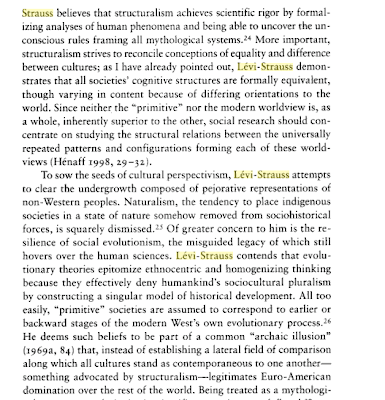
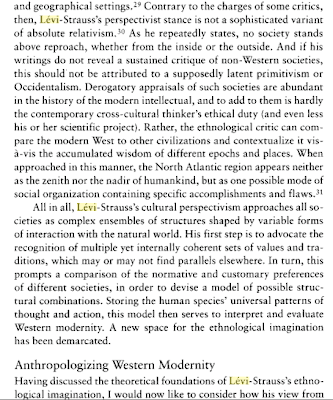
As I looked for something critical of Lévi-Strauss I found The Ethnological Imagination
by Fuyuki Kurasawa which talks a little about some of these topics, but the writer is supportive, not critical. I'll see if I can nail down some of the criticism. My second source did point out that some people were pointing to Lévi Strauss as an early forerunner of Chaos theory and fractals and pointed me to On the Order of Chaos by Mark S. Mosko, Frederick H. Damon - particularly Chapter 2: From Lévi-Strauss to Chaos and Complexity by Jack Morava - but I'm not even going to try to get into that here.

So, here's part of the Kurasawa book, which seems to me to be an attempt to address Lévy-Strauss' detractors, but I obviously need to do some more work here. If you can read these screen captures, fine, otherwise you can go to the link for The Ethnological Imagination above.




Stumble Upon Toolbar

Kayak for Lunch?

Sometimes you see a picture that really grabs your attention. Like this one that I ran into at Fishingfury:

Stumble Upon Toolbar

Thursday, November 20, 2008

Claude Lévi-Strauss One Hundredth Birthday - Post 4: Surrealism, New York, Native American Artifacts

[All the Lévi-Strauss Birthday posts are here.]

The following is from Claude Lévi-Strauss and Didier Eribon (1991) (translated by Paula Wissing) Chicago: University of Chicago Press.

[Prior to this passage, he returns to France after spending 1935-39 in Brazil. He gets drafted into the army, but through some lucky events, does not end up in battle. He got demobilized and assigned to a college. But the racial laws are coming and he gets fired. Through help from an aunt in the US, he gets invited to the New School for Social Research and comes to New York in late 1940 or early 1941.]


D.E. Once you arrived, you got to know the surrealists in exile in New York.
C.L-S. Breton and I kept up our friendship. He introduced me to his old circle.
D.E. You were a young, unknown university professor, and you became part of a group of famous artists - stars, even - Breton, Tanguy, Duchamp...
C.L-S. And Leonora Carrington, Max Ernst, Dorothea Tanning, Matta, Wifredo Lam. . . Masson and Calder were living in the country. I went to see them on a few weekends.
D.E. Did you like the members of the group?
C.L-S. Some of them. I liked Max Ernst right away, and he is the one I stayed closest to. Tanguy, whose painting I admired a great deal, was not an easy person. Duchamp had great kindness, and for awhile Masson and I were very close. I also became friends with Patrick Waldberg. Our friendship continued after the war ended.
D.E. Peggy Guggenheim was financing the existence of the group?
C.L-S. She helped this or that one out financially, but Max Ernst, whom she married, was more affluent than the others. They were leading the Bohemian life in Greenwich Village. Until Max Ernst left Peggy Guggenheim. One day, Breton called to ask me if I had a small sum of money to buy back one of his Indian objects from Max Ernst, who was now broke. This historic object is now in the Musée de l'Homme.
D.E. This little world had its social side, too?
C.L-S. We saw one another at various people's homes. The "truth game" was very fashionable.[Footnote 4: A kind of psychoanalytic parlor game, of which André Breton was said to be particularly fond, the object of which was to elicit the participants' intimate feelings. Peggy Guggenheim mentions it in her memoir Out of This Century: Confessions of an Art Addict (New York: Universe Books, 1979). -trans.] And we would go out to sample the exotic restaurants of New York.
D.E. Playing the "truth game" with people like that must not have been easy!
C.L-S. There was a lot of consideration for outsiders: myself, Pierre Lazareff, who sometimes came, also Denis de Rougemont.
D.E. How did you meet Lazareff?
C.L-S. Breton, Duthuit, and I needed extra money and were working for the radio service directed by Lazareff at the OWI, the Office of War Information, on broadcasts for France. There we all were, among people from different backgrounds, and sometimes we would get together outside of work. There I became friends with Dolores Vanetti, with whom Sartre was later to fall in love.
D.E. Describe your radio work.
C.L-S. I'd already had some experience with radio. To be less of a burden to my parents, I found a job as a student reading the bulletin for the Bureau International du Travail over the microphone at Radio Tour Eiffel in the basement of the Grand Palais. This was why my father painted me as a speaker when he made the huge (30X5m.) murals for the Madagascar Pavillion (a country where he'd never set foot) for the Colonial Exposition.
Two or three times a week in New York, André Breton, Georges Duthuit, Robert Lebel, and I would read the news and propaganda texts issued by Lazareff's offices. I was given Roosevelt's speeches to read because it seemed that my voice could be heard best over the jamming.
D.E. How did you happen to find the work?
C.L-S. Through Patrick Waldberg, whom I've already mentioned. He worked there too. He was both a poet and art critic. Later he wrote about Max Ernst and published some charming books on the turn of the century epoch. At the time we never would have guessed that back in Paris he would become a corresponding member of the Institute de France! He used to drink and lead a wild life, going to little bars in Harlem where he would sometimes bring me along.

D.E. If I'm to believe your essay on New York, one of your main activities at this time was acquiring artwork.
C.L-S. Max Ernst had a passion for primitive art. On Third Avenue - which was very different from what it is now - he discovered a little German antique dealer who sold him an Indian artifact. At that time you almost never saw such things for sale. Max Ernst told us about the dealer. We had very little money, and whoever had a few dollars would purchase the coveted object. Since our antique dealer had found an outlet, more and more objects became available. In fact - I can tell the story now because it has been published - they came from a major museum that was selling them because they were considered duplicates of works in their collection. As if there could be duplicates! When the dealer discovered he had a market, he became the intermediary between the museum and ourselves.
D.E. Did you know that at the time?
C.L-S. We very soon found out. With the help of the guard, he took us into the museum storehouses, in an isolated building in the New York suburbs. We would make our selection, and a few days later the objects would appear in his shop.
D.E. What became of the things you bought?
C.L-S. I brought them back with me to France. But I had personal problems and had to sell them at Drouot's in 1951. The Musée de l'Homme and the museum in Leiden bought several of them. Also private individuals, such as Lacan and, I believe, Malraux, bought a few others. I have two or three of them.
D.E. Did you maintain your ties with the surrealists after the war?
C.L-S. With Ernst, Breton, and Waldberg, yes. I lost track of the others.
André Breton went back to France before I did, since in 1945 I was sent back to New York as the cultural counsellor to the French embassy. So we didn't see one another for three years. We had a ritual going to the flea market every Saturday with his small band of followers. It was considered a great honor to be allowed to accompany Breton on this occasion.
D.E. Were you ever banished from the realm?
C.L-S. Of course we had a row, for which I was unwittingly responsible. Breton had been asked to do a book that was to be called L'Art magique. Inspiration failed him, and as one often does at such a pass, he made up a questionnaire, which he sent to me and some other people. I admired Breton. When we looked at art he had an infallible eye for objects, he was always right on the nose, never hesitating in his assessment. But the term "magic" had a precise meaning for me, it was part of the anthropological vocabulary. I didn't like to see it put to dubious uses. Instead of stating my objections, I preferred simply not to answer. Breton sent me another questionnaire. I was in the Cévennes on vacation with my son from my second marriage, who was seven at the time. The questionnaire came with reproductions of artworks you were supposed to rank as "more or less magical." Even if I objected to the project, I thought it would be interesting to have a child's reaction, and I thought it would interest Breton in the same way. Particularly since my son ranked the pictures without any hesitation. I sent it to Breton, who responded with an acerbic letter. The book came out, with my son's answers included. But the copy he sent to me bore a curt dedication to my son.
D.E. And you didn't see one another again?
C.L-S. We more or less reconciled our differences but it wasn't the same.
D.E. And with Max Ernst?
C.L-S. Our friendship continued after New York. There was never a problem. When the Collége de France invited me to give the lectures for the Loubat Foundation - I was not yet a member, it was about the time I was turned down - Max Ernst came to hear me. I happened to describe a Hopi divinity while expressing my regret that I was unable to obtain a slide to illustrate my point. The following week, Max Ernst brought me a drawing big enough to show for a lecture. I still have it. Max Ernst's attitude toward anthropology was the opposite of Breton's. Breton distrusted it, he didn't like having scholarly matters get between him and the object. Max Ernst collected objects but also wanted to know everything about them.
D.E. Did this contact with the surrealists influence you? I mean your work? Rodney Needham, in an article in The Times Literary Supplement in 1984, compares your work to that of the surrealists.
C.L-S. In a way, the comparison is valid. It is true that the surrealists and I all belong to an intellectual tradition that goes back to the second half of the nineteenth century. Breton had a passion for Gustave Moreau, for the whole symbolist and neosymbolist period. The surrealists were attuned to the irrational and sought to exploit it from an aesthetic standpoint. This is part of the same material I work with, but I am guided by the intention of analyzing and understanding it while remaining sensitive to its beauty.
I will add that among this group there was a climate of intellectual ferment that did a great deal for me. Contact with the surrealists enriched and honed my aesthetic tastes. Many objects I would have rejected as unworthy appeared in a different light thanks to Breton and his friends.
D.E. You say in The View from Afar that the books in your Mythology series are put together like Max Ernst's collages!
C.L-S. The surrealists taught me not to fear the abrupt and unexpected comparisons that Max Ernst like to use in his collages. This influence can be seen in The Savage Mind. Max Ernst built personal myths out of images borrowed from another culture. I mean from old nineteenth-century books, and he made these images say more than they did when viewed by an innocent eye. In the Mythology books I also cut up a mythical subject and recombined the fragments to bring out more meaning.

pp. 31-35

His tone is very modest as he talks about people who are giants of the 20th century. Normaly, I would put links to key names, but there are so many well known people in here and it is late. Google it yourself. :)

Stumble Upon Toolbar

Complete Sentence Controversy

From 60 Minutes, Andy Borowitz

Obama's Use of Complete Sentences Stirs Controversy

In the first two weeks since the election, President-elect Barack Obama has broken with a tradition established over the past eight years through his controversial use of complete sentences, political observers say.

Millions of Americans who watched Mr. Obama's appearance on CBS's 60 Minutes on Sunday witnessed the president-elect's unorthodox verbal tick, which had Mr. Obama employing grammatically correct sentences virtually every time he opened his mouth.

But Mr. Obama's decision to use complete sentences in his public pronouncements carries with it certain risks, since after the last eight years many Americans may find his odd speaking style jarring.
Continued here at the Huffington Post.

This would be funny if it weren't so true.

Stumble Upon Toolbar

Ropi Survives Pálotas

For months now, Ropi, an 18 year old high school student in Budapest, has been blogging about the agony of preparing to dance the Pálotas, a traditional Hungarian dance, at a school performance. The tales of stepping on his partner's feet have been tucked in between accounts of ancient Roman history, scores on math tests, his thoughts about his somewhat cool personality and what others say about it, and what he will do when he gets out of school. It's a blog I follow regularly because it is so charmingly mixes maturity well beyond his 18 years with honest, age appropriate concerns about life, girls, parents, and the future. The look of his blog changes too, reflecting his own experimenting with who he is and could be.

So I was delighted when he posted this video of the dance. There is something very universal, in 2008, of a school dance in a decorated gymnasium, with parents taking shaky videos of their kids' performances. (Yes, there are places where kids don't even go to school, let alone have video cameras, but there are also many places where they do.) Ropi is the tallest kid in his class and he's wearing blue. I think he's right there in the beginning with his back to us.


Stumble Upon Toolbar

Wednesday, November 19, 2008

Fluorescent Bulbs - Dimmers and Mercury

Back in April 2007 I did a brief post on moving to fluorescent light bulbs. We've been changing to the fluorescent bulbs as the old ones burn out. But the one over our kitchen table burned out pretty fast. I thought they were supposed to last longer. Well, I put in a new new. Several days later as I was sitting at the table, there was a poof sound and the light went out.


I mentioned this to someone who does maintenance stuff and it came out that most fluorescent light bulbs DO NOT work with dimmer switches. So I started looking for fluorescents that are ok for dimmer switches. Costco didn't have them. Fred Meyer didn't have them. I called Lowe's. They had them. But I couldn't find them. A very nice sales woman was sure she had seen them, but she didn't seem to have any more knowledge about where they were than I did. She asked another salesperson who said they were "right here" but a women had bought them all and was headed to Wasilla to buy all the ones they had.

I thought that a bit weird, but who was I to question him. The nice saleswoman took me to the info counter where the lady shrugged her shoulders. "I'll look it up in the computer for you if you have a few minutes" the nice salesperson said. I wandered to
the garden shop and when I came back with some cyclamen (pink) and kalenchoe (yellow,) she was waiting for me just around the corner from where we were looking. The whole end of the shelf was dimmable fluorescents.

But there was one more issue. These things have mercury and you aren't supposed to just throw them out. So what do you do? As I was researching this, I also was reminded that batteries have mercury too. From a Lawrence, Kansas recycling site:

Developing awareness of household batteries and their current use is essential to understanding the importance of this collection program. The following list provides facts about battery use and its impact on our solid waste stream:

  • 2.5 billion dry cell batteries are sold in the US each year
  • An estimated 530,000 pounds of batteries require disposal daily
  • Americans own over 900 million battery operated devices
  • The average household batteries accounted for 89% of the mercury in the municipal solid waste stream
  • Alkaline and carbon-zinc batteries are the most common types of batteries consumed, comprising 90-93% of all batteries in the residential waste stream
  • In a recent EPA study, nickel-cadmium (Ni-Cd) rechargeable batteries were found to contribute over 50% of the cadmium in the waste stream
An Anchorage Daily News online post - is this on the recycling and renewables blog? can't tell for sure - from March 2008 written by Kevin Harun says:

Improper disposal of fluorescent lamps includes discarding them in the trash and intentional crushing. Improper disposal of fluorescent lights may eventually make its way into soils and water bodies. When the lamp is crushed, the mercury expels into the air and may contaminate the surrounding area.

If a lamp is crushed, intentionally or unintentionally, the Environmental Protection Agency (EPA) strongly recommends that people present leave the area for at least 15 minutes.

Proper disposal of fluorescent lamps is as follows: Once the lamp is removed, place the lamp in original packaging or a long cardboard box. Do no tape the lamps together. Store them in a dry place.

Once you are ready to dispose of them, bring them to Total Reclaim, Inc in the Huffman Business Park. Total Reclaim, Inc. will charge 18 cents per linear foot for them to be properly disposed of. Total Reclaim may be reached by calling 561-0544.
Types of lamps to look out for:
• Fluorescent – Straight, circular, or U-tubes
• High Intensity Discharge (HID) lamps
• “Green Tip” or “low mercury” lamps
• Neon lamps, and
• Any other lamps that may contain mercury, lead, and high pressure sodium.

What's wrong with this solution? It gives people these personal costs:
a. storing their used bulbs
b. taking them to the Huffman Business Park
c. paying someone to take your bulbs
for basically communal gain
a. reducing mercury (and other) contamination

The Municipality is relying on people's concern for the public good to do the right thing. Certainly, there are people who will do this. But all the costs are personal and the rewards are communal- keeping mercury out of the landfill. OK, I guess knowing you did something good for the community for some people is a personal reward.

But it's so much easier to just dump the bulb into your garbage bag and have Solid Waste people pick it up.

This is a case of the bulb companies being inefficient - using economic terms - because their product has externalities (polluting the environment) that we have to pay for which they don't have to consider in their costs. (An externality is a cost that is passed on to the community and does not show up in the cost or price of the item, so the manufacturer makes a profit by having everyone else subsidize the costs of cleaning-up his garbage. This is one of the problems with the market that even classical economists identify.)

So ideally, the manufacturers find a way to make an efficient light bulb without using mercury or other toxic materials. But until that day, they should be charged a recycling fee high enough to recover the mercury in the bulbs. It could be used by the Municipality to pay people to bring in their old light bulbs and perhaps a little bonus to make it worth their while to drive to the recycle place. In communities with poor folk, the collection of such recyclables with return deposits (like aluminum cans) is often done by the poor who can raise money this way and clean the environment.

So, I now have a dimmable fluorescent light bulb ($11 - yikes!) and when I'm done with it, I get to pay someone to take it off my hands.

Stumble Upon Toolbar

Claude Lévi-Strauss One Hundredth Birthday - Post 3: What Others are Saying

Today I'm going to give you glimpses of what others - people who know this topic much better than I - are saying about Claude Lévi Strauss' 100th birthday. [All the Lévi-Strauss Birthday posts are here.] In each case you are only getting a small portion of what they have written. You can read the rest by following the links. These are in the order that I found them.

From Robert K. Blechman at Blogcritics - Sci/Tech

Beyond his well-known scholarly accomplishments, I think I can say without fear of contradiction that Professor Lévi-Strauss' personal longevity is a testament to the positive benefits of the pursuit of structural anthropology on long life and good health. Just carrying around his four-volume, 2200 page oeuvre, "Mythologiques" will improve your muscle tone and cardiovascular capacity...

Some critics get hung up on discrepancies within the structural methodology which Lévi-Strauss used to explain mythology, totemic systems and kinship systems. Other criticism focuses on how a particular interpretation doesn't fit the recorded ethnography for a culture. While the methodology itself, or its particular application may be subject to review and revision, what is important is that Lévi-Strauss demonstrated that there is a universality to the human mind, and given sufficient symbolic material, all peoples -- whether within an oral culture, a literate culture or our post-literate culture — still retain a commonality which can be explored through our symbol systems and perhaps understood in terms of the underlying structures transmitted via the stories told.

Our own "modern" culture also has a mythic "score," but being part of it, it is difficult for us to see. The distinctions between "raw" vs. "cooked," "nature" vs. "culture" and "modern" vs. "primitive" that Lévi-Strauss finds in his studies of North and South America native populations drive the narratives, beliefs and social customs of 21st century populations as well. [continue here.]


From Patrick Wilcken at the Times [London] Literary Supplement: [Note - this looks like the really authoritative piece to read]

The century of Claude Lévi-Strauss: How the great anthropologist, now approaching his 100th birthday, has earned a place in the prestigious Pléiade library

In 1938, the French anthropologist Claude Lévi-Strauss drove a mule train up a derelict telegraph line, which wound its way across the scrublands of Mato Grosso state in Brazil. He headed an ethnographic team conducting fieldwork among the semi-nomadic Nambikwara who roamed the plains through the dry season. Photographs from the journey look dated even for their era. Men in pith helmets mingling with virtually naked tribesmen, mules heaving crates of equipment through the wilderness, laden-down canoes and jungle campsites – it all has the feel of some grand nineteenth-century scientific expedition. Yet, after the Second World War, Lévi-Strauss would add a modern twist to anthropology with the development of a completely new way of thinking about ethnographic data...

As he approaches his 100th birthday on November 28, Lévi-Strauss has become one of the few living authors to find a place in Gallimard’s Pléiade library. From the almost weightless Bible paper and soft leather cover to the pale pink flyleaves and the gold-embossed “Claude Lévi-Strauss Oeuvres” on the spine, Gallimard has retained the library’s old-world gravitas. In a testament to just how differently the publishing industry works across the Channel, this 2,000-page, seventy-euro edition sold 13,000 copies in its first three months...

The first thing one notices about this book is a huge absence. Organized chronologically, the collection skips from 1962, when Lévi-Strauss had only recently entered the Collège de France, to the mid-1970s, after his retirement; from the birth of structuralism in the popular imagination to the beginning of its decline. The core of Lévi-Strauss’s career when he was professor at the Collège, a media celebrity and one of the most influential theorists of his age, has been excised. Lévi-Strauss has opted for what he described as his “petites mythologiques” over the centrepiece of his career, the monolithic Mythologiques quartet. A further absence is his PhD thesis, Les Structures élémentaires de la parenté (1949), the reinterpretation of the field of kinship studies which established him as a leading thinker in post-war France. As Lévi-Strauss himself made the selection, it seems a timid assessment of his own output. [continue here]

Here are some 1988 (so he's 79 or 80) video interviews in French with several anthropologists (Lévi-Strauss is the first). These aren't related to his birthday, but they give us a chance to see and hear the man. Even for those of us who don't understand French - you surely can pick out some words, including the French pronunciation of his name - they are worth watching.
Entretiens avec Claude LÉVI-STRAUSS, Jean-Pierre VERNANT, Jacques Le GOFF, Pierre BOURDIEU, Andre, COMTE-SPONVILLE, Michel TOURNIER et Luc de HEUSCH. 1988
(part 2 is here)


And one in English, no, it turns out to be in French too. This is 1972 I believe, so he would be 63 here (his birthday is the end of November).


This link at YouTube will give you more videos from these two sets of interviews.


For a detailed discussion of Lévi-Strauss' political development, we have
An essay to mark the 100th birthday of Claude Lévi-Strauss: Anti-Historicism and the Algerian War

Andy Blunden. May 2008

Introduction

The publication of Claude Lévi-Strauss’s “The Savage Mind” in early 1962, as France stood on the precipice of civil war, launched a trend of “anti-historicism” in social philosophy. This “anti-historicism” had its roots in Durkheim’s sociology and structural linguistics, and while remaining a positive contribution to scientific technique, the ethical and political implications of this turn were far reaching and mixed. The point of this article is to show how social movements impact on the development of science. In spite of Lévi-Strauss’s adoption of the cloak of scientific objectivity, his “anti-historicism” was a direct response to the Algerian struggle for independence and presaged the decentred post-colonial world then emerging from such struggles across the world. The impact of this “anti-historicism” on science and politics shifted over the following decades but such transformations were also responses to social movements, whether or not they were valid scientific paradigms shifts. I will explain what I mean by “anti-historicism” later, once some of the nuances of Lévi-Strauss’s position and its relation to the Algerian independence war have been explored.

Lévi-Strauss’s Intellectual Development up to 1962

At school in the 1920s, Lévi-Strauss was involved in moderate socialist politics and at university was general secretary of the Federation of Socialist Students for a time, but his experience of the Second World War and in Brazil led him to a political position of refusing to accept the superiority of his own Western European culture, inclusive of both the dominant capitalist culture and the socialist alternative. He did not ‘drop out’ though, but adopted as his central value Western society’s key achievement, science, and worked assiduously to secure a place in that society as an esteemed scientist. His greatest fear was the prospect of the world being subsumed by a monoculture, and above all he valued cultural diversity, which, somewhat ironically, he credited as both the content and the source of progress.

His commitment to cultural diversity and admiration for ‘primitive’ (Lévi-Strauss’s word) cultures pre-existed all of his scientific discoveries as an anthropologist, and indeed motivated his interest in anthropology. But he almost never lent his name and prestige to a cause or spoke out publicly against the destruction of the ‘primitive’ cultures he so admired, almost never. Lévi-Strauss consistently adopted the cloak of scientific objectivity and rightly judged that his political aims could best be furthered by distancing himself behind the mask of science. Lévi-Strauss’s trope of discovering his political beliefs to be scientifically proven facts is really a very dogmatic mode of political argument.

By his own account, in his youth Lévi-Strauss had three ‘intellectual mistresses’: geology, Freud and Marx. But he was never a Marxist in any recognizable sense; Marx for him was an icon of ethical skepticism and scientific critique, but he never accepted Marx’s commitment to socialism, class struggle nor his historical method. Likewise, geology and psychoanalysis stood for the need to probe below surface impressions to the underlying structures. His public admiration for Marx and Freud did however serve to give him a probably undeserved reputation for being on the Left. [continue here]


And excerpts from the Jewish Daily Newspaper The Forward's article in honor of Lévi-Strauss' 100th birthday:
Claude of the Jungle
The other Lévi-Strauss turns 100

On November 28, the centenary of the legendary French anthropologist Claude Lévi-Strauss will be fêted in Paris. As a centenary celebration of a legend, however, it is rather unusual, as the birthday boy is very much alive and well.

Born in 1908 to a French-Jewish family — his grandfather served as a rabbi in Versailles — Lévi-Strauss made his name with such key texts as “Tristes Tropiques” (“A World on the Wane”) in 1955 and “La Pensée sauvage” (“The Savage Mind”) in 1962. . .
[The photo came with The Forward article and is a Getty Image.]

His sheer mastery of a vast number of subjects — a friend, writer Claudine Hermann, once said that Lévi-Strauss “gave me the impression of universal knowledge” — has left some readers with the image of a remote, aloof observer. Yet over the years, the supposedly cool and reticent Lévi-Strauss has granted increasingly telling glimpses into his personality and motivations.

Among these, unquestionably, are his Jewish roots, as he recently explained to the newsweekly Le Nouvel Observateur. “In grade school, I was called ‘dirty Jew,’” he said. He went on to recall fistfights provoked by antisemitic school bullies: “Suddenly finding oneself contested by a community to which one believed oneself to belong entirely may lead a young mind to take some distance in terms of social reality, insofar as he is forced to look at it simultaneously from within, where he believes himself to be, and from without, where he is placed.” This sense of dislocation as a French Jew, he implies, was a natural mindset for studying other cultures, and especially for reserving judgment on their qualities and right to exist. He survived World War II in exile, and part of that time was spent in New York, teaching at The New School. Faculty members there advised him to call himself “Claude L. Strauss,” lest Yankee students laugh too much at the coincidence between his name and that of the Bavarian-Jewish immigrant tailor who introduced denim blue jeans.

In 1952, a scant few years after he learned the full tragedy of the Nazi occupation of his homeland, Lévi-Strauss wrote a text that continues to resonate, “Race and History.” [A small part of which I excerpted in the first post of this series.] Sponsored by the United Nations Educational, Scientific and Cultural Organization, the book made the case that fighting the notion that some races are inferior to others also means combating the concept that some societies are culturally superior to others. Its adamant originality may have been influenced by a close wartime friendship with surrealist poet André Breton, whose “imaginative vivacity” he lauded in a moving tribute to another writer, Georges Dumézil, at the French Academy.

The rest of the Forward piece is here.

I feel a little embarrassed because there are so many people so much more knowledgeable than I on this topic. So I have a responsibility to point out some of them and what they are saying about Claude Lévi Strauss. More tomorrow. And, oh yes, even before reading this last piece above, it became very clear that most people looking up Levi-Strauss are looking up the jeans. Is there some distant relationship between the two? Maybe that will come up as I continue this.

Stumble Upon Toolbar

Anchorage International Film Festival Selections - Documentaries

Here's the list of the Documentary Features and Shorts for the AIFF. The Festival site doesn't have links up yet, so I've done what I could to fill in a bit of information on the films.

The program guide is available in PDF form. The website also says the program guide will be in the Press on November 26.

It would be nice if they had information on getting tickets on their site and prices. There are ads in the Press and ADN that say tickets are available at Bear Tooth, but that's what the website is for. If the info is there, I can't find it.

There are three focusing on Alaska - one on moving the village of Shishmareff, one on Pebble Mine, and one on a junk trip from Washington to Valdez. Another fish movie is about an Oregon tribe's battle to remove dams and bring back the salmon.

DOCUMENTARY FEATURES

A Nashville State of Mind • John-Martin Vogel • 88 min. USA
The alternative music scene in Nashville.


A Powerful Noise • Tom Cappello & Scott • 91 min. USA
"A documentary film about women changing the world. "

Ballou • Michael Patrei • 83 min. USA This film is about a marching band.

Crawford • David Modigliani • 74 min. USA


Junk Dreams • By Skye Borgman • 73 min. USA


Rachel: A Perfect LifeFiona Cochrane • 91 hr/min Australia This is one where the topic might cause some people to pass (single mother, brain surgery, epilepsy) but one reviewer (?) writes:

"This film's appeal lies in the personality of its subject, Rachel Ouchirenko, and her truly brave and forthright approach to solving her biggest problem."


Secrets to Love • Tracie Donahue
• 63 min. USA
"Director Tracie Donahue searches for the answers to finding (and maintaining) a healthy, happy love, by asking real couples and relationship experts the most important questions."

The Last Days of Shishmaref • Jan Louter
• 88 min. Netherlands
This is a Dutch film about an Alaskan village. It looks like an important movie for urban Alaskans to see


The Wrecking Crew • Denny Tedesco • 98 min. USA
About a group of studio musicians in the late 60's who backed up the hottest groups of the late 60s in LA. The music will be good at least, based on the songlist.

Upstream Battle • Ben Kempas • 97 min. Germany
Native Americans on the Klamath River fight for their fish – against an energy corporation. Their struggle may trigger the largest dam removal project in history.


DOCUMENTARY SHORTS

Leave Her to Die • Antonia Thomson
• 49 min. Canada
"A 2 year old baby girl lay alone on a bamboo mat in a government orphanage in Northern Thailand"

Red Gold • Travis Rummel
• 54 min. USA
Produced by Felt Soul Media and Trout Unlimited Alaska, Red Gold is a one-hour documentary film on the proposed Pebble Mine told through the voices of commercial, subsistence and sport fishermen of Bristol Bay, Alaska.


Reefer Madness • Steve Hanson • 23 min. Canada
Can't find much on this one - Canadian freight train graffiti artist Fatso's trip across Canada.

Splitting Hairs • F Stone Roberts • 28 min. USA
The synopsis begins:
Facial hair championships began 30 years ago in the Black Forest of Germany. “Beard Clubs” organized social gatherings that gradually became competitive. Over time, the championships drew competitors from across Europe, but it was not until the early 1990’s that American pioneers Bruce Roe and Phil Olsen discovered the event.

Stumble Upon Toolbar

Tuesday, November 18, 2008

OK World - Do we get a little slack now? We did NOT reelect Ted Stevens

Today's numbers give Mark Begich enough votes to win the Alaska Senate seat. We do some things right.

From the Anchorage Daily News:


MICHAEL R. BLOOD 11/18/08 9:22 PM EST AP
ANCHORAGE, Alaska — Sen. Ted Stevens, the longest serving Republican in Senate history, narrowly lost his re-election bid Tuesday, marking the downfall of a Washington political power and Alaska icon who couldn't survive a conviction on federal corruption charges. His defeat to Anchorage Mayor Mark Begich moves Senate Democrats closer to a filibuster-proof 60-vote majority.
Stevens' ouster on his 85th birthday marks an abrupt realignment in Alaska politics and will alter the power structure in the Senate, where he has served since the days of the Johnson administration while holding seats on some of the most influential committees in Congress.
The crotchety octogenarian built like a birch sapling likes to encourage comparisons with the Incredible Hulk, but he occupies an outsized place in Alaska history. His involvement in politics dates to the days before Alaska statehood, and he is esteemed for his ability to secure billions of dollars in federal aid for transportation and military projects. The Anchorage airport bears his name; in Alaska, it's simply "Uncle Ted."

Tuesday's tally of just over 24,000 absentee and other ballots gave Begich 146,286, or 47.56 percent, to 143,912, or 46.76 percent, for Stevens.


[Later Update: Here's the New York Times report on the Alaska election results and the impacts on the US Senate.]

Stumble Upon Toolbar

Claude Lévi-Strauss One Hundredth Birthday - Post 2

[All the Lévi-Strauss Birthday posts are here.]


I'm going to continue offering work by or about Lévi-Strauss for the next week in the hopes that I'll learn something useful and in that some of you will have the patience to read something a little heavier than normal blog fare if it's in short doses. And some people have complained that reading blogs prevents them from reading books, so we come full circle.
[Photo credit below*]

I'm drawn in this section, to the point, mentioned yesterday too, that Lévi-Strauss believed that the mind of 'primitive' peoples was no different from the mind of 'civilized' peoples. My experiences overseas certainly confirm this. There are bright inquisitive minds in every culture just as there are dull ones. Although I live in a 'civilized' community, neither I nor most of my fellow citizens have done much to create the world in which we live. We are dependent on technology most of us cannot even fix let alone create. And few of us can even make 'simple' things like baskets or weave fibers into cloth. In Alaska this is particularly of interest, since many of the rural inhabitants, who are looked down on by the many urban inhabitants, can probably do a lot more to create and repair the environments in which they live.

In any case, here is an excerpt from one scholar's (Hans H Penner) introduction to Lévi-Strauss. He's very sparing of the commas, so if you get confused, try reading it out loud until you figure out where he meant to pause. At one point I stuck in [,]s because I really needed them.

The list of scholars who have changed the course of an academic discipline in their own lifetime is very short. Einstein and Chomsky are clearly on the list and so is Claude Lévi-Strauss, who made the words "structuralism" and "structural analysis" common terms in most newspapers and weekly magazines around the world. The terms were certainly used before Lévi-Strauss made them so popular. No one would deny that the term "structure' was used in physics, logic, and anthropology long before Lévi-Strauss began to lecture on "structural anthropology." This being so it is often claimed that there is really nothing new in what Lévi-Strauss has to say, his popularity was nothing more than one of the many vogues that arise and pass away in Paris. If this is true then it is hard to explain the explosive controversy that took place after Lévi-Strauss began to publish essays on something called "structural analysis." Structuralism simply cannot be separated from the thought of Lévi-Strauss. After Lévi-Strauss the study of kinship, totemism, myth and ritual would never be the same again. As one disgruntled scholar put it, "Yet it has been said that when one turns from Lévi-Strauss to any other attempt to analyze these myths, the results look old-fashioned and unconvincing; and I too find this to be so." I agree.

The Fundamental theme running through all of his writings is that it is a serious error to follow the thought of Lévy-Bruhl (as many do) and think that there is a fundamental difference between so-called "primitive" and "modern" societies. That "primitive mentality" is like the mentality of our children, or, that they are "mystical" and we are "logical" in our way of thinking, that there are two modes of thinking that are different in kind. The basic binary opposition, nature/culture (raw/cooked) can be found in all of his publications. It would be an error to think of this basic opposition as a dualism or as containing ontological significance. Nevertheless, the opposition nature/culture clearly marks what Lévi-Strauss thinks human nature is all about. We are rational creatures who [,] says Lévi-Strauss [,] must first of all know the world before it becomes useful to us. Lévi-Strauss is not a pragmatist. What fascinates Lévi-Strauss are such questions as, "since it is clearly not necessary for our existence, why do human beings cook food?" Why are there prohibitions on eating certain kinds of food? Perhaps the most significant question Lévi-Strauss asks is, "what is the significance of 'the other'?" "We/they?" Throughout all of the diverse material he studies Lévi-Strauss finds a logic, a structure. And for Lévi-Strauss where there is a logical structure there is also rationality.


From:

Plenner, Hans H (ed)(1998) Teaching Lévi-Strauss, Atlanta: Scholars Press, pp. 1-2

*The photo of Claude Levi-Strauss is from culturamauff.blogspot.com but I suspect is not original to that blog.

Stumble Upon Toolbar

Monday Odds and Ends (posted Tuesday)


After a couple of long posts, I get to do a short one. Just a few shots from yesterday. After class, I stopped at the UAA library to get the Levi-Strauss books and ran into this old friend. I got to see this Steven Gordon painting everyday when my office was in the library building in with ISER. That was before the library was expanded. It was nice to see it again - still in the library building. Gordon manages to capture the look and feel of the trees here. I mean, it's just a bunch of trees, right? No, it's much, much more than that. (I thought about cropping the chair out of the picture. It really messes up the balance badly. But, it's part of the environment of the picture now. And this is supposed to be a fast post.)

Then back home with my treasures. It was gratifying to see that I'm not the only one still using my bike. While I'm not riding with the frequency of the summer, at least to the University and back isn't too far and the paths are well maintained. I was also glad to see in the ADN yesterday that the city has put up new bike racks. I'm curious to see what they got. Not all bike racks are equal. Some are almost impossible to use, but the ones here are good. It says $17,000 for 13 bike racks, which sounds steep. But each rack should accommodate 5-10 bikes which would come to $130-$260 per bike space. It also included two bike boxes - I saw some of those in Portland - which I'm sure are much more expensive. But, compared to car parking spaces, it's a great deal. And if bikers had better spaces to ride (the trails are nice, but only if they go where you are going, and the ones along the streets can be pretty bumpy) and safely lock their bikes, more people would bike, even in winter.

Then we needed a Thai fix, and ran into our mayor, whose suspense over the election might end today. He was picking up take out with his son at the Thai Kitchen. Of course, he can't do this without talking to everyone. I wonder how long it will take, if all goes well, for everyone in DC to know who he is too. A little more time than it took Sarah I'm sure.

Stumble Upon Toolbar

Monday, November 17, 2008

Claude Lévi-Strauss One Hundredth Birthday - Post 1

[All the Lévi-Strauss Birthday posts are here.]

I first read a book by Levi-Strauss as a doctoral student. It wasn't something assigned; I'm not sure how or why I picked it up. It was about going to Brazil. I was enchanted. I haven't gotten around to reading more about him, but he's always had a favored spot in my mind. So I was more than a little excited when I did the Famous People Born in 1908 post last January discovered that he was still alive. I wanted to do some posts in honor of his birthday - which will be a week from Friday on November 28. But I don't know all that much. So, finally, today, I stopped at the library and checked out seven books on or by Levi-Strauss. I'm hoping to do some cramming in the next ten days and to share some quotes here each day. Note, since I'm working from books and not the web, I'll put in citations for people who want to find the original. (I'll try to see if I can also find some of this online.)

What I'm discovering though, is that Levi-Strauss does not do sound-bites. What he's writing about is very complex, and he doesn't simplify it. So I felt a little better when I read, from Edmund Leach

The outstanding characteristic of his writing, whether in French or in English, is that it is difficult to understand; his sociological theories combine baffling complexity with overwhelming erudition. (Leach, 1977, p. 3)
Actually, I think that exaggerates it somewhat, but I try to put up quotes here that are reasonably easy to understand. Levi-Strauss, it seems to me, is complex, and has lots of caveats, simply because it is extremely easy to take things he says out of context. So he's constantly making sure that the reader isn't doing that. For example:

The way of thinking among people we call, usually and wrongly, 'primitive' - let's describe them rather as 'without writing,' because I think this is really the discriminatory factor between them and us - has been interpreted in two different fashions, both of which in my opinion were equally wrong. (Levi-Strauss, 1979, p. 15)
I have to admit to being guilty to doing much the same thing in this blog - lots of asides to expalin how what I'm writing might be taken wrong and how I really intend it. And also lots of qualifications, such as 'in my opinion'. Some would say, 'well of course it is just your opinion,' but if I don't write it, others will jump to conclusions that I'm stating a 'truth.' So, I take comfort in Levi-Strauss' writing.

So for the next week I'll try to write a little bit about what I'm discovering in the books. Today I really want to start with Levi-Strauss' own words. One book, Myth and Meaning, is from a series of radio talks Levi-Strauss gave in December 1977 on CBS. (As I'm writing this I'm going to Google this and see if the audio is available. Answer: Not found easily.) The table of contents is a series of questions that are addressed in each chapter. From Chapter 2:

There are those who say that the thinking of so-called primitive people is inferior to scientific thinking. They say that it is inferior, not because of a matter of style, but because, scientifically speaking, it is wrong. How would you compare 'primitive' thought with 'scientific' thought?
Claude Levi-Strauss responds (somewhat abridged):

He starts this section with the quote immediately above. He then goes on to describe the two fashions. Malinowski felt that:

The thought of all the populations without writing which are the subject matter of anthropology was entirely, or is, determined by the basic needs of life. If you know that a people, whoever they are, is determined by the bare necessities of living - finding subsistence, satisfying the sexual drives, and so on - then you can explain their social institutions, their beliefs, their mythology, and the like. This very widespread conception in anthropology generally goes under the name of functionalism.
The other fashion is not so much that theirs is an inferior kind of thought, but a fundamentally different kind of thought. This approach is exemplified by the work of Lévy-Bruhl, who considered that the basic difference between 'primitive' thought - I always put the word 'primitive' within quotes - and modern thought is that the first is entirely determined by emotion and mystic representations. Whereas Malinowski's is a utilitarian conception, the other is an emotional or affective concpetion; and what I have tried to emphasize is that actually the thought of people without writing, is or can be in many instances, on the one hand, disinterested - and this is a difference in relation to Malinowski - and, on the other hand, intellectual - a difference in relation to Lévy-Bruhl.
He's going to explain what he means by disinterested and intellectual soon.

What I tried to show in Totemism and in The Savage Mind, for instance, is that these people whom we usually consider as completely subservient to the need of not starving, of continuing able just to subsist in very harsh material conditions, are perfectly capable of disinterested thinking; that is, they are moved by a need or a desire to understand the world around them, its nature and their society. On the other hand, to achieve that end, they proceed by intellectual means, exactly as a philosopher, or even to some extent a scientist, can and would do.
Hey, I found this online - I don't have to keep typing this. SMILING.

This is my basic hypothesis. I would like to dispel a misunderstanding right away. To say that a way of thinking is disinterested and that it is an intellectual way of thinking does not mean at all that it is equal to scientific thinking. Of course, it remains different in one a way, and inferior in another way. It remains different because its aim is to reach by the shortest possible means a general understanding of the universe —and not only a general but a total understanding. That is, it is a way of thinking which must imply that if you don’t understand everything, you don’t explain anything. This is entirely in contradiction to what scientific thinking does, which is to proceed step by step, trying to give explanations for very limited phenomena, and then going on to other kinds of phenomena, and so on. As Descartes had already said, scientific thinking aimed to divide the difficulty into as many parts as were necessary in order to solve it So this totalitarian [I think holistic would be a better word since totalitarian has another connotation] ambition of the savage mind is quite different from the procedures of scientific thinking. Of course, the great difference is that this ambition does not succeed. We are able, through scientific thinking, to achieve mastery over nature—I don’t need to elaborate that point, it is obvious enough—while, of course, myth is unsuccessful in giving man more material power over the environment. However, it gives man, very importantly, the illusion that he can understand the universe and that he does understand the universe. It is, of course, only an illusion.

So, what I understand this to mean is that people without writing think the same way as people with writing. But rather than attempting to understanding the world by breaking it up into smaller and smaller parts which they can study, the people without writing develop holistic myths that explain and help them understand the universe. It's the same type of thinking, but focused on a macro explanation rather than micro explanations. I'm not sure I buy this completely that it is the same type of thinking, but I agree that it is certainly as sophisticated.

He goes on to talk about using different parts of the brain. This is easier to understand.
We should note, however, that as scientific thinkers we use a very limited amount of our mental power. We use what is needed by our profession, our trade, or the particular situation in which we are involved at the moment...
Today we use less and we use more of our mental capacity than we did in the past; And it is not exactly the same kind of mental capacity as it was either. For example, we use considerablyless of our sensory perceptions. It seems that there was a particular tribe which was able to see the planet Venus in full daylight, something which to me would be utterly impossible and incredible. I put the question to professional astronomers; they told me, of course, that we don't but, nevertheless, when we know the amount of light emitted by the planet Venus in full daylight, it was not absolutely inconceivable that some people could. Later on I looked into old treatises on navigation belonging to our own civilization and it seems that sailors of old were perfectly able to see the planet in full daylight. Probably we could still do so if we had a trained eye.
It is exactly the same with our knowledge about plants or animals. People who are without writing have a fantastically precise knoweldge of their environment and all their resources. All these things we have lost, but we did not lose them for nothing; we are now able to drive an automobile without being crushed at each moment, for example, or in the evening to turn our our television or radio. This implies a training of mental capacities which 'primitive' peoples don't have because they don't need them. I feel that, with the potential they have, they could have changed the quality of their mind, but it would not be needed for the kind of life and relationship to nature that they have. You cannot develop all the mental capacities belonging to mankind all at once. You can only use a small sector, and this sector is not the same according to the culture. That is all.
Actually, he keeps going. You can read more at this link to Myth and Meaning.

Levi-Strauss, Claude (1979) Myth and Meaning, New York: Schocken Books (also the link above)
Leach, Edmund (1970) Claude Levi-Strauss, New York: The Viking Press

Stumble Upon Toolbar

Sunday, November 16, 2008

Intimate Partner Violence at the Opera


We went to Carmen this afternoon. The Discovery Theater at the Performing Arts Center is a wonderful space. Acoustics are good and no one is too far from the action.

But I have to say, that since being on a steering committee for the prevention of intimate partner violence I see things I probably would have glossed over in the past. Here's an opera about a woman who makes sport out of seducing men. Except Don Jose becomes infatuated and when Carmen is over him, he becomes obsessed.

Certainly others must have made the connection between Carmen and Domestic Violence. Or so you'd think. But Google doesn't reveal many who have done much about it. The first ten pages of Google hits for Carmen+Domestic Violence show us a lot of women named Carmen who were the victims of domestic violence, with a few more who work in that field. There was only one hit (on page 2) related to the opera. The Syracuse opera had a discussion with one of their performances of Carmen:

If you think you’ve seen Carmen in all her blazing persona, wait until you experience this more intimate version of Bizet’s famous opera by Peter Brook, the provocative English theatre and film director. Designed to intensify the psychological state of Carmen, Brook’s adaptation (with Marius Constant and Jean-Claude Carrière) focuses solely on the three main characters: Carmen, Don Jose, Micaela. The New York Times called Brook’s innovative version of Carmen “a raw, brutal tale of mutual self destruction that’s fueled by both lust and existential bloodlust – and is as deadly for others as it is for themselves.”

Syracuse Opera's LIVING OPERA series in collaboration with VERA HOUSE and the Redhouse Arts Center present:

RED FLAGS

A FREE insider's look into La Tragédie de Carmen and its parallels to modern day domestic violence issues

•Spot the 'red flags' of potential domestic violence issues in relationships•
•Explore the 'good girl vs. bad girl' stereotype and its effect on violence towards women•

Join us as we discuss the contemporary issues being brought to light by this raw, brutal electrifying opera.

Panel Speakers include: Stage director Jeffrey Tangeman, Syracuse Opera's Director of Music Douglas Kinney Frost, and Radio Host and Vera House [A Domestic Violence intervention and prevention organization] Advocate Elisa Morales.


Adding 'opera' to the search terms narrows things down a lot. We get a booklist from the Boston Public Library to prepare for the Boston Lyric Opera's performance of Carment that includes:

Sex! Violence! Bullfights! Smoking! Great music!
Georges Bizet's Carmen is one of the world's best-loved operas. It tells the story of the Spanish gypsy girl, Carmen who took love all too lightly. From the opening of the opera in front of a cigarette factory to the dramatic conclusion of the story in front of the bullring, very little of human emotion remains unsung. This booklist is designed for the opera-lover and the opera-neophyte in celebration of Boston Lyric Opera's "Carmen on the Common" and its preview performances at the Boston Public Library.

Defending Our Lives: Getting Away from Domestic Violence & Staying Safe by Susan Murphy-Milano
A resource which offers step-by-step plans for leaving abusive relationships


In How to Stop Elder Abuse Anne Hart writes:


I don't really know if the Discovery Theater has a cloak room, but from this jumble of coats during intermission, it would appear other people don't know about it if there is one. I'd pay a dollar not to have to sit on my coat.

Anyway, after about 30 minutes of Googling, I've really only found the one opera company - in Syracuse - that seems to have done anything about using Carmen as a way to educate opera goers about intimate partner and domestic violence.

I think that every domestic violence intervention and prevention agency in communities that have opera should get in touch with their opera companies and begin working now to collaborate with them on any production of Carmen. I'm embarrassed I didn't think about it here in Anchroage. There can be a page or two in the program. There can be before or after performance discussions. I can't imagine an opera company that could, politically, turn down such a request. Syracuse seems to have a model that can be used as a starting point.

There's no reason to stop performing Carmen, but it is important to use such performances to raise people's consciousness of domestic and intimate partner violence and how to work to prevent it.


Stumble Upon Toolbar

When was the last time you rode a bus?

That's a paraphrase of the headline on a NY Times opinion piece today. I wonder how many people who don't have to ride a bus in Anchorage - or wherever you are reading this - have actually been on a bus in the last year? So, if you have a car, when was the last time you took a bus? If you haven't taken a bus, why not?

I think about all the students and faculty and staff at the University of Alaska Anchorage (UAA) whose University ID card is a free bus pass. How many of you have ridden the bus? For you it's free for crying out loud!

Gas prices have been up to unheard of heights, parking at UAA is a pain, and there's the People Mover right there - free for UAA people - and most don't even consider it an option. I know, there are good excuses. It takes too long. It doesn't go where I want, when I want. And on and on. Here are some tips:

1. Check the on-line Route Generator.

You just put in where you are and where you want to go etc. and it tells you what bus to catch, where, and when.
2. Each bus stop has the times buses are due and a list of main stops.
3. Buses rarely if ever come by early. My experience is that they are generally 2-10 minutes late (the further from the starting point and the more traffic the later they are.)
4. Just going to a bus stop to catch a bus can be a hit and miss thing. More miss than hit. If you don't use the bus regularly, you don't know the routes. Plus there are times of the day when it may be an hour wait for the next bus. It makes much more sense to check the schedules so you don't have to wait long.
5. Take a book or i-Pod and enjoy the free time to catch up on something you want to read or hear.
6. During summer, try biking to the nearest bus stop - after checking the schedule - putting your bike on the rack and riding the bus somewhere and then biking home.

Public transportation is one of those situations where low demand makes for low service which in turn decreases the demand. But if more people use it, it becomes more cost-efficient to have more frequent service, which makes it more convenient to use it.

But first the People Mover has to get people to change their mental images of the bus, to recognize that it is an alternative to the car for getting from here to there. I challenge everyone in Anchorage who reads this to take the bus one day for at least one ride. Then report back here about how it went.

Oh, yeah, the NY Times piece by Robert Goodman was interesting too. Here's the beginning.

THE federal government is giving General Motors, Ford and Chrysler $25 billion in low-interest loans, and the companies are asking for up to $25 billion more. These same companies have spent millions of dollars lobbying against federal fuel-economy standards and are suing to overturn the emissions standards imposed by California and other states. In exchange for the loans, Congress should first insist that the automakers stop fighting these standards. But it should also make sure that better outcomes will result from these billions than just fuel-efficient cars.
The rest of the article is here.

Stumble Upon Toolbar

Intertribal Gathering at Alaska Native Heritage Center

After the Prop 8 protest Saturday, we went to the Intertribal Gathering at the Alaska Native Heritage Center. Most of the attention was focused on the dancing. We saw a little bit of Alaska dancing, but there were tribal groups from the rest of the Lower 48, and even a local Irish tribe.


Of course you need to hear the drumming and see the movement to get even a tiny sense of what it was like.

The little kids were raptly watching the Irish dancing.


Then J wanted to go through the display hall to see the beading demonstrations.


Stumble Upon Toolbar

Saturday, November 15, 2008

Anchorage International Film Festival Selections Available

The 2008 Anchorage International Film Festival (AIFF) selections have been posted on the AIFF website. You could keep pretty busy December 5-14 just watching movies. Here's a list of the selected features:

FEATURE FILMS
Butterfly Dreaming • Director Rufus Williams • 84 Min. Seattle/Australia

Bart Got a Room • Director Brian Hecker • 80 min. USA

Carrot Cake Conversations • Director Michael Wang • 97 min. Singapore

Chronic Town • Director Tom Hines • 94 min. Alaska/USA

Coyote • Director Brian Peterson • 95 min. USA

Half-life • Director Jennifer Phang • 116 min. USA

How to Be • Director Oliver Irving • 85 min. England/UK

Jar City (MYRIN) • Director Baltasar Kormakur • 93 min. Iceland

Moon And Other Lovers (Der Mond und Andere Liebhaber) • Director Bernard Bohlich • 102 min. Germany

Offside • Director Joffre Silva • 82 min. Brazil

The Project • Director Ryan Piotrowicz • 82 mins. USA/NYC

Resurrection County • Director Matt Zettell • USA

Skid Marks • Writter Don Rearden • 85 min. • USA

Sky in December (Jyunigatu no Sora) • Director Hiroshi Toda • 83 min. Japan

Streetsweeper • Director Neil Mansfield • 72 min. Australia

Vanaja • Director Rajnesh Domalpalli • 111 min. India


The Festival website itself has all the rest (about 150 films total) including about 40 animated films. This is a great chance to see interesting movies (and a few duds) before the rest of the world gets to see them. And in many cases you can talk to the director and other members of the cast and crew.

Last year's entry, Taxi to the Dark Side, went on to be the Academy Award Winner for Best Documentary. To whet your appetite the 2007 AIFF's best feature - The Clown and the Führer - can be seen on YouTube. [Whoops, it's just the trailer. I thought it was strange to have the whole, but I read 1:42 as an hour and 42 minutes.]

Stumble Upon Toolbar

Anchorage, Alaska Prop 8 Protest


We went to lend our support to today's protest. Everyone was polite and friendly. I went up into the new parking garage to take this picture. Another man was there also taking a picture. I said I counted about 70 people, two more including us. He said, "I can't be there. I'm a teacher. I just can't risk it." Wow. We aren't just talking marriage here. I hope he's being overly cautious. He knows he has legal rights, but "people can make my life miserable." His partner did join the crowd, but he's retired. So, while I think it probably is overkill, I've tried to cut out or blur any faces that might otherwise be recognizable. I think the people there were willing to have their pictures here, but I didn't get a chance to ask everyone. (If you'd like your face visible, go to my profile and email me. Any obviously visible face is with permission of the person.)


News people are the exception to the blur rule.


After marching through downtown this way and that way, the group stopped for a picture at city hall. Then went on marching further. We were getting hungry so we slipped into the Teriyaki Box for some noodles.
Then we headed back to the car and off to the Native Heritage Center open house. As we got back to the Atwood Building, the sky was opening up a bit.

[Update: someone posted more pictures at Northernvisions.]

Stumble Upon Toolbar

More Class Poster Fixer Uppers

I posted earlier about our assignment to take a poster from the Art Building bulletin board and jazz it up a bit. Here are a couple more examples. I bet you can tell which were the originals and which were the student remakes.


Stumble Upon Toolbar

View from Lake Otis and Providence Friday Afternoon

Stumble Upon Toolbar

Friday, November 14, 2008

La Nostalgia Re-Mix: Best Hits and Out takes for an imaginary bar Guillermo Gomez-Peňa & James Luna


Out North had one of its culturally challenging nights. By that I mean, I had to stretch a bit, I had to think about where I was on the continuum between insider and outsider, between supporter of the status quo and challenger. Between comfortable and on the edge.

The bleacher seats were facing each other with a small stage on either end. We ended up sitting right in front of James Luna's bar as often violent black and white video splashed on a screen to our left to a varying playlist. On the other end of the field - it felt more like a field than a stage, I thought of ball court at Chichen Itza - was Guillermo Gomez-Peňa, in a feather headress. I snapped the picture quickly before the performance officially began.

And we watched the ball bounce from one side of the field to the other as the artists alternated short vignettes from their side of the stage. Luna took us, on his turns, into his life as an artist and Indian challenging the world's stereotypes. His first piece was about an early performance piece at a museum where he, in the Indian exhibit, with a lot of his own memorabilia, lay flat on his back in a loin cloth, on a bed of sand in an open display case as the unsuspecting museum goers came into his hall. We saw photos of the event as he lay flat on his back in a loin cloth at Out North telling us about the experience.


Then, we shifted our attention to stage left, where Peňa read his outsider artist manifesto. The most startling piece was when audience members were brought up to him and given a machine gun and asked to pose with him, dressed as a terrorist, and they holding the gun on him - to his head first, to his chest, genitals, mouth,etc. They held the pose for - I really don't know how long, I didn't time it, but it was a long pose. Maybe a minute, maybe two. These were the stereotypical television images of the terrorist being menaced with a gun touching his body by a soldier. Seeing the image, held for a long time, right there in front of us, was very powerful. It also forced me to think about whether I would agree to participate in that event if asked. (No.)

This was a thought provoking evening with people whose authentic voice most of us never hear. There will be a performance Saturday night November 15 and Sunday afternoon November 16. Getting performances like this in the tiny Out North theater means you are right there, almost on stage. No need to bring your opera glasses. There were no empty seats that I saw tonight. You can save $2 a ticket buying them online.

Stumble Upon Toolbar

Why I Think the Prop 8 Arguments are Wrong

[Brief Overview:

  • I haven't commented on Prop 8 so far, the issues are complicated, and I don't want to be simplistic.
  • There's an anti-Prop 8 and pro equality rally scheduled for Saturday in Anchorage at noon at the Atwood Building, so now is the time to comment.
  • I found an article from a pro Prop 8 website that 'debunks' arguments for same-sex marriage.
  • I took that article and give my reactions to the debunking.
    • Despite all the logical facade, the basic anti same-sex argument boils down to:
    • Same-sex marriage is not about civil rights. It’s about validation and social respect. It is a radical attempt at civil [I think he meant social] engineering using government muscle to strong-arm the people into accommodating a lifestyle many find deeply offensive, contrary to nature, socially destructive, and morally repugnant.
    • A second key factor is claiming that male-female marriage is the natural order of things and that marriage cannot be socially constructed. That argument seems to be contradictory. If marriage between men and women was not and cannot be socially constructed, then socially constructing same-sex marriage simply will not work anyway. Nature will win out. No need to spend $37 million to fight it.
    • There's more, but I think those are the highlights.]

    Post Starts Here:

    Last week Jay noted that while I took pleasure in the historical event of Obama's election, I had not mentioned that the one civil rights landmark was marred by the passage of Propostion 8 in California and similar anti-gay marriage in a couple of other states.

    Since then, there have been anti-Prop 8 demonstrations in California and demonstrations are being planned for Saturday in Anchorage and Fairbanks. Anchorage's is at

    noon November 15 at the Atwood Bldg on 7th between E and F.

    And I still have not commented on this. In part, because it is probably the most divisive issue this election and such issues require particular care and tact if I'm to discuss it in a way that tries to present opposing views objectively. And since I find the anti-gay marriage argument ultimately lacking in merit, I'm hard pressed to do this well. Besides, what more can be said about this?

    Well, I started a long detailed look at the arguments I thought were being made. After several pages on biblical commandments, I realized I was writing a tract that no one was going to read. Then I switched tactics and started looking at some pro Prop 8 websites to see what they were arguing. One, essentially had no serious arguments for opposing gay marriage. It was as though it were so obvious they didn't need to say anything. But a second one did spell out ways to deal with arguments opposed to Prop 8. There was one particularly well written piece that went through argument after argument. I realized, wearily, that I was going to end up doing a long post after all. But so be it.

    Gregory Koukl's piece, "Same-sex marriage - challenges and responses" stands out because it doesn't mention religion and uses a logical argument that, with just a couple of exceptions, is free of blatant emotional appeal.

    I've taught enough graduate students to know that critical thinking is not a skill one necessarily acquires in the US school system, even after four years of college. And if you don't trust my judgment, just consider all the people who bought houses using sub-prime loans. So, I can't just link to this post and assume that even an educated reader will automatically see the problems in Koukl's discussions. So, hang on. I've given up trying to do this in just a brief synopsis. It's too complicated. Well, ultimately it comes down to some basic issues, but to really address the arguments I need to go into detail.

    I'll give brief quotes from his article and paraphrase the rest. You can go to the article itself to see whether I'm doing him justice.

    His overview of the problem has two points:
    First, changing the definition of marriage implies that marriage is just a matter of cultural definition.
    This would mean, he says, that all the rules about marriage would be overthrown - “It’s privileges, protections, responsibilities, and moral obligations are all up for grabs.” He says that polygamy will also be on the table.

    In a sense he is right - this is an ontological debate. Ontology is the field of philosophy that deals with the question of what is real. The basic responses are
    a. Realist Position: The truths of the social world are ‘out there’ in nature for us to discover
    and
    b. Nominalist Position: The social world is socially constructed. Humans shape and constantly reshape the concepts and the institutions they live in.

    Both these responses have generated adherents and detractors, are complicated, have situations where they obviously apply and situations where they don’t. One difficulty I see is the impossibility of separating out the physical reality from the social reality. For instance, motherhood and fatherhood are physical realities that are ‘out there’ in the sense that a child is the physical consequence of a sexual act of its parents.

    But is an adoptive mother not a mother? What is a family? Is it the American ideal of mother, father, and two point three kids? Is it the extended family of many cultures including several generations and aunts and uncles? Is it a blood relationship or a spiritual bond among people living together?

    Our formal upbringing and culture tend to favor the realist position. It is the ideology of mainstream natural science. But many critics of social conditions, such as the role of women in society, monarchy, slavery, the caste system in India, would argue that these institutions are socially constructed and institutionalize and justify a system that gives some people power and others little or none.

    By declaring unilaterally that marriage is a natural phenomenon rather than culturally defined, Koukl attempts to cut off the social construction option altogether. But, from my perspective, this is like declaring (but not proving) that his opponents’ basic assumption is wrong.
    Second, a marriage license for same-sex couples would be a governmental declaration that homosexual unions are no different than heterosexual unions in the eyes of the law.

    If so, then “marriage” is nothing in particular and can be restructured at the whim of the people. Even as I write, there are cases wending their way through courts in Utah challenging prohibitions on polygamy. Why not, if “marriage” is just a social construction?

    As you can see where he says “marriage is nothing in particular and can be restructured at the whim of the people” he is merely repeating his ‘realist’ argument from the first point. He then goes on to complain that:
    It will then be impossible to deny homosexuals full adoption rights. For the first time in the history of civilization a culture will declare that neither mothers nor fathers are essential components of parenthood; neither makes a uniquely valuable contribution. Same-sex marriage will deny children a right to a mother and a father.
    Ah, so his real gripe is that homosexuals would be able to adopt kids. He argues this later on - that kids need both a mother and father. I don’t disagree that having both genders as role models is good for kids. That may, under ideal conditions, be considered the best possible situation. But it doesn't mean that kids can't also have a great upbringing with two same gender parents. After all, there are also lots of single parent families without that. There are orphans who have neither. (So it would be better to leave them in foster care than to have gays or single people adopt them according to Koukle's arugment.) And other people - aunts, uncles, grandparents, good friends - can, and do, play those roles for kids. It isn’t a deal breaker.

    He then goes on to say, quite rightly, this is all very complicated. So he’s going to respond to common arguments for gay marriage and show their problems. What I’m going to do is look at his responses and show the problems with those.

    1. “We’re being denied the same rights as heterosexuals. This is unconstitutional discrimination.
    There are two complaints here. First, homosexuals don’t have the same legal liberties heterosexuals have. Second, homosexual couples don’t have the same legal benefits as married couples.
    He argues that gays have the same rights everyone else has - to marry someone of the opposite sex. No one else has the right to marry someone of the same sex, so gays aren't discriminated against. He creates this bizarre analogy:
    Smith and Jones both qualify to vote in America where they are citizens. Neither is allowed to vote in France. Jones, however, has no interest in U.S. politics; he’s partial to European concerns. Would Jones have a case if he complained, “Smith gets to vote [in California], but I don‚t get to vote [in France]. That‚s unequal protection under the law. He has a right I don’t have.” No, both have the same rights and the same restrictions. There is no legal inequality, only an inequality of desire, but that is not the state’s concern.

    There are several problems with the analogy. Logically it fails because Jones could move to France and apply for French citizenship, but gays don't have an analogous option. Probably more important is the implication that homosexuality is a choice. My sense of this issue is that Kinsey's continuum of sexuality from totally straight on one end to totally gay on the other end is probably the most accurate reflection of people's sexual tendencies. So for people on the gay end, an 'interest' in French politics, isn't a whim or quirk, it is who they are.
    2. “They said the same thing about interracial marriage.”

    The difference here, he says, is that interracial marriage is about males and females. It was a mistake that has been corrected because skin color is irrelevant. He uses a clever analogy here.
    Consider two men, one rich and one poor, seeking to withdraw money from their bank. The rich man is denied because his account is empty. However, on closer inspection, a clerk discovers an error, corrects it, and releases the cash. Next in line, the poor man is denied for the same reason: insufficient funds. “That’s the same thing you said about the last guy,” he snaps. “Yes,” the clerk replies. “We made a mistake with his account, but not with yours. You’re broke.”
    I say this is a clever analogy because the logic in the example is clear. It had me stumped for a while. But then I remembered that when you have an analogy, there has to be correspondence between the example and the actual situation. That's the problem. This story is NOT analagous to the gay marriage situation. Why? Let's try to match the two.

    Who is the rich man and who is the poor man in the interracial situation and what is 'the money?" It's hard to say because they don't match. Let's set up the analogous interracial situation.

    A white (rich) man with a dark suntan comes into the county clerk's office to get a marriage license. At first the clerk says, "I'm sorry, but black men can't marry white women." Then he checks and finds out he's really a white man with a suntan. "Oh, my mistake, here's your license." Then the black (poor) man, next in line, is told the same thing. "But you gave the last guy his license." "Ah, because we checked and found out he was really white."

    He didn't get asked if he was a man. He got asked if he was black. The correction ultimately, when interracial marriage was approved, was not a simple, "Oh we made a mistake and you turn out to be qualified by our rules." No, it was, "We have decided to change our rules and now if you are black, you can get married to a white."

    The ban against interracial marriage was, like the ban on same sex marriage, based on tradition, it was said to be the natural order of things, and it was done within a power structure where whites had the power to exclude blacks, all supported by passages lifted from the bible to justify this power structure. It seems to me that this argument by the pro-gay marriage folks - banning gay marriage is analogous to banning interractial marriage - is, after all, a good one. Koukl tries, cleverly I admit, to distract us and say it still preserved the male-female part. That may be true, but it's irrelevant. The ban against interracial marriage was socially constructed and then socially deconstructed. Basically Koukl's argument that gay marriage is against the natural order of things is no different from what those opposed to interracial marriage said.

    Therefore, he argues that gays are not discriminated against, have no legal rights denied, because they have the same rights as everyone else - to marry someone of the other gender. They just choose not to. But this ignores the Kinsey continuum and assumes that you are either male or female, black or white, with no shades of gray. Kinsey's research, plus more recent studies clearly show that gender - with the ultimate example being hermaphrodites - is not a neat dichotomous issue.

    In the second part, he says that it may be true that gays are denied some entitlements, but says that's ok because entitlements are not guaranteed to everyone the way rights are, and with good reason, marriage is favored because it is the base of civilization. More on that below.

    3. “We shouldn’t be denied the freedom to love who we want.”

    Read this passage carefully. It's critical. Basically he says, gays won't gain any new freedoms with the right to get married. They can do all things married people do. There's only one thing they won't get - respect, societal approval.

    This [gaining new rights through marriage] will not happen because no personal liberty is being denied them. Gay couples can already do everything married people do – express love, set up housekeeping, share home ownership, have sex, raise children, commingle property, receive inheritance, and spend the rest of their lives together. It’s not criminal to do any of these things. ..

    Gay marriage grants no new freedom, and denying marriage licenses to homosexuals does not restrict any liberty. Nothing stops anyone – of any age, race, gender, class, or sexual preference – from making lifelong loving commitments to each other, pledging their troth until death do them part. They may lack certain entitlements, but not freedoms.

    Denying marriage doesn't restrict anyone. It merely withholds social approval from a lifestyle and set of behaviors that homosexuals have complete freedom to pursue without it. A marriage license doesn’t give liberty; it gives respect...

    Same-sex marriage is not about civil rights. It’s about validation and social respect. It is a radical attempt at civil [I think he meant social] engineering using government muscle to strong-arm the people into accommodating a lifestyle many find deeply offensive, contrary to nature, socially destructive, and morally repugnant.

    To me, this is the most revealing passage of the whole article for two reasons:
    A. Koukle essential reveals his underlying beliefs - he thinks gay marriage is deeply offensive, contrary to nature, socially destructive, and morally repugnant. This is a theological and emotional reaction to the idea of gay marriage. All the rest of this essay, I think, is an attempt to use non-religious, non-emotional methods to try to convince people who do not share his religious and emotional objections to marriage. They aren't his fundamental objection. They are just window dressing. This is the gut issue driving everything else: "I think gay marriage is disgusting." These are the same arguments that were made for banning interracial marriage. According to Wikipedia,

    The trial judge in the [Loving case - the one in which the US Supreme Court finally overturned the interracial marriage ban -] case, Leon Bazile, echoing Johann Friedrich Blumenbach's 18th-century interpretation of race, proclaimed that
    Almighty God created the races white, black, yellow, Malay and red, and He placed them on separate continents. And but for the interference with His arrangement there would be no cause for such marriages. The fact that He separated the races shows that He did not intend for the races to mix.

    All the elements are there - contrary to nature (God's will), socially destructive (interference with His arrangement), and morally repugnant (God sets the standards for what is morally right and He did not intend for the races to mix.)

    B. The second significant aspect of this one is that this strong opponent of homosexuality has basically said, "look, they've gotten everything they want - they can have sex, they can live together, they can play married, etc. He's basically ceded that homosexuality is legal and that in practical terms, gays have everything, relating to marriage type relationships, that non-gays have. Except societal approval of the arrangement. While the exception is a big one, to focus only on that and not see how far society's acceptance of gays has progressed would be myopic. Gays' progress toward total equality has moved much faster than did African-Americans. OK, I know the ultimate (at least in today's vision) legal prize still eludes, but a lot has been achieved.


    4. “Marriage is about love.”
    He rejects this altogether and says marriage is about children.

    On reflection, though, it's clear that love and marriage don’t always go together.

    In fact, they seldom do.

    If marriage were about love, then billions of people in the history of the world who thought they were married were not. Most marriages have been arranged. Love may percolate later, but only as a result of marriage, not the reason for it.

    Further, if love were the sine qua non of marriage, no for better or for worse promises would be needed at the altar. Vows aren’t meant to sustain love; they are meant to sustain the union when love wanes. A pledge keeps a family intact not for love, but for the sake of children.

    The state doesn’t care if the bride and groom love each other. There are no questions about a couple's affections when granting a license. No proof of passion is required. Why? Because marriage isn’t about love.


    5. “Marriage is constantly being redefined.”

    Well, it might appear that way, but however marriage has changed over time, there is still the basic pairing between a man and a woman. The reason? See 6.

    6. “Not all marriages have children.”

    No, he acknowledges, but that is the purpose of them.
    Clearly, not all families have children. Some marriages are barren, by choice or by design.

    This proves nothing, though. Books are written by authors to be read, even if large ones are used as doorstops or discarded ones help ignite campfires. The fact that many lie unread and covered with dust, or piled atop coffee tables for decorative effect doesn’t mean they were not destined for higher purpose.

    So, if you don't have children, your marriage serves a lower purpose. Unread books? Nice try, but some people get married with no intention of having children. And some people who have children, had no such intention.

    Clearly, there are examples, of marriages without love (#4), but not all marriages were intended to have children. Marriages were also intended to unite families and clans. The royalty of Europe betrothed children to create alliances. Sure, having children would probably strengthen those alliances, but producing competing heirs might also endanger the alliances.

    If marriage is not about love, but about keeping the loveless couple together to raise their children, then it would seem that not forcing gay men to marry women might increase the likelihood that marriages would stay together. Allowing gays to get out of the hetero marriage
    market - by allowing them to get a legally sanctioned same sex marriage - I suspect the divorce rate among male-female marriage would go down. Fewer children would be born into to families destined for divorce. In fact, while we're at it, the next logical extension here would be to ban all divorce.


    7. “Marriage is a social construction we can redefine as we please.”

    I've discussed this above. Kukle takes the realist position that marriage is a natural phenomenon that cannot be redefined by society. I think that if he really believed that, he wouldn't fear people making changes, since the natural human affinity for male-female marriage, the purpose to have children, etc. would 'naturally' guarantee the long term health and survival of marriage. Only if marriage truly were a social construction, could humans significantly change it. And he says this himself:
    If the definition of marriage is established by nature, then we have no liberty to redefine it. In fact, marriage itself wouldn’t change at all even if we did.
    So, it doesn't matter if we allow same-sex marriages.

    Well, maybe he doesn't believe what he says. The very fact that he is concerned about the future of marriage suggests to me, that deep down, he understands that it is socially constructed and that he wants to make sure that the present construction stays that way he wants it.
    Same-sex marriage is radically revisionist. It severs family from its roots, eviscerates marriage of any normative content, and robs children of a mother and a father. This must not happen.
    If male-female marriage is the natural state and humans cannot socially construct marriage, then how would same-sex marriage eviscerate marriage? But if he admits that marriage is socially constructed, then male-female marriage would no longer be 'natural,' but just a human construction. You just can't have it both ways. Sorry Mr. Koukle.

    OK, that's how I see it. I've felt a little rushed here to get this out today. If there are flaws in my reasoning please point them out.

Stumble Upon Toolbar

Thursday, November 13, 2008

British Petroleum's New Moose Not Kept in the Dark

From BP's website:

We work hard to minimize the environmental impact of our operations.


This shot was taken about 10pm on Wednesday night. Either British Petroleum's employees are all working late, or they have trouble turning off the lights when they go home.

Attention to little things that adds up. If they can't turn off the lights at night in Anchorage, what little things are they forgetting on the North Slope?

Stumble Upon Toolbar

Partial Redemption for Alaskans?

The ADN says yesterday's vote counting has erased Ted Stevens' 3000+ lead and now Begich is 814 votes ahead. That was after 60,000 absentee and questioned ballots were counted. There are still 40,000 ballots to go.

When I was poll watching there were about 40 questioned ballots while I was there (7am-4:30pm) out of about 800 votes. They fell into the following categories:

  • People not on the list because they were voting outside their regular polling place.
  • People not on the list who thought they were in their regular polling place (and some of these had spouses with them who were on the list, and some were on my list of people supporting Democrats in that polling place.)
  • People who were on the list, but said they had moved. Even though they were on the list, and in most cases still living in the same area, they had to vote a questioned ballot and to fill out a new registration with their new address. If they hadn't said anything they could have voted regular.

Anyway, does it reflect differently on Alaskans if one more person votes for Begich than Stevens or vice versa? It still means half the people who voted marked a convicted felon.

But, Democrats. What would you have done if your candidate had been convicted and there was a Democratic governor who would get to appoint the next senator and maybe keep the office Democratic? Especially if the governor had suddenly burst onto the national scene and been a big hit with the 'real' Democrats and could appoint himself and thus move back to the national scene?

While I agree that voting for a convicted felon doesn't play well for the rest of the world, I do understand it as a tactic to further one's cause. And I'm not sure given a roughly similar situation, Democrats wouldn't have done the same. A number of people in both parties (yeah, I know there are more than just two) are more than willing to abandon their professed principles if it means they 'win.' I personally believe that our behavior reflects our values more than what we say. So these people really do, in my book, value 'winning' over their other professed values.

The real key is to convince enough voters to vote for the candidate who isn't a felon so the issue becomes moot. If we stop electing candidates with dark clouds hanging over them (you mean there is no one else well qualified?) then parties will stop nominating indicted candidates.

I don't know if the remaining 40,000 votes (if that's an accurate number) are going to split like the 60,000 counted so far. If they do, then it is moot. And Alaska will be in a new era as is the US.

By the way, the NY Times reports today on the 'unnamed McCain campaign figure' who 'leaked' that Palin said Africa was a country. He's a hoax. So, maybe we gain a bit more credibility on that count too. But my question is, did Palin know that Africa was a continent, not a country? Her comments in a press conference later didn't really inspire confidence. She didn't flatly deny she'd said that, rather she made like it really didn't matter.
"If there are allegations based on questions or comments I made in debate prep about NAFTA, about the continent versus the country when we talk about Africa there, then those were taken out of context..."
In any case, our governor needs to be more careful about her facts - maybe that's why most of her public discussion avoids them - see this latest press conference video. The Anchorage Daily News cover story in Monday's paper quotes her saying:
And banning books. That was a ridiculous thing also that could have so easily been corrected just by a reporter taking an extra step and not basing a report on gossip or speculation. But just looking into the record. It was reported that I tried to ban Harry Potter when it hadn't even been written when I was the mayor.
Well, ok, so I'm just trying to check the record. When was the first Harry Potter book published? Wikipedia says:
Since the 1997 release of the first novel Harry Potter and the Philosopher's Stone, which was retitled Harry Potter and the Sorcerer's Stone in the United States, the books have gained immense popularity, critical acclaim and commercial success worldwide.

And when was Palin mayor of Wasilla?

The official bio at the Governor's office site leaves out dates:
Palin served two terms on the Wasilla City Council and two terms as the mayor/manager of Wasilla.

The McCain campaign site doesn't have the dates either.
So, back to Wikipedia:
Palin was a member of the Wasilla, Alaska, city council from 1992 to 1996 and the city's mayor from 1996 to 2002.

But I better double check with other sources to be absolutely certain. Time magazine mentions "the 1996 campaign for mayor of her hometown, Wasilla..." The Anchorage Daily News had a long feature in 2006 which included this:
Previous offices: Wasilla City Council, 1992-1996; Wasilla mayor, 1996-2002; Alaska Oil and Gas Conservation Commission, 2003-2004.

OK, then,
The way I read things, not only had Harry Potter been written by the time she was mayor, but it had been published. Maybe she meant, "in 1996, when I became mayor, Harry Potter hadn't even been published." But Governor, you have to say what you mean. If you say " it hadn't even been written when I was the mayor" then we're going to assume that is what you mean. Part of being a politician is being able to get your facts right and say what you mean. (Now, if the ADN has falsely quoted you, I apologize profusely on this point.)

When I first saw the bogus list of Palin's books to ban, I immediately knew it was a hoax. It had too many well known and loved books. We certainly would have heard about that - all the way in Anchorage - had she tried to ban that long list of books.

But it wasn't Harry Potter that people were concerned about. People did check their facts - better than the governor seems to check hers - and there was a librarian who told us that she'd been asked about removing books. And I personally had a chance to hear Howard Bess discuss how his book, Pastor, I'm Gay kept disappearing from the library, no matter how often he donated new copies. And that Palin's church was campaigning to get books out of the library.

So, first, people did check facts. Yes, there were scurrilous stories, but also a number that were solid. That goes with the territory. The governor, for example, is still talking about Obama 'palling around' with terrorists.

Second, I understand how someone can forget or misspeak details now and then. It happens to me all too often. I understand being more concerned with the big picture than the details. There is, however, a big BUT that goes here. If you don't have any of the details right, then your big picture is built on falsehoods. If we disregard the hard facts, then every model of the world is equal. Everyone has a right to their opinions, but the rest of us don't have to buy them.

We need politicians who have a broad picture of how the world works that is grounded on a solid base of proven facts. Palin did a pretty good job of this with the AGIA proposal. She had outstanding public administrators backing her up on that. But since the first hints of Troopergate and then the nod from McCain, it's been very heavy on questionable theory and little proven fact.

Stumble Upon Toolbar

Wednesday, November 12, 2008

Dr. Dolittle had Polynesia, Dr. Pepperberg had Alex

One of my absolutely favorite set of books when I was a kid was Dr. Dolittle. This was well before the movies. The stories were wonderful for a little boy who loved all things animal. Of course my favorite character, after Dr. Dolittle, was Polynesia the Parrot. (Well, probably it was Timothy Stubbins, the nine and a half year old boy who 'discovers' the good doctor.) Dr. Dolittle's important gift was his ability to talk to all the animals.


I'm sure Dr. Dolittle was the reason that I was always skeptical when I heard people - even scientists - say that humans were the only animal that could talk. I think Dr. Dolittle must have set my mind to be receptive to seeing evidence that they could. And eventually, even scientists were saying that 'higher' animals, like whales and dolphins and chimps, could, in fact, communicate. People who worked closely with animals always knew that.

So as Terry Gross woke me up this morning interviewing Irene Pepperberg, I was drawn right in. This was a lady who taught her parrot to talk. Not just "Polly want a Cracker." She did demonstrations that showed the that Alex could distinguish words and concepts:

Fresh Air from WHYY, November 12, 2008 · Although his brain was no bigger than a walnut, Alex the African gray parrot could do more than speak and understand — he could also count, identify colors and, according to his owner Irene Pepperberg, develop an emotional relationship. When Alex died in September 2007, his last words to Pepperberg were "You be good. I love you."

You can listen to the interview at the link above. A couple points stuck in my mind.
  • First, was how she was treated when she applied for her first grant to work with Alex. She says that one applicant reviewer questioned what she was smoking. A great example of Thomas Kuhn's discussions on how holders of a paradigm (in this case operant conditioning) reject ideas that contradict the premises of their paradigm.
  • Second, was the idea that, that Hugh Lofting, Dolittle's creator, wrote in the passage above (originally copyrighted in 1922, my edition says it's the 24 impression) that animals have their own languages, but we only notice their linguistic abilities when they learn a human language. Which led me to wonder, if people are so smart, how come we can only talk to animals when they learn our language? Well, of course that isn't quite true since horse and dog-whisperers are examples of people who have learned to understand animal languages.


There's more, but I'm heading out to the Alaska Apple Users Group meeting and I need to be going. But I would also mention that when I taught 6th grade in LA the year between Peace Corps and graduate school, I brought in my Dr. Dolittle book to read after lunch to the class. One day, as I was reading to my African-American students, I realized that Dr. Dolittle was about to use a racist phrase. I stopped in mid-sentence. When the students asked about Dr. Dolittle the next day I made up something like the book was due back at the library. If it happened today, I would have used that situation to give a lesson on how we had evolved in terms of racism, but I wasn't that evolved at the time.


The picture of Irene and Alex is from the Fresh Air site. The one of Dr. Dolittle and Polynesia is from the book cover at the top.

Stumble Upon Toolbar

Tuesday, November 11, 2008

Encaustics Poster


It was sunny when I went to my class yesterday at 1. But it was drizzling slightly when I got out. There was a big hole in the sky. And now, it's snowing.


We're moving on from our 'fantasy' pictures where we take four photos and merge them into one picture. Mine is taking longer than I thought, partly because I'm using way more than four different photos. Getting the light to match in each of the merged pictures may be beyond my ability before it's due.

But yesterday we started and finished a new project - focusing on text. The assignment was to go downstairs to the bulletin board in the Art building and find a poster. Then we were supposed to redo the poster so the text and graphics were better. I chose the white one with all the text and one picture on the lower left before the lighter panel.

It's for an Encaustics workshop. I never heard of Encaustics either. So I turned to the web. There were a couple of great descriptions of how to create the encaustics materials on a site called wet canvas (and wet canvas2) but I had to look further for a definition which I got on jocelynaudette:


Encaustic paintings are painted with beeswax, resin, and pigment. It is an ancient process that was used by the Egyptians and Greeks, and examples have been found in Egyptian tombs. Generally, the painting process involves using a hot palette to melt and mix the colored wax, painting it onto the panel using a brush, and fusing the layers with a heat gun. All paintings are on wood panels which provide a rigid and supportive surface. (Like always you can double click to enlarge the pictures.)

So, here's the original poster. It has a lot of details about the class, about cost, discounts, times, places, etc. but it isn't very eye catching. It seemed to me that a poster for an art workshop ought to be somewhat artistic itself. So I googled encaustics images and there were plenty. The workshop poster talks about collage too, so I figured I should have a collage like poster. And as much should be visual as possible. So I got the seven people - all from different encaustics work on line - that was the maximum class size. I found an encaustics picture I could use as the base of the poster - one that had a fair amount of white space I could fill in. The flag is a Jasper Johns encaustic. And the beeswax had to go somewhere since it is the basis of encaustics as I understand it.

I had to leave out a lot of the text, so I put the contact information in a prominent place. We were supposed to then take our printed posters and pin them up next to the old ones. But yellow wasn't working on the printer, so it should get done Wednesday. Fortunately we were supposed to get this done in the 45 minutes left of class so it was 'done' when the time limit was up and I don't have to agonize over it to make it perfect.

These workshops were over in September, but I guess if you're interested you could still go to the website and see if new ones are planned.

Stumble Upon Toolbar

Monday, November 10, 2008

Independent, Self Reliant Alaskans and other myths

Sometimes I just can't help myself, and my wife is gone so she can't restrain me.

My apologies to JC because her letter isn't different from a lot of others. This is from today's letters to the Anchorage Daily News.

Alaska has long been the last bastion of individual self-reliance and independent thought in the entire United States. The Daily News endorsement of the man who is the very antithesis of those concepts is exceedingly disappointing. President-elect Obama wants the general populace to become more dependent on government for their livelihood, housing, education and health care. All of which, naturally, will give the government more control over what they do, where they live, how they are educated and what quality of care they will receive.

I look forward to the next election, when this trend toward becoming a nation of grown-up-infants can be turned back and we can continue to become a nation of mature, independent, innovative, motivated and free adults.

-- JC

Homer

The opening sentence really got to me:

Alaska has long been the last bastion of individual self-reliance and independent thought in the entire United States.
The last time Alaska was truly a bastion of individual self-reliance was when Alaskan Natives were living off the land - whether Tlingits in Southeast, Yup'ik and Inupiaq, Athabaskans, Alutiiqs, and all the other Alaskan Native peoples - before the Russians came.

Since the time Russians, and then non-Native Americans, arrived, Alaska has basically been a colony of outside interests. The Russians enslaved Aleuts and others to kill seals and otters to send the furs back to Russia.

The missionaries came to Christianize the Alaska Natives, exploiting the devastation caused by the diseases they brought to the indigenous peoples to 'prove' that the old ways were evil and that the Christian ways were good. Most did their best to ban the local languages and the practice of local traditions. They lived off of contributions from churchgoers throughout the US and the hunting and fishing skills of their congregants.

Then there was the gold. The lifeline was the supplies coming up from Seattle.

Copper, same thing.

Fish. Same thing.

Military - the most successful cooperative living experiment in US history, where everyone sacrifices, income, personal freedoms and choices - location, health care, housing, education, even sacrificing life - for the good of the whole.

Oil, back to resource exploitation by Outsiders (we've all heard repeatedly what kinds of profits the oil companies have made the last few years) and many of the people working up here have come up from Outside, often to leave after making (or not) their fortune.

Federal spending is the largest single source of Alaskans jobs.
[As I understand it, these are the five largest sectors in the Alaska economy and the jobs from oil include jobs paid for by the spending of the PFD checks. Slide from ISER Powerpoint.]

Our self-reliance and independent living comes from receiving (in 2004) the second largest amount of federal expenditures in ratio to tax burden of any state (New Mexico beat us) and from our collective ownership of the oil in the North Slope.

[Map from the Tax Foundation. Double click to enlarge it]

This is a long way from the Alaskan Natives who really lived off the land without supply ships, or even our romantic image of non-Native trappers living in little cabins in the middle of nowhere surviving by their wilderness skills and often their shipped in liquor. Instead we get our Permanent Fund checks, drive our gas guzzling cars and recreational vehicles of all kinds paid for by jobs funded either by the federal government or through using up Alaska's natural resources - more responsibly than in the past only because environmentalists have gotten in a few laws that regulate some of the industries.

President-elect Obama wants the general populace to become more dependent on government for their livelihood, housing, education and health care.
Excuse me. I believe that when Democrat Clinton left office in 2001 our economy was doing well and we had a huge surplus erasing the deficit left by Republican President George Bush I. And as the Bush 2 administration leaves office our economy is in its worst shape since the Depression in the 1930's and we are reeling in debt.

JC, the emperor has no clothes. I'm not sure which world you are living in or who's been telling you what to believe. From my perspective you've bought into the Orwellian Newspeak of conservative attack talk radio - Black is White, War is Peace, Republicans are fiscally responsible, Democrats are not. The words are good, but they are totally disconnected from facts. Is that what you meant by "independent thought"? That it was independent from facts?

What the Bush administration teaches us is that the market is NOT the answer to all our problems. Government may well have grown fat by the 1970's when the tax revolt began, but people had jobs, were living better than their parents, the physical infrastructure of the US (roads, bridges, rail lines, water systems, etc.) was kept in reasonable repair, kids graduated from high school with a reasonable education in most places. Government is NOT the answer to all our problems, but without a strong government, private companies grow larger and more powerful and offer a threat even greater than government.

It's conservative Republicans who have concluded that the market is going to collapse without the help of massive government spending. Or, an even more sinister interpretation, as the Bush administration winds down, they see this as their last chance, for a while, to raid the government coffers.

We need both the government and the market to perform what they each perform best. And in an informed democracy, people can keep their government accountable. But in a brainwashed population that believes myths like "the self-reliant and independent Alaskan" and the "Obama who is about to enslave Americans with big government," we'll do things like elect convicted felons to represent us in the false hope that the money spigot from Washington will continue and we won't have to actually be self-reliant and independent.


Sorry, my wife is out of town and not here to keep me from hyper-ventilating when I read letters like this. Fortunately, enough people in the US have seen through the hype of the last eight years.

JC, I know that the ADN doesn't give you too many words to make your points with, but how about a few references to actual facts that cause you to make the generalizations you make.

Stumble Upon Toolbar

Sunday, November 09, 2008

Returned Peace Corps Volunteer Dinner


There are quite a few Returned Peace Corps Volunteers in Anchorage, but you wouldn't know it unless it somehow came up in conversation. We don't generally wear Peace Corps pins or have a secret handshake. But we do tend to be a little more cross-culturally sensitive than the average American. There's a relatively small group of RPCV's who meet for dinner when they can - either at a restaurant or at someone's home - and on a low key way they sponsor a number of projects - including helping in the recruiting and giving information to new volunteers. Saturday night we had dinner - the food is always great as people get out recipes from the countries where they served - and then elected new officers for this year.

Anyway, the dinners are always interesting - besides the good food, I love to meet with this group and see what they are doing now that they are back in the US. We also had a couple with us who are headed for Albania as volunteers next spring. BTW the dinners are open to anyone - there's usually a blurb in the newspaper, but you have to look carefully.

This post is going to stay minimalist since I just don't have the time or energy to pick up any of the possible threads this could lead into - the role of the Peace Corps internationally, changes in how the PC is run, why Peace Corps volunteers get significantly more and better language and cultural training than do teachers going to rural Alaska, the role of volunteers once they are back in the US, and on and on. This is just the tip. If you want to dip into some of this you can check on WorldView, the magazine of the National Peace Corps Association - a group made up mainly of returned volunteers and not a government organization.

If you want to see what Peace Corps Volunteers are doing around the world, here's a website with links to Peace Corps journals. Well, that's what it's called. I'm not exactly sure how blogs get up there - since mine is linked too in the Thailand section, which is how I know about this resource. But I think most are actual volunteers and not old volunteers who might write about visiting their countries of service or Peace Corps in general.

And while I'm on this topic, I've added a link to Bangkok Pundit on the right side. You can also get news of Thailand at the Bangkok Post or the Nation. But this is a blogger who tries to go behind the headlines. I'm sufficiently out of the loop on Thai politics these days that I don't know how accurate Pundit is, but it's at least a way to be aware that things are going on - such as the months of demonstrations in Bangkok in protest to the current government, that occasionally come into confrontations with the police or military.

To give you a sense of the blog - below, from tomorrow's post (they are a day ahead of us) he's quoting a BBC report and making comments (where it says BP:) on it:

The article continues:

"The problem of Thai political crisis is a class struggle", says Attajak Satayanutak, an academic from Thaksin's home town Chiang Mai.

"We have a wide gap between rich and poor. The poor did not receive anything from the state for a long time. Then, for the first time, Thaksin gave this opportunity for them."

The affection for Thaksin Shinawatra has held up remarkably well in the north-east, a poor and arid region known as Isaan.

Local people say his populist policies, like universal healthcare and the village loan scheme, brought big improvements to the quality of their lives.


BP: As a percentage of the government budget, both items are rather small - the village loan scheme was initially are a one-off payment (since expanded) and it is has low debts. Actually, the amount of government money spent and the non-perfomring loans is much smaller than all the forms of corporate welfare which is regularly given out.

Stumble Upon Toolbar

Good Bye Studs Terkel

I've been pondering how to acknowledge the life of Studs Terkel, who died last week at age 96. I first remember becoming explicitly aware of him when I read the book, Working. As I think about it, he has to be one of the influences on me and some of what I do on this blog - particularly documenting the 'ordinary,' especially 'ordinary' people who I find interesting, but wouldn't normally be featured in the news.

KWMD has played a number of recordings of Terkel interviews all week. NPR has done a few pieces, and "This American Life" today also had some great interviews. So, I'll defer to "On the Media" which did what was, for me, the best succinct overview, and which also has embedable audio. "On the Media's" website says this and then goes to the audio:

The Recording of America
November 07, 2008

Studs Terkel, who died recently at the age of 96, spent the majority of his life documenting the lives of others – very often everyday, working-class people he believed were “uncelebrated and unsung.” From coal miners and sharecroppers to gangsters and prostitutes, every American had a story to tell and Terkel wanted to hear it. Publisher Andre Schiffrin talks about Terkel's singular gift for oral history.


[There's about 45 seconds of intro on the audio, then about 10 minutes of show.]


The episode of This American Life should be available Monday on their site. The Terkel piece is one of several in the show - with some fascinating interviews of people who lived through the depression.
[I've corrected the spelling from Turkel to Terkel. Grrrr. Spelling. Editors do serve a purpose.]

Stumble Upon Toolbar

Friday, November 07, 2008

Interesting October Google (and other) Searches

Well, using Google analytics, I've got the last 30 days or so. By far the most popular page was President and Vice President Job Duties with almost 2500 folks going there. It gained renewed interest after Sarah Palin talked about the vice president job duties. It also seemed that a lot of teachers gave assignments on that topic judging from the number of people search vp duties from schools. They got there googling a variety of phrases like:

  • "what does the 5 things a vice president of the united states do" Part of me thinks google should have a message that says, "No hits until you fix your grammar." But only if it's coming from a computer using English.
  • job without duties (vp) - item without comment

The next highest was Victor Lebow's Complete Original 1955 Article

Some of the unique search terms were:

  • "men that are gay having sex whet aman" - That got the person to the Eliot Spitzer post

  • "what do bears know that people don't" - This one got to the posts on wildlife in Anchorage

  • "famous people born on lunar eclipses" - "famous poeple born" get a lot of people to the post on Famous People Born 1908 . Nothing there about eclipses though.

  • "will do what's best for the people in tapping into that position and ushering in an agenda that is supportive with the president?s agenda in that position" - from Paris, on a Spanish language Mac - I hope they weren't learning English using Palin's interviews

  • "what do people look like in alaska" - Pale? What sort of answer was this person expecting?

  • "what part of alaska do moose come from?" - Moose Pass?

  • "how do you pronounce teklanika" - They got a bit about Teklanika, but no help pronouncing it. For the record people say Tek Kla NEE Ka. And while we're at it, the 1989 oil spill was near Val Deez, even though it's spelled Valdez.

  • "anyone ever get in trouble for leaving off a dependent to join the military" - from someone in Oklahoma- is this like the new laws about dropping off kids you can't handle?

  • "teeth been sold out" - got to “Bear Tooth vp debate sold out” - from the UK

  • "mccarthy alaska 4th july videos" - Here's a Google screw up. They got an archive page in July, but not the videos of July 4th in McCarthy

  • "tiberius gracchus and obama" - did someone else really make this association between these two folks, or had they seen the post once and were trying to find it again?

  • "governors appointing themselves us senators" - hmmm, wonder what could have spurred this query? Sarah, any thoughts?

Stumble Upon Toolbar

Thursday, November 06, 2008

Keeping Busy with Leadership Anchorage While J's in LA

Took J to the airport yesterday. Although cloud covered most of the sky, Denali and Foraker where shimmering crisp and clear under a blue sky and in bright sunlight off in the distance. (The battery in my camera was home charging, so no pictures.) Then to my class. (I'm still working on my photoshop picture and will post it when it's reasonably done.) Then I had dinner with K. Jim at Leadership Anchorage invited me to be K's mentor. I think we hit it off well. Today was the mentor orientation at the school district. There are about 16 [20] participants in this year's Leadership Anchorage class. The other mentors who were there were an impressive group including Arliss Sturgulewski (former Municipal Assembly member, State Senator, and who continues to work hard to support the development of our community and good state policy), Eleanor Andrews (owner of the Andrews group, former Commissioner of Administration for the state, and currently working as head of the Anchorage Urban League), Carol Comeau (Anchorage school superintendent) and Michael Carey (Anchorage Daily News columnist, former editor, radio host, whose expertise on Alaska and Palin was featured widely - BBC, NPR, etc.).

This was a great photo opportunity, but I couldn't find my camera on the way out. I did find it when I got home. Always need to put things back where they belong, not just a convenient vacant spot. So, no pictures. But the participants are a varied group working in a wide variety of places from the Food Bank, to Providence, to Municipal Light and Power, and many other places.

There are no age restrictions for this program that started in 1997. Applications for next year's class can be turned in between May and August 2009. This is something I highly recommend for anyone who's interested in leadership training with a focus on community service. Check the Leadership Anchorage website.

Stumble Upon Toolbar

Wednesday, November 05, 2008

No more eating in the kitchen when company comes

"Hold this Thought" this morning, very appropriately, featured "I, too, sing America" by Langston Hughes. You can hear Vivian Melde read this poem at the "Hold this Thought" link. Thanks, Barbara for this and all the other excerpts you've been giving us to think about everyday.

I, too, sing America.

I am the darker brother.
They send me to eat in the kitchen
When company comes,
But I laugh,
And eat well,
And grow strong.

Tomorrow,
I'll be at the table
When company comes.
Nobody'll dare
Say to me,
'Eat in the kitchen,' Then.
Besides,
They'll see how beautiful I am
And be ashamed--

I, too, am America.

Stumble Upon Toolbar

Election Night Video and Some Results

Here's a bit of video to give you a sense of the evening downtown.

[This is a new version with a short clip added of state house candidate Pete Petersen that inadvertently got left out in the original.)


And here's Alaska's disconnect from the rest of the US (for latest results):


Stumble Upon Toolbar

Tuesday, November 04, 2008

Looks Like Alaska is Electorally Keeping its Distance from the Lower 48

The Obama high for Alaskan Democrats is being tempered by the early returns on the US Senate and House races. After sharing Sarah, if we elect a convicted felon (yeah Ted, I use the old fashioned definition of convicted) and a Congressman under serious investigation, while the rest of the country went for Obama, they may let us secede.


We're back home. I was getting pretty tired. The wifi at Egan was slooooooooooooooow. And J leaves for LA tomorrow.

Stumble Upon Toolbar

Egan Center and Anchor Bar Full of Happy Voters


Stumble Upon Toolbar

Poll Watching on Historic Day

This is an historic night as the United States ends the Bush era in a big way and just as significantly, demonstrates that while racism still exists, it's significance is reduced to the point where a majority of Americans can vote for an African-American candidate. Things haven't been officially called for Obama, but enough key states have gone his way that I can't see how Obama could lose. I'll save other comments on this incredible change in the United States' ability to go beyond race and the potential we know have to regain our status as a country the rest of the world looks up to. Meanwhile I'll tell you about my day as a poll watcher.

I was at the 'staging area' (someone's basement) at 6:40am and at the polling place at 6:50am in time for the starting of voting at 7am. It was dark when I got there and it wasn't clear where the polling place was. This picture on the left I took when I was leaving at 4:30pm and they had put up some signs. Still, it was hard to see. There was also a sign up on the street by the time I left(see bottom picture).

I had several jobs:

1. Keep track of the likely Democratic voters. I had a list of voters who were expected to vote Democratic and my job was to mark them off on three identical lists. The first list was to be picked up at 9:30am, the second one at 1:30pm, and the third one at 4:30pm. The lists, as I understood it, were to be used to call people who hadn't voted yet.

2. Report problems with voting - people turned down, overly long lines, machine problems, etc.

When I got there, about 30 people were in line, waiting for the polls to officially open at 7am. Once that initial crowd got handled, there were never more than four or five in line and most of the time there was no wait. But most of the time things were moving along briskly and the voting booths were busy all day.

The election workers were great. They were very friendly, made things as easy for me as possible, and were on top of any problems before I even knew about them.

No one came to pick up the 9:30am list. Nor did anyone come at 1:30pm, including my replacement. So I stayed. One problem came up with the voting machine about 4pm. Apparently, someone had dropped a ballot on the floor and it picked up a chunk of de-icing salt which got caught in the shute and so the ballots couldn't go in. They started putting them into the side box to be counted after they closed the polls. But Richard who was monitoring the machine was able to get the salt chunk cleared out and voters could put their ballots through the shute again and they could get counted.

The voting at our polling place was running much lower than one might have expected. By the time I left - my replacement came about 4:30pm - only about 25% had voted. (That doesn't count people who had voted early or absentee or had questioned ballots.) Of those who voted, about 40% were on my list which seemed like a good sign. There was no Republican poll watcher.

I'd left a message on our home phone to let J know I was still there and not sure when or if I'd get relieved. She showed up with a bag of goodies about 3:30. Do I have a great wife? And we left at 4:30, when I took the two outdoor pictures. And since we were across the street from the Thai Kitchen and they were about to open, we stopped there for dinner.

Stumble Upon Toolbar

Monday, November 03, 2008

Obama Overkill?

"Hello, my name is Steve. I'm part of a crazy horde of Obama supporters and our goal is to call every home in America at least 26 times."

Sometimes when you know how to do something well, there comes a point where doing it no longer pays off. I don't know if the Obama campaign's phone banks are still serving a useful purpose or if they've reached the point of diminishing returns. I spent two and a half hours this afternoon calling people in Las Vegas. I had five or six pages of names - about 20 to a page. Where they got the numbers I have no idea, but they were in numerical order all in area code 702. Most people were not home or the phone was not in order. I left a few messages, talked to a few people. Other people there had been calling Iowa and some were actually calling people in Anchorage. If you got a call, this is what it looked like where I was calling from. I should have brought an earplug for my other ear.


But overall, it didn't feel right.

  • I couldn't help but think about all the people being bothered by the phone calls. One caller near me said the people had been leaning for Obama but were so disgusted by the phone calls that they were now voting for McCain. Obviously the point is to make sure Obama supporters vote. But our list was orphan numbers - they didn't know what the people were planning on doing.
  • I couldn't help but wonder what the enormous amount of volunteer time might be better used for. Non-profits always need volunteers. Can this organization now be used to redirect the volunteers to some of those organizations or is this just about Obama?


Was my time usefully spent? I know, we're just the foot soldiers who are supposed to do as we're told because we don't understand the big picture. Someone said that McCain couldn't do this using real people. Their calls are all robocalls. I hope that the cumulative effect of all this phoning will actually pick up some Obama voters. The best option would be that they don't matter because the Obama lead will be enough without our effort. But who knows, so we were calling.

The script we had was really stilted and I started modifying once I got the hang of things. Humor did seem to get past the anger. I told some people who complained about the calls that I felt the same way so I decided to get out of the house and make calls so I didn't need to answer any more.

Tomorrow I experience something I haven't experienced for a while - being awake before 6am. I have to get to the polling place where I'll be a poll watcher by 6:45 after picking up my badge and lists at a gathering point.

Stumble Upon Toolbar

Slow Cool Run


I haven't run since I got back from the LA-Portland trip. It took a while to adjust from 90˚+ to 20˚ (32˚C to -6˚C) and I found a lot of reasons why I couldn't run. But then I read Theresa's post on her -10˚ (-23˚C)run in Fairbanks and I decided that I couldn't hold out any longer. It may be 70˚ colder than it was in LA, but it's still 30˚ warmer than Fairbanks. So today I took a slow lazy run (3 3/4 miles) in the light snow dust. It feels good now that I'm back. Part of the way I thought about being close to the waves at Venice Beach and that warmed my hands a bit.

Stumble Upon Toolbar

Sunday, November 02, 2008

The Last Minute Sleaze Arrives - Don Young Flyer Lies About VECO Influence

[Jamglue, the site I've been using to host audio, has gotten rid of the embed code for some reason. The audio I have embedded below was the first one I did and I set it for play automatically. But now I can't turn that off. TO TURN OFF THE AUDIO, HIT THE YELLOW BUTTON TO THE LEFT OF FLOOREXCHANGE. ]

We forgot to check our mail yesterday, so I looked in our mailbox when I got home from poll watcher training tonight. In with the mail was this flyer (see below.) To suggest that Ethan Berkowitz is a VECO supporter is a totally outrageous and deceptive accusation. For the Don Young campaign to do is unbelievable. (The flyer says "Paid for by Alaskans for Clean Elections." Clearly this is NOT from the group that sponsored the clean election amendment in the primary. Only Don Young supporters would have an interest in something like this.)

1. VECO regularly hosted the pig roasts and raised tons of money for Don Young. At the three political trials last year, VECO President Bill Allen (whose picture is on the flyer) and VECO Vice President Rick Smith talked about the pig roasts, about golf tournaments, and other events where Don Young was the recipient of VECO largesse.

2. VECO doesn't exist. They were sold to CH2M Hill over a year ago. So VECO made no campaign contributions for this year's campaign. Checking the website link on the flyer, looking up contributors to Ethan Berkowitz, there is a $500 contribution from Bill Allen and one from Rick Smith for the year 2000. That is 8 years ago! Apparently that was their last contribution to Berkowitz. Since 2000, Don Young has received $116,000 from VECO!!!


(Click on picture to enlarge)

3. Ethan Berkowitz is the state representative who stood up on the floor of the House and protested that VECO officers were giving instructions to Republican legislators during the House debate in June 2006. You can hear that his comments at the link below. (Click on the Yellow button with the black arrow.)(First you hear Rep. Weyhrauch explaining why he was changing his vote. The Berkowitz comes on and argues forcefully against the VECO team telling legislators like Weyhrauch how to vote.)
[Nov. 5: I've cut the audio of Berkowitz because it is so annoying to have it come on automatically and Jamglue where it's hosted has messed with the embeds so I can't change it to NOT play automatically. You can still listen to it here.]

Stumble Upon Toolbar

Sometimes Just One Side is Right

Our mainstream media often like to tout their impartiality by equally reporting 'both sides' of the story. Sometimes they even search out the single person in favor of something (who more likely than not stands to profit from his position) to have a 'balanced' story. We're told that there are always two sides to a story. Often there are three or four or more. When I was a grievance coordinator, it was always important to keep this in mind when a union member was telling me his tale of woe. I always had to think about what facts were being unintentionally left out, or what the person being grieved against would say.

But sometimes there is a right side and a wrong side. One person was the aggressor and did something wrong and the other person is totally in the right. Or one solution is clearly much better than the other. ("You need to take a cab home, you are way too drunk." "No, no, I can drive home.")

So as we get ready to vote on Tuesday (for those of you who haven't voted early), try as I might, weighing everything from ideology to personality, I can't help but conclude that the Obama-Biden team is so clearly the right choice compared to the McCain-Palin team.

Let's look at this from a couple of sides.

1. Ideology - The McCain-Palin ticket picks up from where the Bush-Cheney administration left off. The war. The faith in unregulated capitalism. The anti-government sentiment. The mixing of religion and politics. The McCain people I hear on the radio saying, "Obama scares me" leave me shaking my head. How could Obama scare you more than a continuation of George W. Bush? (I know you can argue McCain's not Bush, but his policies are pretty damn close.)

It just seems to me that Obama's world view is closer to how things actually are, so that he's just more likely to take a cab home when he needs to, and to drive home when he can. McCain was wrong about getting into Iraq. He admits (generally a good sign, except when you're running for president) he doesn't know that much about economics.

Obama has a well educated grasp on the economy and basically on a way of thinking about problems and coming up with solutions. He also has a white and black parent. He is truly bi-racial and can see the world from both the perspectives of a black man and a white man. This makes him much better connected to the current and growing diversity of the United States population. He's not into denial about racism in America, but through his white mother and grandparents, he understands their perspective too. He went to school for a while in Indonesia! That means he probably knows where it and other Southeast Asian countries are on the map, not to mention he probably has some understanding that the people there are just as real and just as human as the people of the United States. Meanwhile Sarah Palin even makes distinctions between real and unreal Americans.

We can debate how we get out of Iraq, how we negotiate with Iran, about how to ensure the most people possible get decent health coverage and educations. But I can't help but feel that Obama's much less blinded by ideology and much more connected to reasoned and practical action. And that he can adapt as conditions change.

And we're seeing a number of high level Conservatives and Republicans, like Colin Powell, who despite their ideological alliance with the Republican Party, who are endorsing Obama. Reasoning Republicans are starting to realize how bad the McCain-Palin ticket could be.

2. Personality

Obama is a black man who grew up in the United States. As I've said before, to get where he is today, he had to learn how to control his anger. Angry black men don't survive, and certainly do not thrive in the white world. We saw, time and time again, how Obama answered attacks and challenges coolly, rationally, in measured tones. In contrast we've seen McCain lurch impulsively through this campaign. His choice of Palin was, we have found out, not preceded by the kind of thorough vetting most presidential candidates use. It was a gut decision based on superficial view of her strengths, but no awareness of the weaknesses. His decision to postpone the first debate so he could solve the financial crisis and then his change of mind all show his unsteadiness. We see him and much more his running mate foment unfounded fear about Obama's loyalty, race, and religion. This is not the way I want to see America go.

As I listen to people opposed to Obama, I hear platitudes - "he's inexperienced" followed by numerical proof that Palin's years as governor and mayor make her more qualified than Obama. Yes, that makes logical sense out of context of all the other factors. It ignores the embarrassing point that George W. had even more executive experience than Palin. Logically, perhaps that means that Obama is better qualified. We heard the ridiculous attempts to justify Palin's foreign policy experience by citing the fact that Alaska is near Russia. These are arguments are so absurd that I can't take seriously the reasoning or rationality of the people making them. These are the kinds of silliness people get into when they are trying to defend the undefendable. There aren't two sides here.

And then there are the people who won't vote for Obama because his middle name is Hussein or because they believe, or want to believe, he's a Muslim, or because he's 'not a Christian,' and because he's, well, you know, um, black. And I forgot a socialist and communist. I was always waiting for someone to ask Palin exactly what socialist means and how that fits in with the "owner state" concept and the government giving out checks to its citizens.

If the only thing you care about is overturning Roe v. Wade, then, well, probably you should vote for McCain. His next Supreme Court choice will probably swing the court. Unless he chooses the way he chose Palin.

If you have more money than you could ever spend in your lifetime and you take pleasure in knowing that most people are comparatively poorer and will never be as rich as you, then McCain might be your better choice. But remember, the current financial crisis has cost most investors way, way more than any capital gains tax ever envisioned would have.

If Obama is elected, the US will finally walk back onto the world stage as a respected world power. There is a chance that we can take on the challenges of the 21st Century, with models of the world that match the new conditions of the world. That doesn't mean an Obama administration will glide through those challenges. In some cases there will be choices that force us to compromise one value to advance another, and we'll fight over which one gets advanced and which doesn't. Obama's team will make mistakes. Some will be corrupted by power. But, overall, the Obama ticket seems so much more ready to take on this task than does the McCain ticket.


Sometimes there is only one right side. This, in my (some would say not so) humble opinion, is one of them.

Stumble Upon Toolbar

Maggie Anniversary Party Webcam

Dianne sent me the following email this morning, along with pictures her friend Chris took when they went to visit Maggie this year. There's a link to the Anniversary Party webcam - happening right now - but I'm having trouble opening the webcam myself on my Mac - guess they're getting a lot of traffic. I'm assuming that 11am is California time, so it's 10am here in Alaska.


For those who cannot celebrate Maggie's special day, in-person, the webcam will be focused on her from 11:00am - 1:00pm. To view the webcam, on Sunday, please click here or go to www.pawsweb.org and select "webcams" from the Quick links menu, located on the right side of the PAWS home page.

At 12:00pm Maggie will devour her anniversary cake on the webcam. PAWS? Co-founder, Pat Derby, will bake Maggie?s cake. It will be made of bran and molasses, and will be adorned with raisins, Jolly Ranchers, and a carrot candle.

As an added treat to honor Maggie's first year at ARK2000, Dr. Mel Richardson, PAWS Veterinarian, will give Maggie a very special pedicure. He will then save and package Maggie's foot trims to share with her human friends (after they are cleaned and polished of course). There will only be 10 packages available.


Bidding will begin at $10 each. If you would like to bid on Maggie's foot trims please click here .

PAWS? plans to create a unique line of elephant foot trims jewelry. The designs are in the development phase.


There's something about all this that bothers me. I'm not sure if it is making such a fuss over an elephant when there are starving people - especially children - around the world. But another part of my brain says that we can't individually take care of all the problems in the world so we should do the things we can. We don't have to bring everyone down to the lowest level, but those of us who live relatively well, should make sure that we are helping to dismantle the obstacles for others to do the same.

Elephant toenail jewelery? Well, if Alaskan tourist shops can sell moose poop jewelery, why not?

Stumble Upon Toolbar

Saturday, November 01, 2008

Ropi, Nowhere Can You Escape History

Ropi [the 18 year old Budapest high school student blogger) left a comment today on my very first or second post more than two years ago. He wrote:

Hmm, I have too much time on my hands despite the history contest so I was curious about your 1st post.


So I decided that, in case he was still bored and avoiding prepping for this history contest by checking out other blogs, I would put up some Roman history. This is, of course, risky since he is the expert in this area. So I went looking. The first part below is mostly interpretive discussion - a little difficult to find 'facts' for Ropi, but the more I read, the more familiar the story sounded. But I did take a snippet that had some hard data in it to test Ropi. OK now, Ropi, here are your questions:

1. In 151 BC, [Roman] citizens went as far as refusing the call up for another levy [of soldiers] to be sent to what country?

2. In 153 BC, who was the young tribune, who staked his reputation on a treaty with the [Country in Question 1] in order to save the trapped army of Mancinus from certain destruction?

The answers are in the section at the end. But I think people will find reading the first part rather eerie in the similarities with . . . well, I don't want to prejudice you.

From the Roman Empire Net:

The story of the late Roman republic is essentially a tragic one.
Yet the various causes for the demise of the republic are far from clear cut. One can not point to one single person or act which led to the fall.

Looking back one feels that most of all the Roman constitution was never designed with the conquest of wealthy overseas territories in mind. With the addition of ever more provinces, especially that of Asia (Pergamene), the delicately balanced Roman political constitution began to collapse from within.

For individual politicians, especially for those with a talent for military command, the prize of power became ever more extraordinary as the empire expanded. Meanwhile, on the streets of Rome the will of the Roman electorate was of ever greater consequence, as their favour granted a politician ever greater powers.

In turn the electorate was flagrantly bribed and cajoled by populists and demagogues who knew that, on achieving power, they could recoup any costs simply by exploiting their offices overseas.

Had in the earlier days of Cincinnatus high office been sought for status and fame within Roman society, then the latter days of the Roman republic saw commanders win vast fortunes in loot and governors make millions in perks and bribes in the provinces.

The key to such riches was the Roman electorate and the city of Rome. Therefore who controlled the Roman mob and who held the pivotal positions of tribunes of the people was now of immense importance.

The fate of the ancient world was now decided in the miniature world of one city. Her town councillors and magistrates suddenly were of importance to Greek trade, Egyptian grain, or wars in Spain.

What had once been a political system developed to deal with a regional city state in central Italy now bore the weight of the world.

The very virtue of Roman unchanging stoicism now became Rome’s undoing. For without change a catastrophe was inevitable. Yet adaptable as the Roman mind was to matters of warfare, it was resistant to any sudden change in political rule.

So, as the Roman elite did, what it was bred to do, as they competed ruthlessly with one another for the highest positions and honours, they unwittingly tore apart the very structure they were sworn to protect.

More so, those who possessed extraordinary talents and succeeded only reaped the suspicion of their contemporaries who at once suspected their seeking the powers of tyranny. Had previously Rome handed extraordinary commands to great talents when a crisis required it, then towards the end of the republic the senate was loath to grant anyone commissions, no matter how urgent the situation became.

Soon it therefore became a contest between those of genius and those of mediocrity, of aspiration and vested interests, between men of action and men of intransigence.

The descent was gradual, unperceivable at times. Its final acts, however, proved truly spectacular. It is little wonder that this period of Roman history has proved a rich source of material for dramatic fiction.

-

Much more material has survived regarding this period of Roman history. Hence we are provided with much greater insight of the events of this era. Thus, this text can elaborate on the problems in much greater detail.

The Brothers Gracchus

Tiberius Sempronius Gracchus

Tiberius Gracchus
Tiberius Gracchus

The first fatal steps in the eventual demise of the republic can most likely be traced back to the disgraceful behaviour of Rome in the Spanish wars.

Not merely did the lengthy campaigns lead to an ever greater alienation between the citizens who supplied the soldiery for lengthy campaigns overseas and the leadership back in Rome. – It must be noted that in 151 BC citizens went as far as refusing the call up for another levy to be sent to Spain. So far had the resistance toward serving in Spain grown.

But more so, the scandalous Roman conduct in Spain most likely directly contributed to the eventual break with the nobility by the brothers Gracchus.
For it was at Numantia (153 BC) that a young tribune, Tiberius Sempronius Gracchus, staked his reputation on a treaty with the Spaniards in order to save the trapped army of Mancinus from certain destruction. [for the rest]

Stumble Upon Toolbar

Art for Art's Sake

What with the trip to LA and all, I didn't get to post the project I turned in for my computer art class. I wrote about the instructions earlier and showed what the professor demonstrated. Since I was headed out of town, I did a number of different projects and then turned in the one that I did in the required 30 minute time limit.

This is the display with all the student products. (Like usual, you can double click to enlarge the pictures.) Mine's in there somewhere.

It really is pretty amazing what the computer can do for you. A lot of what comes out is 'accidental' as you explore the different filters that can cause all sorts of interesting effects. But we did all stick within the guidelines. And the similarity shows. Even though they are all very different. Below are some practice eggs I did. These didn't get done under the time limit, not even close. But I got better using the Photoshop tools as I did them.

All the horizons in the original examples were at the top, so of course I had to do one with the horizon at the bottom. There's even an underwater filter which helps give it the watery sense. I tried the shafts of light because Mariano had done that in one of his demonstrations. His looked a lot better than mine.


Based on the three practice eggs, can you figure out which one is mine in the group display? If you figure three rows A, B, C, you can identify your guess as say A1 for the top left egg, or C6 for the bottom right egg.

The new project is to take four pictures and combine them all in one "fantasy" picture. I'll try to post mine on Tuesday if it's ready.

Stumble Upon Toolbar