Showing posts with label homeless. Show all posts

Wednesday, April 29, 2026

Why Books? Some New Ones At the Library

 While picking up my next Book Club book at Loussac Library, I went up stairs to peruse the new book section.  In this day of 300 character social media posts, I find books a great place to retreat to a deeper way of knowing about the world.  

So here are, in no real order, some of the books I looked at in the New Books section. 


Hush:  How to Radiate Power and Confidence… by Linda Clemons   (for an audio intro:  https://www.youtube.com/watch?v=0FyKL-6OvyE )


I saw Hush first   This is a self-help book to give the reader "power and confidence."  The "without saying a word" more than suggests it's going to be about body language.  There's a link above to an audio intro to the book by the author, who let's you know she can tell all your secrets by the way you hold and move your whole body as well as parts of your body.  


Language is Gesture
 -  by David McNeill     I saw this second book, ostensibly on an overlapping topic a bit later.  This is more of an academic book outlining this idea that language is based on gesture.

"Abstract:

A new way of viewing language, as a dynamic mode of meaning-making of which gesture is a fundamental part.

When David McNeill began his work on gesture more than forty years ago, language and the action of speaking were regarded as separate realms. But language, says McNeill in Language Is Gesture, is dynamic and gesture is fundamental to speaking. Central to his conception of language, and distinct from linguistic analysis, is what McNeill calls the “growth point,” the starting point of making thought and speech one. He uses the term “gesture–speech unity” to refer to the dynamic dimension of adding gesture to speaking. It is the growth point that achieves this unity, whereby thought is embedded in gesture and speech at the same time.

Gesture is the engine of language. It is foundational to speaking, language acquisition, the origin of language, animal communication, thought, and consciousness. Gesture is global and synthetic and brings energy; speech is linear and segmented and brings cultural standards. The growth point is a snapshot of an utterance at its beginning psychological stage, the starting point of unifying thought and speech. Growth points create gesture–speech unity by synchronizing a bundle of linguistic features with a gesture that carries the same meaning. This gesture–speech unity is a form of thought, a unique form of cognition."  [From Linguist List]

I found the similarity of the covers of these four books interesting.  


The Rolling Stone's review title is 

"OZZY OSBOURNE’S ‘LAST RITES’ MEMOIR  IS HAUNTING, REVELATORY, AND OFTEN DEEPLY SAD"

Rolling Stone offers 14 things they learned that hadn't been in other Osbourne bios.  There was nothing I needed to know, but if you're a big Osbourne fan, maybe , . .


From Kirkus on Sumner:

"A skillful blend of legal history and biography that honors the 19th century’s foremost champion of civil rights..".

Given today's Supreme Court ruling gutting the Voting Rights Act, perhaps we can bring Sumner back to life to help fight again for civil rights.  The decision is 36 pages.  Kagan's dissent is 48 pages.


Also from Kirkus on Lionel Richie's book:

"There’s an abundance of love and gratitude in this wildly entertaining, utterly charming memoir."


Roosevelt, also from Kirkus
"Roosevelt’s forceful life is portrayed as the embodiment of America 'as it was meant to be.'

Baier, chief political anchor for Fox News, is a prolific biographer whose volume on Theodore Roosevelt joins his works on George Washington, Ulysses S. Grant, Dwight Eisenhower, and Ronald Reagan. The author’s portrait of the 26th president draws on Roosevelt’s writings, diaries, letters, speeches, and other biographies. Baier sketches Roosevelt’s transformations to politician, president, soldier, writer, and naturalist. .  .

This portrait of an iron-willed president digs only so deep."

I wonder if the author embraces Roosevelt's trust busting and preservation of natural wonders in National Parks.  


When All the Men Wore Hats, Susan Cheever

 The Cheever book looked particularly interesting, though I've only read a few of her father's short stories.  


From Spectrum Culture:

"When All the Men All Wore Hats, the second study by author John Cheever’s daughter Susan, follows Home Before Dark, her longer 1984 memoir, inevitably repeating some of the material. Both accounts blend candor and tact, respect and pain, as she delves into his sense of never quite belonging to the patrician New England-New York smart-set her father limned.

John came from a checkered New England legacy, one that, like the many floundering characters in his short stories, trended downward. Susan archly observes: “The New Yorker was the stern father who would occasionally hand you a dollar and tell you to go and buy yourself a new fifty-dollar shirt.” Cheever’s standout stories mostly had been published before the 1966 success of the adaptation of The Swimmer into a Burt Lancaster film, and John didn’t publish more than a handful of stories at the magazine that had cemented his mid-century reputation after that."


Cloud Warriors, Thomas E. Weber 


 From Princeton Alumni Weekly:

"As his reporting proceeded, Weber began to focus on why more accurate forecasts don’t necessarily translate into better outcomes, in lives and property saved. Weather satellites, radar stations and the specialized scientific knowledge to understand the data they produce are all important, he concluded — but a key, underappreciated factor is how to manage human psychology.

A turning point came with Weber’s interview with a social science expert who traveled to locations that had recently been struck by tornadoes. As her colleagues were focusing on estimating wind speeds and damage patterns, this researcher was asking community members about the warnings they’d heard before the storm and how they decided to take the actions they did.

“I realized then that there was a huge push in the weather world to start better understanding people, as well as the atmosphere,” Weber says. 'The real issue is, how do you get people to make the safest decisions? You have to communicate that to people in a way that gets them to treat it with a gravity that is appropriate to the danger. It’s a complicated chain of events.'”


Empty Vessel:  The Story of the Global Economy in One Barge, by Ian Kumekawa 


From the New York Review: 

Over the past few decades journalists and academics have chronicled the “lawless ocean,” documenting widespread human rights abuses in the shipping and fishing industries and what might be termed “the outlaw sea.” In Empty Vessel, Ian Kumekawa, a historian at MIT and Harvard, finds that the seas are in fact replete with laws—but that many of them are designed to get around other laws, to exploit or create loopholes, or to obtain regulatory and tax advantages, all with the goal of maximizing profits for shipping companies. This parallel offshore universe of laws and contracts was slowly built up by lawyers, corporations, and territories that function as tax havens, enabling them to reap profit without paying their due—and becoming central to what we call globalization.


Empty Vessel tells the story of a single barge, from its construction at a Swedish dockyard nearly half a century ago to its current status as a rusty, “laid up” accommodation barge for oil workers in the port of Onne in Nigeria. (The book also cursorily follows its sister ship, an identical vessel built at the same time, which had a similar course over the years.) By tracking the ship’s many lives—as a floating barrack for British troops during the Falklands War, as a prison ship moored at Pier 36 in Lower Manhattan and then in Portland, England, and as a temporary housing barge for assembly line workers in West Germany—Kumekawa charts the dramatic transformations that the world economy has undergone since the 1980s: globalization, the decline of manufacturing, financialization, neoliberalism. The ship’s trajectory lays bare both the physical infrastructure of the global economy—in the form of ships, ports, and the workers who operate them—and the invisible legal architecture without which it would be impossible. 


The Injustice of Property - Steven Przybylinski


"With the rise of homelessness in many U.S. cities, municipal governments are sanctioning organized encampments as an official strategy for sheltering unhoused people. Examining the shortcomings and consequences of these municipal policies, The Injustice of Property explores how unhoused individuals living in self-managed encampments navigate and organize themselves within and against the confines of liberal property systems. Through ethnographic research in Portland, Oregon, a paradigmatic city in advancing this model of homeless shelter, Stephen Przybylinski details the everyday struggles of self-managed encampments to highlight how key contradictions inherent to liberal ideology maintain property as a means of structuring sociopolitical equality. He argues that justice cannot be realized for unhoused communities within the liberal model of private property due to how liberalism and liberal ideology prioritize the rights and values of property over the personal rights of self-governance.

The Injustice of Property is a conceptually robust and empirically rich account of the limits of liberal thinking regarding what “just” property relations look like for unhoused and housed people alike. The book shows that while encampment communities struggle to establish alternative property relationships to the traditional model of private ownership, the injustices that residents of encampments face provoke a necessary reevaluation of how beneficiaries of property systems influence who can become housing stable and on which terms. This insightful book reveals how the injustices surrounding Portland’s encampment communities reflect the limits and injustice of liberal property more broadly."  


The Cost of Being Undocumented, by Alix Dick and Antero Garcia

From interview on UUWorld:

Dick: I would like people to understand that the decisions that immigrants make were never made lightly. Nobody leaves home by choice. When people read this book, I want them to understand that what happened to me could happen to anybody. It’s a privilege to think that tragedy will never hit you.

A black-and-white portrait of Antero Garcia, couthor of "The Cost of Being Undocumented."

Antero Garcia: Taking the “cost” part of the title, I hope readers see that the costs of undocumented life are so much more than just financial numbers. Sure, we offer a financial estimate of what living undocumented has cost Alix at the end of the book. However, more importantly, I want readers to understand the toll of living away from family, of navigating language and social barriers, of losing the opportunities for youthful joy in a new country. The financial costs also go both ways: while existing economic reports point to the fact that undocumented individuals actually provide a net-benefit to the U.S. economy, Alix’s story also highlights the ways wage theft, out-of-pocket medical expenses, and inaccessible university costs actually extract even more income for the most marginalized individuals in this country.


 I pulled out a few more books, but this is a good enough selection.  In this time of social media, influencers whose test for truth is how many viewers they have and how much money those viewers bring, and a president who's truth is measured by his own perceived best interest, taking a mental vacation from all that and reading a few books feels like a luxury.  

And it's a good time to support your local library.  Most have a new book section.  You can even find a comfy chair and just lose yourself in the library.  

Saturday, June 21, 2025

Michael O'Calahan, Anchorage Man Way Ahead of His Time, Leaves Us

First, thanks to Barbara Brown, another Anchorage resident who's moved to Portland, for alerting me to this story.  

I'm not going to write much here.  You can check the links for details.  

O'Calahan's causes - helping the homeless, giving away fish and other foods, promoting bike riding - all seem to be attempts to get people to become aware of the waste and callousness of our ruthless consumerism.  Ride a bike, help the poor, you don't need to be rich to be happy.  

Here's a 2020 ADN article about O'Calahan and his contributions to our city.

Here's a the announcement from Oregon Public Radio Barbara sent me from 

"2024 Portland mayoral candidate killed in MAX train crash

Eighty-one-year-old Michael O’Callaghan (pictured), who ran for Portland mayor last year, died Wednesday after being struck by a TriMet MAX light rail train while riding a bicycle in Southeast Portland. Investigators said O’Callaghan was traveling northbound on Southeast 8th Avenue from Southeast Division Street Wednesday afternoon when he encountered lowered railroad safety arms and traffic. He was a sixth-generation Otregonian and a self-taught lawyer who ran on improving Portland’s homelessness, safety and housing issues. (OPB staff)"  There's more here.  

He showed us you could live an impactful life off the financial treadmill.  He had spiritual wealth, and could see things most of us can't see.  Without him, there is less sparkle in the world.

Sunday, August 04, 2024

Pension Funds: One Of The Many Causes Of Housing Shortages, Homelessness

 I started a long post trying to show that homelessness isn't a local issue.  Well, sure, the impact is local, but the main causes are outside the control of local politicians.  While that post sits around (maybe forever) waiting for me to make it perfect, an article in Sunday's LA Times gives a great example of how greed and uncontrolled capitalism set up a structure that makes many ordinary folks with money in pension funds unwitting accomplices to the high cost of housing.  From the LA Times:

"At the Shady Lane Apartments in the suburbs east of San Diego, the carpet could be worn, the appliances old. But with some of the cheaper rents around, the complex was a relatively affordable home for an increasingly priced-out working class.

Then, in 2021, the nonprofit that owned the 112-unit property sold it. In less than three years, the new owners raised rent for vacant units 21 percentage points more than landlords in nearby neighborhoods, according to data from a real estate research firm. On average, available homes at the complex went from less expensive than the surrounding area to more expensive.

Existing tenants saw change too. Rubin Flournoy, a supervisor at a city water treatment plant, said he’s seen his rent climb roughly twice as much annually since the sale. What he didn’t know was that the new owners had a surprising funding source: people like himself.

The El Cajon complex had been sold, according to research firm CoStar and commercial loan reports, to a giant real estate investment fund managed by the private equity firm Blackstone. Investors in the fund include the California State Teachers’ Retirement System and other public pension funds across the country.

There's the bind.  Pension and other such funds, like the Alaska Permanent Fund, are supposed to be invested to increase the value of the fund.  For pension funds, the purpose is to be able to pay pensions once people retire.  An important goal.

But few fund managers worry too much about the social and environmental impacts of the funds they invest in.  Some have started to pay attention to these issues - generally called ESG (Environmental, Social, Governance).    Republican legislators have started introducing legislation demanding punishing companies that use ESG criteria in investing.   [This is a Forbes article and I assumed I'd be blocked.  They said it was 1 of 4 free articles.  Clear out your cache regularly]  It seems Republicans are against regulations except when they aren't.  


Now, this was a short and easy post to write (and I hope to read).  Store it in that part of your brain that monitors housing and homelessness issues.  And the negative side effects of unregulated (or loosely regulated) capitalism.  

Also check on the funds your money (personal or pension or Permanent Fund, etc.) is invested in.  

I did look at the Alaska Permanent Fund Investments and the Alaska Teachers Retirement Fund (2021), but I couldn't find Blackstone.  But such funds could be hidden somewhere I didn't know to look.  I did find that Blackstone bought the Alaska Permanent Fund's infrastructure portfolio for $1 billion.   I didn't go much beyond the headline because of a paywall. (Giving them my email address is a kind of paywall to me.)


Thursday, September 14, 2023

Panhandling, Inflation, Clouds

 Despite three different topics in the title, this isn't going to be a long post.


1.  It's ok for firefighters, but not for the hungry

Lake Otis and Tudor is one of the busiest intersections in the city.  I also have to get across it on a couple of my regular bike rides.  


Two weeks ago it was crawling with firefighters raising money for charity.  Though collecting money in Firefighters' boots seems a little gross.  They didn't look like new, unused boots.  


That's an admirable activity.  But they were doing it standing in the intersection.  Some in the middle, others between the right turn lanes and the through traffic lanes.  


Photo by ADN photographer Marc Lester
Eighteen months ago, signs like this caused a stir in Anchorage.  

The ADN article tells us:

"The municipality spent more than $8,000 to post anti-panhandling signs at dozens of Anchorage’s busiest intersections in December — but the city law cited on the sign was found unconstitutional by a state court years ago."

"Corey Young, a spokesman for Mayor Dave Bronson, said the signs are meant to 'keep pedestrians away from dangerous situations in the roadway.'” 

It appears from the article that this was done by the mayor's office without consulting affected  departments like the Police Department.  I don't think anyone disputes the idea that there's an element of danger involved in walking the lines of cars at busy intersections, but the courts had said it couldn't be prohibited. 

If the mayor's office thinks this is dangerous, why are they letting the Fire Department do this?  Did the mayor's office even know the Fire Department was doing this?  

Or maybe we should ask if the original signs were an attempt to make those experiencing homelessness less visible to the general public, and danger wasn't the real issue.  


2.  Who's responsible for inflation

I like seaweed.  I don't eat it everyday, but I do now and then.  Last week I went to the Korean grocery story on Fireweed and Eagle to get some more seaweed.  Here's last year's empty package.


And the new one I got last week.  

The weight and number of servings are both the same.  It's at least a year since I bought the first package of seaweed there.  But the price of both is still the same!  

While national chain groceries have been rapidly raising their prices, this local Korean grocery is charging the same amount as they did a year ago - $9.99.  A similar product at Carr's, for instance, is advertised:


This is a total of .92 ounces for $8.99.   The Korean store seaweed is 65 servings at .07 ounces per serving, or 4.55 ounces!  One is $9.77 per ounce  and the other is $2.20 per ounce.

But my point isn't that you can get seaweed much cheaper at the local Korean grocery than at the chain store.  

It's really about inflation.  We know prices have gone up rapidly in the chain store groceries.  But on this item, the Korean grocery has kept the price the same for over a year.  No blaming inflation to raise the price, and adding further to inflation.  [But it's true that I don't know how much the Gimme packages were selling for a year ago.  It's possible that no one increased the price of seaweed.]


3.  Clouds

Anchorage has been having weather this month.  By that I mean wind and rain and sun all fighting it out.  I put up some cloud pictures two weeks ago.  Here are from one this week's bike rides.


Same corner as top pic but with little traffic and no fire department panhandlers. 

Taku Lake

4.  Biking.  And since I've mentioned bike rides, I reached my 1000 km goal for the summer (since April) and then got to 1100.  Getting most of my rides done on the local bike trails and getting regular views of places like Taku Lake make the riding a pleasure.  For lots of folks 600 miles is not that much, but it's kept me out exercising regularly all summer.  

Tuesday, July 11, 2023

AirDrop Is Back - Demolished Housing, New Trail. Abandoned Kayak, Skateboard Park [UPDATED]

 Some time back, not too long ago, my Air Drop stopped working between my phone and my MacBook.  I checked online but couldn't make it work.  I'd get the Blu Tooth connected both ways, but the airdrop wouldn't happen.

So lots of pics on my phone just stayed there.  I tried other work arounds.  When I plugged my phone into my computer I got a screen that wanted to download everything from my computer to my phone and there was no way I could get rid of it other than just unplugging.  

Frustrated, today I tried again.  But this time instead of searching for Blu Tooth solutions, I looked for AirDrop solutions.  I got this HelpDeskGeek page with a whole table of contents of approaches.  Quickly I found a good prospect - Open Finder on Mac.  Then Set Air Drop To Open To Anyone.  

That was the magic trick.  Somehow it had gotten switched to Open To No One.  I'm back in business and can now post some pictures here.

But there's a large backload of things I passed on - Juneteenth Festival, Gay Pride March and Festival, and a bunch of other things.  

I'm just going to focus mostly on some pics from (mainly) yesterday's bike ride to highlight changes going on.  

This first pic is from June 4th.  A new homeless camp showed up on the 'off-ramp' from the Campbell Creek bike trail to Dowling.  


About a week ago, it had been reduced to this:
    
And yesterday, it looked like this:


Yesterday's turnaround point was the AARP fitness spot just south of Taku Lake.  

There's construction going on down the trail there (toward Dimond).  Someone recently told me they're building a skateboard park.  

Also heading out yesterday, I noticed someone kayaking in the creek, but there were trees around and I didn't see too much, except it was a red kayak.  On my way back, the kayak was blocking the bike trail.  


Didn't look good.  Nobody was around. But I figure if they got the kayak out, the people got out too, but not sure why they left their stuff there.  That's an old restaurant in the background that they've been slowly working on, including adding landscaping.  It says Creekside something on the other side.   Behind me is Peanut Farm and Arctic Roadrunner.  


Meanwhile, just down the block from our house, I discovered at the beginning of the ride that an old house was demolished.  It's been there at least since the 70s.  It was there two days ago, but this is all that was left yesterday:


The tape says something about asbestos.  It was on a double lot.  Presumably Anchorage will get some new housing.  A single family house?  A duplex?  Two houses?  Stand by.  


Other changes.  I noticed a bike headed up the hill near the forestation at Campbell Airstrip Road at Tudor a week ago.  I decided to see what was there.  It's a wide new gravel path that goes up, south of Tudor.  It starts not too far from Tudor but gets further into the woods.  Then there's a long downhill to this long bridge across what I'm guessing is sometimes wetlands.  

[UPDATED July 16, 2023:   It's called the Chugach Foothills Connector.  Steve Johnson left comment with this link to a Muni page describing the project and the ribbon cutting will take place July 23,2023 at the bridge in the picture below:

"The event will take place on July 26th, 2023 from 4pm to 5pm. If you are driving to the event parking is available at the Benny Benson School's Parking Lot. The rib​bon cutting will take place on the boardwalk in the center of the trail.​"

Thanks, Steve] 


Past the bridge, with some bear poop to remind me this wasn't a place a lot of people went before this trail was put in.  

Then it veers back toward Tudor and the power line right way.  It ends where that power line is.  There's a small path that continues.  And the new trail turns left into a housing area just past where Tudor curves into Muldoon.   There's a big sign that says Neeson Construction is doing this project, but all the paper work was about Alaska employee rights, not anything about this trail and whether it will stay gravel or eventually get paved.   I came out onto Muldoon at Regal Mountain Drive.

And yesterday I got my summer (starting April) biking total up to 603 km.  60% of my target of 1000 again this summer.  


[UPDATE July 16, 2023  below is the map of the project:


For sharper version visit the Muni website


Tuesday, June 20, 2023

John Martin Shot To Death

https://www.adn.com/alaska-news/crime-courts/2023/06/19/shooting-of-man-sleeping-in-south-anchorage-parking-lot-was-unprovoked-attack-prosecutor-says/


Back in 2012 I posted about John Martin's city hall protest 
.   The post included a 
video that is no longer working (it was on Viddler and they cut my account long ago.  Though they did send me the files for my videos.  I redid some on YouTube, but not all of them.  Not sure where that file is anymore.  I mention this simply because this is a danger in an age when people store the photos, videos, and data outside of their control.)  In the video I talked to John and then Mayor Sullivan comes across the street and gives John a cup of coffee and they chat a bit.  

A previous post shows him at the Assembly and I did a brief video at the break. (It too was on Viddler and doesn't seem to be working, though it flashed an image of John just before turning black.  Somewhere I probably have these on a sound card.  When Mac upgraded they switched out of the old iMovie and so those original files are available either.  Beware how you backup your stuff.)

I'd been walking from the bus station to the Redistricting Board meeting and showed up at just the right time.  

I don't know much about John.  He did later attempt to cross the Bering Sea to Russia.  He was a committed advocate for the poor and homeless.  He saw the world from a slightly different angle than most people.  


I don't know why he was shot.  I don't know if he was the target or he was just randomly shot.  I just know we've lost a unique and sensitive member of our community to gun violence.  

Wednesday, February 08, 2023

My Thoughts On Pro Publica And ADN Summary Of The Bronson Corruption

[NOTE:  This post highlights the ProPublica/ADN report on the Bronson administration.  I've added my own reactions in blue.]

For those in a hurry, summary of  points I make:

1.  Baker, as a private contractor, was NOT a client of the Municipal Attorney and thus the attorney saying he can't discuss the case because of that is incorrect.  And if he was a client of the attorney, then t was more inappropriate as part of the Mayor's team to approach the Attorney.

2.  Assembly should make it illegal for the administration to remove the indemnity clause in contracts without Assembly approval, regardless the value of the contract.  

3.  Media have to do a better job of getting past the facades of politicians (and others in power) to get the public the real scoop on who these people are and what they do.  Local media need to give reporters focused beats and incentives to stay on them to develop reliable contacts who will give them tips.  


Image from the ProPublica/ADN article
ProPublica and the ADN published a long article that pulled together many of the events that have happened in the Dave Bronson administration.  It's worth reading. 

It didn't cover all details, but focused on Larry Baker and the conflicts he had over the Golden Lion because he and other Bronson owners lived nearby.  I hadn't heard about the DOTPF memo being mischaracterized to make it look like the state would demolish the Golden Lion.  It discuss Baker's younger partner Brandon Spoerhase and his attempts to get the Muni Attorney to drop all charges against Spoerhase for violating a restraining order against a woman working in the Mayor's office.  

The article mentions that the mayor did not hire Baker as a Muni employee, but skirted the need for Assembly approval by hiring him as a contractor with three contracts at $29,500 - just below the $30,000 threshold that would require Assembly approval.  The contracts also gave Baker immunity from prosecution, meaning the Municipality would be on the hook for problems he caused.  

They asked then Municipal Attorney Peter Bergt about Baker's interference:

"Bergt declined to say whether Baker pressured him to drop or reduce the city charges against Spoerhase, citing concerns that he could break legal rules protecting confidential communications between attorneys and clients. . .

 “I took very seriously my ethical obligation to my client — the Municipality of Anchorage — and always acted in its best interest.”

My thought is that if Baker as a private contractor, the he wasn't Bergt's client.  The Muni, not a contractor is the client.  So there shouldn't be any attorney client privilege here.  [Of course I'm not an attorney so I'm sure some or even most lawyers might say I'm wrong. ]

[OK.  I've spoken to an attorney friend who first said that Baker, as a private citizen, has the right to contact the Municipal Attorney and try to point out legal reasons why he charges should be dropped.  But, I asked, he's the Mayor's policy advisor, so there's a conflict of interest.  In that case there may be an ethical problem, but probably not a legal one.  Then I went on to read the quotes above.  Then my attorney jumped and said, that as a private contractor coming in to discuss his business partner's charges, he's absolutely NOT a client of the Municipal Attorney.  And if the Attorney thinks he is his client, then there are bigger barriers to him interfering with this case.]

But I would also recommend that the Assembly pass a law that says a contractor cannot have the indemnity clause removed without approval from the Assembly, regardless the dollar amount of the contract..  

The article also quotes Assembly member Quinn-Davis (who also acted as temporary Mayor) about Baker and she responded.  

“Unlike Bronson, he knows he needs to get along with people and relationships matter,” said Assembly member Austin Quinn-Davidson, who filled in as mayor for several months after Berkowitz resigned.

“I like him,” she said of Baker. “I think he relies on that, which is smart. People sort of trusting him or liking him as a person to get things done.”

Getting along with people is a very useful skill.  My thought is how many people use this skill to mask some not so nice behavior as Baker did?  How many people in positions of power do dastardly deeds protected by a nice guy image?  Or other images that suggest competence - clothing, education, purported experience.  This is a call to media and political opponents to do a better job learning and then alerting the world about important background information about the people running for office and serving as corporate executives.  George Santos is only the most egregious example of the media not doing their job in this area.  Except for the North Shore Leader. which wasn't able to get the story a wider audience.  

While we have watched quite a bit of this play out over the last year and a half, we we lacked key details that were revealed by Amy Demoboski when she was fired and sent a nine page letter of accusations.  As a conservative Assembly member who moved over to serve as Bronson's city manager, she had the insider's view of what was happening and because she's an ideological ally of the mayor, her accusations have more weight.  

I mention this because I think 'nice' guys are protected by insiders generally not exposing them as Demboski has done.  

This means we really do need better ways to keep our officials accountable and keep government as transparent as possible.  When local reporters have long term assignments, they have time to build up networks of insiders who give them tips.  Let's hope we can get media outlets to keep reporters on beats long enough to develop these networks.  I'd like to thank ProPublica which is helping the ADN do more long term coverage of major issues.  

One of the issues the article doesn't cover is the crowd of abusive Assembly attendees who made anti-Semitic and anti-LGBTQ attacks in opposition to both COVID regulations and the Assembly's homeless actions.  They were loud and and worked to intimidate Assembly members and the public who did not support their politics.  These were basically stirred up and supported by the group of Geneva Woods neighbors - including Larry Baker - who were opposed to using the Golden Lion Hotel for an addiction center.  

Monday, December 05, 2022

AIFF2022: Dealing With Dad and Bering Family Reunion

 Watching movies from noon until 8pm leaves me a little spacey.  The wifi was working today in the auditorium at the museum, but there just wasn't much time between events.  There were lots of short films during the day. Please excuse mistakes, it's late but I want to get this up already.

I'm finding I am mentally resurrecting an old evaluation standard for films:  

  1. There are films that are technically well made 
  2. There are films that have something important to say or to contribute
  3. Films that do both 1 and 2 well
  4. Films that do neither
  5. And most films fall somewhere in the continuum of both those factors
Dealing With Dad did both 1 and 2 well.  The film is technically good enough to easily fit in on Netflix or another streaming channel.  The acting and pacing are all high quality. Yet it's much more than a slick formula film. It's a poignant story told with love and humor. 

What does it contribute? The director Tom Huang said after the film that the story is adapted from his own family experience with a domineering immigrant father who works hard so his kids can have a better life.   After Dad gets laid off and goes into a deep depression, the two older kids fly home to try to deal with this only to find that Mom and the 30 year old younger brother still living at home find life much easier now that Dad just stays in bed all day watching television.  The family reunion reveals old tensions among the siblings.  The younger brothers accuse the older sister of being a lot like Dad.  The younger brother has a long time crush on a high school friend who just returned from the Peace Corps, but is afraid to ask her out until the older sister older sisters him into asking her out. (That was the one part that didn't ring true to me - she had been in three or four different countries.  And while a volunteer can sign up for a second tour of duty after completing one, it's not common, and the way it was described in the film, she seemed to move around from country to country as part of her assignment.) The mother has already set up the middle son, who's having marital problems, with a date.  While there are dynamics that may be more common in a Chinese American family, the story is really a universal one.  It moved along quickly moving from heavy drama to humor and back seamlessly.  The humor wasn't added on, it was just part of the relationship.  Often it was funny to the audience, but often not to the characters themselves.  I think it was easier to watch than The Last Birds of Passage, but Birds, probably had a much weightier story to tell.  

The other full length film was the documentary Bering, Family Reunion.  Bering followed Etta Tall, an Inupiaq woman from Little Diomede as she searched for her relatives from Big Diomede.  These are two islands a few miles apart, Little D in Alaska and Big D in Russia.  Before WWII people from the two islands visited each other frequently and there were many family relations across the two islands.  The Soviet Union, at the beginning of WW II removed the islanders to the mainland and maid Bid D into a military base.  When Gorbachev and Reagan opened the border between Alaska and the Soviet Union, some of the first to travel across the border were Inupiats going to visit their relatives they hadn't seen in many years.  We see how the plans were made, how a family company that arranges arctic travel got asked to look for relatives when in Russia, and slowly how the reunion eventually comes to be.  This film involves families who were cut off from each other by war and geopolitics.  It considers culture, language, and people's undying compulsion to find their families.  A little slow at points, the film nevertheless has very high significance, documenting this story, a story that has been repeated around the world as national governments ignore indigenous and minority people's needs.  
The first question in my mind was "How did a Mexican film maker come to make this story?"  It just seemed odd.  And it was the first question asked of the woman who'd carried a list of names to Russia with her when she went to the Russian far-east, who answered questions after the film. She was a friend of the film director Lourdes Grobet (who passed away in July 2022) who wanted to make this film.  You can learn more about her at the Festival Internacional de Cine de Morelia site where the film was show in October.

There were lots of shorts.  Some were well made.  Some told important stories. Some did both.  Some left me scratching my head.  I'll note a few that I reacted to most.
Queen Moorea had to be the most compelling, and one of the longest.  It told the story of a high school homecoming queen who was born with a genetic condition that made her different.  It wasn't clear to me exactly what her disability was (it was mentioned briefly I didn't catch it.)  The film was another with the theme of people who don't fit in.  Another audience member after the film said that people tend to categorize people with disabilities by the disability and that often keeps them from reaching their full potential.  This film portrayed Moorea was living up to her potential.  

Never Again Para Nadia - shows how the Jewish community in a Rhode Island prison town team up with the local Latino community to protest against immigrants being housed in a local prison.  To be clear, they are protesting that the prison is nearby, but that immigrants are being put into this private prisons for the financial gain of the prison owners and their shareholders.  The film documents the protest, a car driving through some protestors whose driver eventually gets acquitted.  It's an important record as far as it goes, but more statistics on the private prison and its profits and the numbers of immigrants housed in the prison.  

I liked Sunday With Monica - an interesting short story of a movie that left this viewer wanting to know more about.  I'm guessing this could be an early version of a future feature film.  The divorced father picks up his daughters from his ultra-orthodox Jewish ex-wife and takes them to meet his non-Jewish girlfriend who has horses and a riding rink.  One daughter is drawn to the horses and the other is thinking how Mom wouldn't approve.  

Gina is a brief portrait of a homeless woman in LA. We get to know this woman a little beyond what we might imagine of her if we just saw her on the street.  The Pastor who befriended Gina while handing out food to the homeless and eventually is impressed with Gina again reminds us not to judge people through our stereotypes, but to get to know them as people.  

Rain was a beautiful chocolate of a film - lots of beautiful animated images of rain and a little girl who plows through the puddles.  

And then there was Snowflakes another light animated film made for the Make A Wish Foundation, about a little girl with cancer just admitted into the hospital.  Another girl invites her to play but she's not in the mood, but does eventually get enticed.  It was all pretty innocuous, but I couldn't help being struck by the perfect faces - pretty lips, big eyes, and what appeared to me as lots of make-up. Someone connected to the film was there and answered questions.  My wife discouraged me from asking whether these perfect, make-upped images of very young little girls didn't perhaps send the wrong message.  So I didn't.  But someone else asked less directly about how the images of the little girls came about and we were told the animator determined that.  To be clear, their heads were shaved, but they were still model quality.  


Friday, August 19, 2022

Sorting Through All The Crazy

I was going to post some links to different posts I thought worth reading.  But the first one is probably more than enough.  


The real Joe Gerace   - Lex Treinen worked on the article that exposed Bronson's Anchorage Health Department head for adding non-existing  masters degrees to his resume and led to Gerace's resignation.  This link takes you to background on that piece - the work and revelations that led up to it.  It's good, open book, here's-how-I-got-this-information type journalism.  

"A few days later, I was in Fairbanks sitting on a beach. I called a former business associate of Gerace.

'I’m surprised Joe’s in charge of the homeless in Anchorage,” the man said, “I remember we used to drive down 3rd Avenue where the homeless shelters used to be. Joe would talk about taking out his rifle and shooting the people camped there.'”

After lengthy background investigation and some personal interactions earlier, Treinen finally calls Gerace to confront him with the evidence he's found of padded resumes.  While Treinen thought he might be hung up on, the interview lasts over an hour.  It seems like Gerace knows he's cornered and while he starts out putting up some resistance, it's just bravado. before he gives up.   He's almost begging Treinen to not be too harsh on him. 

I asked him about his guard service. He dodged. I pressed again, trying to nail down a detail, or at least an acknowledgement of dishonesty on his resume. He squirmed like a slippery salmon. Sometimes his words were too confusing to understand his answers. Sometimes he made excuses. But sometimes he acknowledged he’d lied, like when I asked him about the 5 combat deployments he listed on one of his resumes.

Me: Were you deployed in combat? 

Gerace: No. 

Me: You wrote on that Visit resume that you have five combat deployments.

Gerace: Did I write that? 

Me: You wrote that. Do you know why you would have written that?

Gerace: Can you show that to me? Does it say that? 

Me: Yes. On the Visit resume that was shared with me. 

Gerace: I don’t think I wrote that Lex. 

Then Treinen moves on to the masters degrees.  Here he just folds completely.  He knows his lies have caught up with him.  Perhaps a load has been taken off him as he confesses.


" I asked him about his MBA, which he said was from Henry Cogswell College. 

Me: We checked with them, and they said they don’t they didn’t offer a Masters of Business in the year that you got. How was it you could have got it?

Gerace: I don’t know. I don’t know. I can’t answer that question.

Me: You don’t know how you got a master’s degree? 

Gerace: Wait, wait, stop. I do. I went to the classes in Everett, Washington.

Me: Do you know why they would say that they don’t have any record of that in the state of Washington doesn’t have any record of that degree? 

Gerace: I don’t know, because I’d have to ask them because there was some when the school closed, there was some heavy confusion about how to even get our stuff.

He refused to say where he would have got his Masters in Physician Assistant Studies as well. I wound down the conversation an hour and a half into it and he promised to send me copies of his degrees before the end of the day. Still, it was surprisingly cordial. Several times he tried to elicit sympathy, talking about protecting his former partners from harm that might be caused by publishing this story, or talking about the decades of service for people he’d claimed. He told me a stroke he had last week had left him partially paralyzed on his left side, and he was having trouble concentrating. Finally, he half-heartedly begged for some sort of mercy. 

'You’re gonna destroy my credibility all over I mean, I get you have to do it. Can you just not say that Joe’s not — fine, Lex, just do whatever you need to do,' he said."

Definitely worth reading for Anchorage folks. 

 My sense is that Bronson got elected because of two issues - the COVID mask requirements and the Golden Lion planned conversion to a drug rehabilitation facility.  The Kriner crowd supported him on the masks and a group of Geneva Woods NIMBY's supported him so he'd shut down the Golden Lion plans.  And that seems to be his basic agenda.  I'm sure there's also some national GOP help since they are so into local government control.  And censoring libraries is a big deal for them, which would explain our library director fiasco. 

Oh, yeah, he wants to buy a giant tent to put the homeless in.  The Assembly blocked that and it looks like Bronson might have pushed the homeless to the Centennial campground so he could argue there's no option left but going back to the tent idea.  So now we have to find the link between Bronson and the tent manufacturer.  I'm sure it's there, but it's just one more thing I haven't had the time to pursue.  

Thursday, December 16, 2021

A Venice Beach Break

 Our outdoor thermometer read -10˚F (-23˚C).  That was not abnormal when we first moved to Anchorage in 1977, but it hasn't been that frequent in the last 10 or 20 years.  I know it sounds awful - especially to folks who have never experienced it, but the sky was crystal clear, the air still, and it's like being in another, amazing world.  As they say, there's no bad weather, just bad clothes.

In any case, we flew through Seattle and got to LAX Monday night.  LAX is still trying to be a world class airport.  But it still doesn't have rail service and you have to take a shuttle bus to get a taxi or Uber, etc.  It used to be a taxi to my mom's house was around $30.  That's why we often just took the bus.  Then came Uber and Lyft and we could get to the airport for about $19.  But when I opened the Uber app, prices ranged from $33, then a bunch between $56-$86, and then some that were $200 and up.  We decided on a taxi, which ended up $29.  (That's all without tip of course.)

Tuesday was the storm.  It rained on and off, but didn't seem to match the great storm predictions.  Or maybe we slept through it.  By the afternoon there was sun.  But it was in the high 40s, chilly for LA.

Yesterday it was in the 50s and J found the bike pump and I went off to see what the last two years have brought.  Things look pretty much the same.  The biggest difference was the fence along Penmar Golf Course.  (This is a public course that was a swamp when I was a kid and a great natural playground I spent many hours in.)

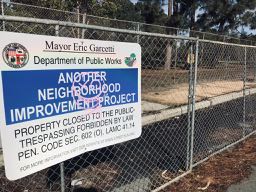
Well, of course the gold course has always had a fence.  But there's a dirt pathway along the outside which had been changing into a homeless camp.  It had campers parked there for a while, but last time there were also tents along the walkway. Here's a pic I posted January 2019:


Here's what it looked like yesterday:


There are houses across the street and having homeless folks camped out by your house without bathrooms can become old.  From the neighbors' perspective this is neighborhood improvement.  Not sure what the homeless who camped here think.  If they've been offered decent lodging, maybe they'd agree.  

From my perspective, the city has blocked off a beautiful walkway along the golf course that I used to jog along when I was still running.  The bike trail is still usable.  It's only an improvement in the sense that our society has deteriorated to the extent that there are so many homeless people that the city has to fence off their encampments to get them out of the neighbors' hair.  Having a social safety net like most European countries have would have been a better way to deal with this - that is make it so people have health care, including mental health care.  Have jobs that pay a living wage.  Support those losing jobs to cheaper labor overseas or automation.  Better education.  Child care for working families, etc.  Then this would still be a lovely walk way for the neighbors to enjoy without the extra fencing blocking it off.  

Our understandings of the world and of human behavior never worked all that well, but the Protestant work ethic - just work hard and you'll do well - is not an accurate description for most people.  Yes, there are examples of it working, but the homeless populations in the various US cities shows us that we need more complex theories.  

But I was headed for the beach on this nbikeride and so were you in this blog post.  

The next picture has me almost there - riding down the last block of Rose Avenue before getting to Venice Beach.  I love this view with the palm trees and the water off ahead of me.  I spent a lot of time at the beach here as a kid and later in life visiting my mom.  


But I got to the bike trail, which wasn't there anymore.  Truly, we must have slept through the worst of the storm.  The bike trail was completely covered with sand.  Mostly it was navigable by bke, but there were places I just had to get off and walk.  I did google to see if anyone has explained all the sand, but all the reports are from previous years - usually wind blowing sand.  But I've never seen it like this.  Was it high tides and wind?  (The moon was close to full.)  I did call a number on an LA City Venice Beach website, but the woman who answered said she had nothing to do with Venice Beach.  I've sent an email to an address on that page, but I'm not holding my breath.  


I got to the skateboard park which had a few skaters despite a sign saying it was closed for filming obligations.   


Folks were filming - tv show?  movie?  commercial?  - taking advantage of the dune like setting.  I'd note this wall of sand is usually there, courtesy of the City of Los Angeles.  Then I made my way a little further to Venice Pier where I got these pictures 
Santa Monica mountains in the background.


This isn't a high resolution photo, but if you look closely above the building, closer to the pole on the left, you can see what I think is Mt. Baldy with a good amount of snow.  I'd note, with the sandy bike trail, there were very few other bikers.  The pier was pretty empty and I didn't see anyone fishing in the choppy waters.  Nor were there any surfers below the pier.  That's a first for me.  

On the way back I just stayed on the pedestrian walk (that turns into the Venice Boardwalk) which had been cleared of sand.  I stopped at the Frank Gehry house (designed by the famous architect, not where he lives).  Here's a post with the Disney Concert Hall for a very different Geary construction.


Finally back to the Boardwalk - Venice's contribution to edgy kitsch.


And then I was back on my way home having enjoyed the beach, and pushing pedals.  

And yes, I've got links to all the redistricting legal challenges and I'm trying to figure out what I want to do with them.  Also so Tom Begich's press release about yesterday's Board meeting (also an email and I can't find a link) which I spent at Venice Beach.  Later.