Showing posts with label weather. Show all posts

Wednesday, April 29, 2026

Why Books? Some New Ones At the Library

 While picking up my next Book Club book at Loussac Library, I went up stairs to peruse the new book section.  In this day of 300 character social media posts, I find books a great place to retreat to a deeper way of knowing about the world.  

So here are, in no real order, some of the books I looked at in the New Books section. 


Hush:  How to Radiate Power and Confidence… by Linda Clemons   (for an audio intro:  https://www.youtube.com/watch?v=0FyKL-6OvyE )


I saw Hush first   This is a self-help book to give the reader "power and confidence."  The "without saying a word" more than suggests it's going to be about body language.  There's a link above to an audio intro to the book by the author, who let's you know she can tell all your secrets by the way you hold and move your whole body as well as parts of your body.  


Language is Gesture
 -  by David McNeill     I saw this second book, ostensibly on an overlapping topic a bit later.  This is more of an academic book outlining this idea that language is based on gesture.

"Abstract:

A new way of viewing language, as a dynamic mode of meaning-making of which gesture is a fundamental part.

When David McNeill began his work on gesture more than forty years ago, language and the action of speaking were regarded as separate realms. But language, says McNeill in Language Is Gesture, is dynamic and gesture is fundamental to speaking. Central to his conception of language, and distinct from linguistic analysis, is what McNeill calls the “growth point,” the starting point of making thought and speech one. He uses the term “gesture–speech unity” to refer to the dynamic dimension of adding gesture to speaking. It is the growth point that achieves this unity, whereby thought is embedded in gesture and speech at the same time.

Gesture is the engine of language. It is foundational to speaking, language acquisition, the origin of language, animal communication, thought, and consciousness. Gesture is global and synthetic and brings energy; speech is linear and segmented and brings cultural standards. The growth point is a snapshot of an utterance at its beginning psychological stage, the starting point of unifying thought and speech. Growth points create gesture–speech unity by synchronizing a bundle of linguistic features with a gesture that carries the same meaning. This gesture–speech unity is a form of thought, a unique form of cognition."  [From Linguist List]

I found the similarity of the covers of these four books interesting.  


The Rolling Stone's review title is 

"OZZY OSBOURNE’S ‘LAST RITES’ MEMOIR  IS HAUNTING, REVELATORY, AND OFTEN DEEPLY SAD"

Rolling Stone offers 14 things they learned that hadn't been in other Osbourne bios.  There was nothing I needed to know, but if you're a big Osbourne fan, maybe , . .


From Kirkus on Sumner:

"A skillful blend of legal history and biography that honors the 19th century’s foremost champion of civil rights..".

Given today's Supreme Court ruling gutting the Voting Rights Act, perhaps we can bring Sumner back to life to help fight again for civil rights.  The decision is 36 pages.  Kagan's dissent is 48 pages.


Also from Kirkus on Lionel Richie's book:

"There’s an abundance of love and gratitude in this wildly entertaining, utterly charming memoir."


Roosevelt, also from Kirkus
"Roosevelt’s forceful life is portrayed as the embodiment of America 'as it was meant to be.'

Baier, chief political anchor for Fox News, is a prolific biographer whose volume on Theodore Roosevelt joins his works on George Washington, Ulysses S. Grant, Dwight Eisenhower, and Ronald Reagan. The author’s portrait of the 26th president draws on Roosevelt’s writings, diaries, letters, speeches, and other biographies. Baier sketches Roosevelt’s transformations to politician, president, soldier, writer, and naturalist. .  .

This portrait of an iron-willed president digs only so deep."

I wonder if the author embraces Roosevelt's trust busting and preservation of natural wonders in National Parks.  


When All the Men Wore Hats, Susan Cheever

 The Cheever book looked particularly interesting, though I've only read a few of her father's short stories.  


From Spectrum Culture:

"When All the Men All Wore Hats, the second study by author John Cheever’s daughter Susan, follows Home Before Dark, her longer 1984 memoir, inevitably repeating some of the material. Both accounts blend candor and tact, respect and pain, as she delves into his sense of never quite belonging to the patrician New England-New York smart-set her father limned.

John came from a checkered New England legacy, one that, like the many floundering characters in his short stories, trended downward. Susan archly observes: “The New Yorker was the stern father who would occasionally hand you a dollar and tell you to go and buy yourself a new fifty-dollar shirt.” Cheever’s standout stories mostly had been published before the 1966 success of the adaptation of The Swimmer into a Burt Lancaster film, and John didn’t publish more than a handful of stories at the magazine that had cemented his mid-century reputation after that."


Cloud Warriors, Thomas E. Weber 


 From Princeton Alumni Weekly:

"As his reporting proceeded, Weber began to focus on why more accurate forecasts don’t necessarily translate into better outcomes, in lives and property saved. Weather satellites, radar stations and the specialized scientific knowledge to understand the data they produce are all important, he concluded — but a key, underappreciated factor is how to manage human psychology.

A turning point came with Weber’s interview with a social science expert who traveled to locations that had recently been struck by tornadoes. As her colleagues were focusing on estimating wind speeds and damage patterns, this researcher was asking community members about the warnings they’d heard before the storm and how they decided to take the actions they did.

“I realized then that there was a huge push in the weather world to start better understanding people, as well as the atmosphere,” Weber says. 'The real issue is, how do you get people to make the safest decisions? You have to communicate that to people in a way that gets them to treat it with a gravity that is appropriate to the danger. It’s a complicated chain of events.'”


Empty Vessel:  The Story of the Global Economy in One Barge, by Ian Kumekawa 


From the New York Review: 

Over the past few decades journalists and academics have chronicled the “lawless ocean,” documenting widespread human rights abuses in the shipping and fishing industries and what might be termed “the outlaw sea.” In Empty Vessel, Ian Kumekawa, a historian at MIT and Harvard, finds that the seas are in fact replete with laws—but that many of them are designed to get around other laws, to exploit or create loopholes, or to obtain regulatory and tax advantages, all with the goal of maximizing profits for shipping companies. This parallel offshore universe of laws and contracts was slowly built up by lawyers, corporations, and territories that function as tax havens, enabling them to reap profit without paying their due—and becoming central to what we call globalization.


Empty Vessel tells the story of a single barge, from its construction at a Swedish dockyard nearly half a century ago to its current status as a rusty, “laid up” accommodation barge for oil workers in the port of Onne in Nigeria. (The book also cursorily follows its sister ship, an identical vessel built at the same time, which had a similar course over the years.) By tracking the ship’s many lives—as a floating barrack for British troops during the Falklands War, as a prison ship moored at Pier 36 in Lower Manhattan and then in Portland, England, and as a temporary housing barge for assembly line workers in West Germany—Kumekawa charts the dramatic transformations that the world economy has undergone since the 1980s: globalization, the decline of manufacturing, financialization, neoliberalism. The ship’s trajectory lays bare both the physical infrastructure of the global economy—in the form of ships, ports, and the workers who operate them—and the invisible legal architecture without which it would be impossible. 


The Injustice of Property - Steven Przybylinski


"With the rise of homelessness in many U.S. cities, municipal governments are sanctioning organized encampments as an official strategy for sheltering unhoused people. Examining the shortcomings and consequences of these municipal policies, The Injustice of Property explores how unhoused individuals living in self-managed encampments navigate and organize themselves within and against the confines of liberal property systems. Through ethnographic research in Portland, Oregon, a paradigmatic city in advancing this model of homeless shelter, Stephen Przybylinski details the everyday struggles of self-managed encampments to highlight how key contradictions inherent to liberal ideology maintain property as a means of structuring sociopolitical equality. He argues that justice cannot be realized for unhoused communities within the liberal model of private property due to how liberalism and liberal ideology prioritize the rights and values of property over the personal rights of self-governance.

The Injustice of Property is a conceptually robust and empirically rich account of the limits of liberal thinking regarding what “just” property relations look like for unhoused and housed people alike. The book shows that while encampment communities struggle to establish alternative property relationships to the traditional model of private ownership, the injustices that residents of encampments face provoke a necessary reevaluation of how beneficiaries of property systems influence who can become housing stable and on which terms. This insightful book reveals how the injustices surrounding Portland’s encampment communities reflect the limits and injustice of liberal property more broadly."  


The Cost of Being Undocumented, by Alix Dick and Antero Garcia

From interview on UUWorld:

Dick: I would like people to understand that the decisions that immigrants make were never made lightly. Nobody leaves home by choice. When people read this book, I want them to understand that what happened to me could happen to anybody. It’s a privilege to think that tragedy will never hit you.

A black-and-white portrait of Antero Garcia, couthor of "The Cost of Being Undocumented."

Antero Garcia: Taking the “cost” part of the title, I hope readers see that the costs of undocumented life are so much more than just financial numbers. Sure, we offer a financial estimate of what living undocumented has cost Alix at the end of the book. However, more importantly, I want readers to understand the toll of living away from family, of navigating language and social barriers, of losing the opportunities for youthful joy in a new country. The financial costs also go both ways: while existing economic reports point to the fact that undocumented individuals actually provide a net-benefit to the U.S. economy, Alix’s story also highlights the ways wage theft, out-of-pocket medical expenses, and inaccessible university costs actually extract even more income for the most marginalized individuals in this country.


 I pulled out a few more books, but this is a good enough selection.  In this time of social media, influencers whose test for truth is how many viewers they have and how much money those viewers bring, and a president who's truth is measured by his own perceived best interest, taking a mental vacation from all that and reading a few books feels like a luxury.  

And it's a good time to support your local library.  Most have a new book section.  You can even find a comfy chair and just lose yourself in the library.  

Sunday, March 29, 2026

Snow - Still Here, Still Covering The Ground, But Its Days Are Numbered


 It's been a cold winter and it's been a snowy winter.  

On March 9, 2025 - there was no snow in our back yard. 

Today, March 27, 2026 - the yard is covered with about a foot of snow.

Until last week, I was leaving the house around 9:15 am in below 0˚F weather. 

Last week all our high temperatures were below the normal low temperature. [Tried to post this a week ago, but I couldn't get Blogger to accept my photos, so two weeks ago our teams were way below normal.)

This past week the temps have shifted up slightly.  My I've walked to Lake Otis School in below +10˚F each day.  Highs have been 28˚-31˚F.  And it's been sunny.  The weather app shows us slowly moving up in the next ten days.

But it finally looks like were going to shift upward, slowly


We're having bright sunny days and the snow is evaporating more than melting because the temps have been below 32˚ F.  


Most of our street is ice free because the Municipality had plows out scrapping the snow and ice off the pavement.  Thought there is a bad spot down at the corner at Lake Otis.  


Some of the evaporating snow is pretty dirty.


But a lot starts to look like clouds and cotton candy as the water is sucked out.


And in some spots it drips.


As I mentioned, this was supposed to go up a few days ago.  I had hoped to put up pictures of Anchorage's No Kings Day yesterday, but having trouble loading pictures here.  That seems to have been overcome and I'll get the No Kings Pics up soon.  


Thursday, December 25, 2025

Yes, Frank, I'm Still Here - Cold and Personal Hotspots

 Frank commented on the previous post that it's been ten days since my last post.  I hadn't realized it was so long.  

It's been cold, generally between +5˚F and -7˚F (-15˚C and -21˚C) and so it takes a little more energy and mental fortitude to go outside.  But I walked over to the University library (about a mile each way) to drop off some books that were due.  I was able to do some of that inside buildings.  About half outside.  I did enjoy seeing this book displayed in the new books section:   


I was clearly enjoying my 'right to be cold.'


Then there were other details to catch up on.  Paying bills and making year end contributions to organizations that are fighting to save our democracy, feed the hungry, etc.  


Our trip to Turkey got me into the world of eSims.  These are electronic Sim cards so you are getting data service in the country you are in, not using up expensive roaming from your home phone provider - in our case ATT.  Instead of physically replacing the sim card in your phone, you canto do it electronically via the internet and it automatically turns on when you land in the host country.  In learning about eSims I realized that there are eSims for the US, and in many cases they were significantly cheaper than local internet access and even phone service.  We settled on a company called Saily which worked fine. 

I have been doing battle with Alaska Communication Service (ACS), formerly Anchorage Telephone Utility (ATU) for a while.  Our internet speed is miserable (1 MBPS) and despite three years of promises of fiber, nothing has changed.  So, before our trip, I cut off our granherdfathered in landline/internet package and vowed to use eSim or find something better when we got back.  

It turned out I could use our ATT unlimited data and a personal hotspot with my laptop.  Bingo.

Well, not quite so fast.  I got a text from ATT that my 10GB per month limit for personal hotspot was


75% used up by the tenth day of our billing cycle.  I checked our bill - J does that bill - and it says unlimited data.  There's nothing on there about personal hotspots.  I went to ATT and talked to the guy I'd talked to before our trip to Turkey.  I liked him then and I still do.  He said that yes there was a 10GB limit to personal hotspot.  It wasn't on the bill, but it was in the contract which he brought up on his tablet.  We have an over 55 package, which he told me was only available for three months and adding 20GB (for a total of 30GB per month of hotspot) would be an extra $34 and I'd have to buy a different plan, though my wife could stay in the old plan.  No, I couldn't simply buy 20GB and patch it on the the plan, you have to buy a whole plan that has more GB of personal hotspot use. And because the over 55 plan was no longer available, I couldn't go back to it if I didn't like the new one.  

We discussed the eSim options. He told me he uses personal hotspot for his internet, and I left saying I'd check what was available before committing to the new plan.

Turns out ATT's $34 for 20GB is not a bad price.  But I was able to get 20GB through Saily for $23 for a month.  But that was a special, normally it's $30, which is not much less that ATT's $34.  But when I was looking for eSims for our trip, I saw that prices change rapidly and constantly.

You do have to go into settings and then the cellular section of your phone and add the eSim which I did.  It's not without obstacles, but it's not that hard.  And Saily has a good chat option that worked well when I needed it.  

After a day and a half I was down to 18.2 GB.  What was happening?  Turns out I was using the Saily instead of my ATT for my data on my phone.  So I've remedied that (back to the cellular section of settings and shutting off Saily when I didn't need it) and we'll see how long the original 20GB last.  I can still use the ATT for personal hotspot, but at a drastically slower speed - worse even than our ACS internet speed.  But knowing that I can plan.  For instance, opening this blogger page and writing here was reasonable.  But uploading pictures wasn't working, so I turned on Saily to do that, then turned it off.  (I know some of you are rolling your eyes and saying it's not worth all that trouble.  But I have a 1997 car with a tape deck, no heated seats, and no video for backing up and no hookup to charge my phone.  People are addicted to luxuries that didn't even exist 30 years ago and they are paying for them as well.)

It would be easier to just go with the old ACS, but even though we were grandfathered in to the landline/internet package, they kept raising the price.  The email addresses that had been free were now $5 a piece.  The free 100 minutes of interstate calls now was $5 a month too.  We never used that but they said it was part of the package and couldn't be waived.  Then there's the $25 late fee if you don't pay the bill by the exact due date.  No grace period any more.  While I was traveling I couldn't pay the bill, because when I went on line to pay, instead of their website, I got a page saying the country I was in (Tükiye) was blocked.  

And instead of sending me an email saying my bill is due in a few days, like VISA does and Chugach Electric does, they send that email the day after it was due.  The other utilities have grace periods and their late fees are either a percentage of the bill or much less than ACS's $25.  This is clearly deliberate.  If a thousand customers pay a $25 late fee, that's $25,000 a month, $300,000 a year.  I've asked to get the name of the CEO so I could write a letter.  None of their officers are on their website.   Wikipedia lists Matthew McConnell as the president and CEO and the parent company as ATN International. [They list the officers now, and the CEO is not Matthew McConnell]  They are owned by a Massachusetts  company - ATN International -  and the most I could get out them was that some of the officers live in Anchorage.  

So now I'm down to two emails with ACS.  I've set up substitute emails.  One is for this website.  The new one is listed in the right hand column.  And I got a $25 late fee charge for a $10 bill for the two emails!  It's called predatory and this sort of ruthless business is supported by the Trump administration which has taken off the limits to these kinds of charges that were introduced by Biden administration.  

I just have to go through the other alaska.net email so I can be sure I replace that address with the new one for organizations that need to contact me.  And I need to hear from.

And so, even if the personal hotspot adds an extra step or two to get my laptop connected to the internet, I think it's worth it (certainly it's much cheaper).  But also because the tech world is constantly changing our options and researching eSims before our trip enlightened me to this new option.  I feel like I'm only 10 or 20 years behind the times.

OK.  I guess I'll stop here.  I was going to skim over a number of other things I've been doing, but clearly I'm not good at skimming.  Often my titles get written after the post because I'm not sure what the post is going to cover.  The combination of cold and personal hotspots is a very accidental title, but I love it.  

So Frank, thanks for reminding me I needed to get back on here.  

Topics that got left out:

  • Hitler's Art Thief
  • Sunday solidarity meeting
  • Chanukah party
  • David Brown, author
  • Gaining daylight after the solstice
  • Flowers blooming inside 
  • Replacing my lost VISA card
  • AIFF2025 left over posts to write

Sunday, December 07, 2025

AiFF2025: Witty Youngman, Saturday Thoughts, It's Cold!

 Friday night (really went into Saturday morning) I was too tired to upload my video of Witty Youngman, especially knowing I was getting up early Saturday.  


Witty played after the movie Burt.  She'd been asked to play an original song from the movie Burt but said she got it fairly late and what she got wasn't too easy to listen to, so she made her own adaptation.  

But then she went on to play for another 40 minutes or more.  The combo of her exquisite voice and guitar work was enchanting.  I couldn't help but capturing some of it for you.  (And for me.)  So far, she has been the highlight of the festival for me.  


It's Sunday morning and I dropped our film maker houseguests off at the Alaska Experience Theater for bagels, networking, and the morning filmmaker panel (anyone can go to these.)  Yesterday I stayed because the panel was for first time feature makers and Nikolas and Katrine were on the panel for their
Katrine, Nikolas, Richie, Emelio

film The World Outside (Draußen die Welt) (the ß is a German letter for double ss).  The other two panelists were Richie James Rollin, whose film Crystal Cross plays tonight (Sunday) at 8:30pm at the Museum, and Emilio Miguel Torres, whose film The Ladder plays at the Museum at 6pm.  I think the moderator, on the left, was Joe Burke, who made Burt. 


I have a bit of time to reflect on the Festival so far before I head back downtown.  

1.  This is the coldest festival I remember.  While the temperature yesterday wasn't terribly low - around 14˚F (-9˚C), the strong and constant wind made it feel (according to my weather app) like -6˚F  (-21ºC).  But at one point we took a bus home and waiting in the wind was brutal.  Fortunately Katrine and Nikolas are much younger and enjoyed the adventure of being in Alaska cold.  But I have to say that -6˚F without a wind is not as cold for me as it was yesterday.

2.  So far I haven't seen a movie that blew me away.  I enjoyed  Brut  on opening night very much.  It's quirky, the characters are great. I liked a lot of the images.  Even though views of cars driving along highways are pretty common in movies, there was one shot of the car going along a winding road that was just exactly right.  

 SPOILER ALERT:  The story is one that happens to a lot of people, particularailly older people (not the specific details, but the idea of a scam).  A plot flaw, in my mind, was Sammy's car.  He was supposed to have come to LA for a few days from New York.  It's unlikely he would drive his own car to LA for a few days.  But if he did, he would have had a New York license plate.  And even Burt would have noticed that he had California plates.  

2.  In The Wake of Justice Delayed was a well-made and effective film focused on the impacts of violence against Native women in Alaska.  Survivors  talked about the impact on them  of losing someone this way.  We joined them in their own space to share that impact.  

Remaining Native was another important film that followed the great grandson of a survivor of Indian Boarding schools.  There were two related stories.  The first was about the boarding schools ("No school should have a cemetery.") and how his great grandfather had run away three times.  The third time he ran 50 miles home.  So Ku Stevens decides to set up a 50 mile run for people to remember their ancestors who had been in boarding schools.  The second story was Ku's own life as a long distance runner on his rural tribal land high school, and trying to get the attention of college recruiters.  While the two stories are clearly related, I would have liked to see them better integrated in the movie.  That said, I don't have suggestions so I don't know how to do it better.  

Both these are important movies.  But I'm waiting for the films about what motivated the school teachers and administrators to treat the Native American kids so badly.  And what causes the men to commit terrible violence on Native women?  Because I think those stories would help us understand what motivates people to join ICE, and a lot of the people who support Trump.  What happened at the boarding schools is happening today to immigrants, transgender folk, women,  and everyone else who doesn't support those in power.  And what kinds of childhoods did the men who torture women have that led them to their evil deeds?  

That isn't the responsibility of the filmmakers of In the Wake of Justice Delayed and Remaining Indian, but I'm hoping someone steps up to address those questions.  (Yeah, I know, I should do it.  I'll put it on my todo list.)

3. Drink And Be Merry:  I'm not a fan of movies that feature alcoholics and bars.  I don't drink more than a glass or two of wine and that not very often.  Watching alcoholics drinking and doing stupid things is like watching a kid playing much too close to a cliff or someone driving a car way too fast.  I'm uncomfortable the whole time.  But Nikolas and Katrine thought it would be better than most such films and so we went.  I could have skipped it. But if that topic is your thing, then you might well have enjoyed it.  My cynical self thought, "The Bear Tooth is playing it because people watching others drink will sell more wine and beer in the theater."

4.  Nikolas and I went to the Alaska Experience Theater to watch Fucktoys.  I'd looked it up and thought it might offer us some insights into people's sexual hangups, but I didn't catch any insights.  We didn't learn anything about the motivation of the men who were paying to be sexually hurt and humiliated, for example. And it seems the curse was never lifted.  But then she substituted a goat for a lamb and I'm not sure it was ever sacrificed.  

5.  Finally, the Thriller shorts.  Again, this is not my genre at all and I should have stayed home.  Most, if not all, appeared to be scenes of a future feature film.  None told a whole story.  The acting in Confidential Informant was strong, but I wasn't thrilled watching a female cop coercing a reluctant informant by threatening to place her child into foster care.  It seemed abusive and while that technique may yield some names (it didn't get that far in the short film), it causes a crisis for the child.  Do cops have the moral right to do that to mothers and their children?  Maybe getting people to ask that question will be the point of the feature film if it gets made.  I like Charon because as I was watching I remembered that Charon
 "is the boatman who ferries the souls of the dead across the waters of Hades to the judgement which will determine their final resting place." (From World History Encyclopedia)

6.  I got to talk to Tony Sheppard- the man who started the Anchorage International Film Festival 25 years ago.  He's here until Monday.  I should have taken a picture and if I see him again, I will.  

At film festivals you see so many movies and meet so many new people from all over that time warps.  Already yesterday (Saturday) the opening night movie seemed to have happened a week ago.  And so not having seen my favorite dilm yet isn't a big deal.  It's only been one day plus an evening show.  

But Witty Youngman's guitar and voice stand out as my highlight so far.  


Wednesday, January 08, 2025

Parts Of LA Are Burning

 It was very foggy several days ago, from what I could tell, mostly within three or four miles of the coast.  


So, this afternoon, as we were driving home from errands that got us as far east as Beverly Hills, and we saw a wall of clouds off to the west, I assumed it was a fog bank.  Though it looked a bit odd, and it seemed to be more north and to the south was still clear.  

When we got home, I walked around the block to take some pictures.  


We were listening to KJZZ, and didn't hear any news of the Palisades fire.  It was pretty windy, and I thought the off shore wind was keeping the fog to the coast.  

It was much later that we heard about the fire.  And then, as I was reading about the fire, almost midnight - an alarm went off on my phone.  


We're about six or seven miles, as the crow flies from the Palisades.  Malibu is even further.  When I bike to the beach and then north through Santa Monica and to Will Rogers State Beach (back in Los Angeles), Pacific Palisades is above the ocean.  Those areas are up in the foothills of the Santa Monica mountains.  We're down in more city area.  

Here's a picture of a couple of houses up on the bluff at Pacific Palisades from my bike ride along the ocean the other day.  


But I did just go outside and while the moon is bright, the air is starting to get smoky.  

And we've had three more alarms go off on my phone.  The last one is for folks in Topanga Canyon to be ready to get out.  


And another alarm just went off but I didn't get a screen shot.  The alarms really screech.  It's 1:15am.  I really don't think we're in any danger.  When I was growing up, we would see the red glow up in the hills, but it never got out of the hills.  

But these are different times.  I probably should leave my phone on, just in case.  But I don't think I'll get much sleep if I do.  

Our tickets back to Anchorage are for Friday night.  

Here's the LA County Emergency map for right now.  We're about where the black star is.  That looks much closer than I realized.  But that orange blotch along the ocean is the evacuation area, NOT the fire area.  There is all of Santa Monica between the evacuation area and us.  As you can see there is another fire to the east.  But I'll leave my phone on.  It's 1:30 am as I post this.  


Saturday, June 29, 2024

Mike from Iowa - How Are You Doing With All That Water?

The title is pretty much the post.  Mike's been a frequent commenter here.  He's warned me about the danger of bears, but his state's been pounded with tornadoes and now flooding from rising rivers.  Hope you're doing ok.  

Saturday, June 15, 2024

Biking Stories This Week - Moose, Innocence, Post Cards, Bike Lanes, Big Leaves

 The moose are out this week.  Tuesday, walking toward Goose Lake we ran into a cow and calf.  Two bikers and a runner had already alerted us, as they were looking for alternate routes.  We got close enough to see them through the trees and walked back.  

Thursday, biking to up Campbell Airstrip Road, I passed a young bull with a nice growing rack.  It was the part of the trail that separates from the road.  Where I'd been warned by a driver a couple of years ago that they'd seen a bear on the trail.  So when I get to this part, I ring my bell a bunch to no one is surprised I'm there.  And down below the trail was the moose.  On the way back, I looked for him down below and there was nothing there.  Then there he was right next to the trail.  Turned back and took the road down.  Where I was able to get this picture.   You can see he's almost on the bike trail.


Then I stopped in the Botanical Garden.  They have a great plant sale.  Well, they sell plants all summer.  There's a good selection of interesting plants - local and not - that do well in Anchorage.  The plant sale is right at the front so I think you can buy plants without paying admission.  But the whole garden is worth some exploration.  And things change in there every week as different flowers start to show.


Here's some Shieldleaf Rogersia at the Garden.   These are very large leaves - the sign says China, Korea.  

They grow in the shade and my yard has lots of shade so I bought one about three years ago.  Bugs have been eating at it each year before it gets real big.  But this year it's looking better.  


Friday I had a couple of stops to make downtown.  First I dropped in at the Alaska Innocence Project.  They help prisoners who claim they were wrongly convicted and have evidence to back their cases.  They helped get the Fairbanks Four freed several years ago.  

I took an Óle course  several years ago, taught by Bill Oberly the (now retired) director and was highly impressed with their work.  

Prisoners don't get a lot of sympathy from the public, and innocent people behind bars is one of the biggest injustices in our society.  Since

Since it was a beautiful day we met in their conference room on the roof.

That's Francisco on the left and Jory on the right.  Here's a short video - under 2 minutes - that I recommend.  It talks about why people are wrongly convicted and how many there are.  


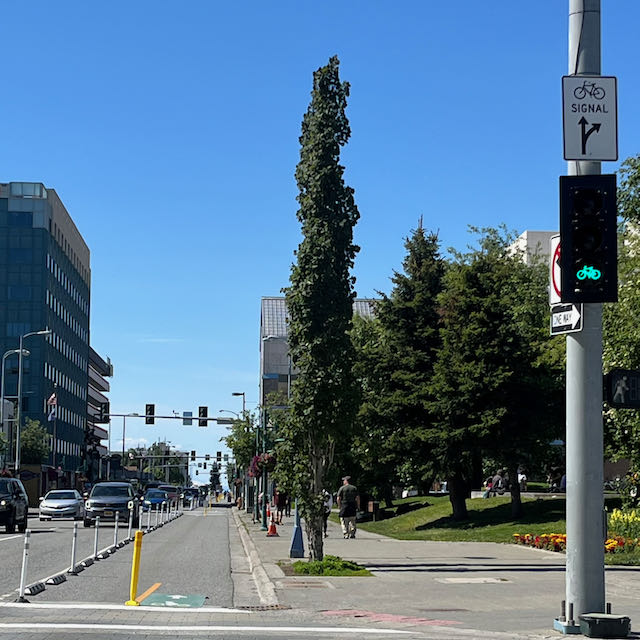
On the way to their office I found the new protected downtown bike lane.  I'd read about it in the Anchorage Daily News, but forgot about it until I came across it.  What an improvement.  No dodging pedestrians on the sidewalk or cars in the street. I could relax and just ride.  But there's not much of it - less than 1/2 mile I'd guess.  And then to get to the office I had to go back to the streets.  It even has its own street light with red and green bikes.  


Next stop was at Tim's to pick up some postcards to mail to voters.  This is probably the least painful way for introverts to be actively working to save Democracy.  [If you think I'm being alarmist, let's talk.  The mainstream media are treating the election as if Trump were a normal candidate.  He's not. Mainstream media only look reasonable in comparison with Fox.  With the Far Right capture of the Supreme Court, a Trump presidency would be the end of democracy in the US.] In this case the Environmental Voters Project combined with the Citizens Climate Lobby.  Tim's in a log cabin downtown, but this one has been modernized a bit.  It even has a touchpad to unlock the door.  

I have some work to do.  


Today was a spectacular day.  I picked up a book that was on hold at the library for me.  I think I requested it six or more months ago - The Sympathizer by Viet Thang Nguyen.  It won the 2016 Pulitzer Prize for fiction and the first 15 pages pulled me right in.                                           I'm still working on Many Things Under a Rock - a book about octopuses.                                                           From the library to the post office to get post card stamps and to mail a letter to my grandson who is away at camp.  The post office was closed, but I could mail the letter.                                                        Finally I could bike on.  As I said, it was a beautiful day - our warmest of the year I'm sure.


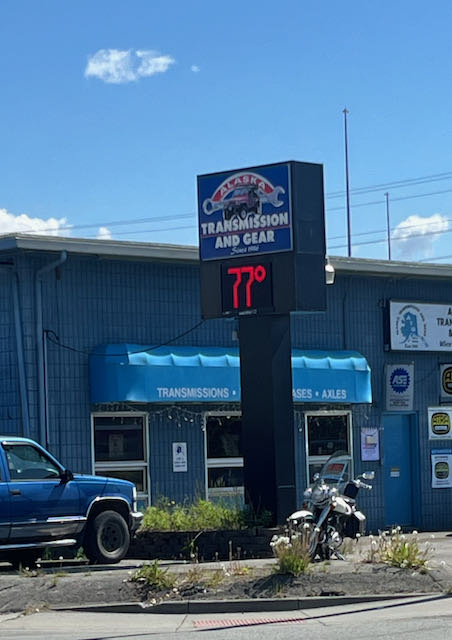
                                                                                      I doubt  the official temperature,
which is measured at the airport, was 77˚F (26˚C), but it was a nice, nice day.  
I went up Arctic to the Campbell Creek bike trail near Dimond and then back down the  trail past Taku Lake and eventually home.  I've gone, as of today, 475 kilometers, this summer.  (That means since the trails were clear enough of snow to ride.)

We had salmon on the deck this evening - with loud rumbles of thunder in the background.  That's not something we get often in Anchorage - sometimes none in a year or three.  

So keeping it fairly light today.  Happy Fathers' Day to all of you lucky enough to have this awesome responsibility. 

Sunday, May 19, 2024

Denali Was Out In Full Glory

Here was the view from the mile 135 Denali Lookout point last Tuesday afternoon.  The mountain was magnificent.  The tallest mountain in North America.  All 20,310 feet (6,190.5 m) were showing, just about.  Aconcagua in Argentina is 22,831 feet (6,959 m).  But Aconcagua is one of many peaks in the Andes range.  The whole of Denali can be seen from 3000 feet and up.  And Tuesday it was all out and clear.  


After about four years in Alaska, I wanted to make a post card of clouds, labeled "Denali as most tourists see it."   There was a couple from Toronto there taking in the sight and I wanted to let them know how lucky they were to see this great view.  And we became friends for the next couple of days, enjoying the park together.  

Below is that same view on Thursday afternoon on our return to Anchorage.  My postcard view.  You'd never know North America's highest mountain was hiding behind those clouds.  You can also see that a lot of snow melted in those two days.  


And below is a picture of Denali from the North (on the right), on the road in the National Park.  Still clear.  


Our Canadian friends got great views of the mountain.  Below it resembles a full moon just rising.  


But as lucky as they were with the Mountain, they were unlucky with animals.  I don't remember a trip to Denali when we saw so few big animals.  The few we saw were not particularly close. There were plenty of ptarmigan, gulls, and ground squirrels.  

First we hiked along the Savage River trail.  We've learned from past experience that this early in the season, the trail on the east side is still full of snow and ice in parts, so we hike to the bridge along the west side (right side in the photo) and returned the same way.  


As you get closer to the bridge (about one mile each way) you start to see these Tolkien rocks.  


And excuse me for putting all these photos up extra large.  Denali National Park is extra large and even this effort doesn't do it justice.  


We stopped at Sanctuary campground for lunch, where we saw this giant head in the rocky mountain across the way.  Anyone else see it?  Two of us did.


Just before Teklanika campground, there is a pair of small lakes, ponds really.  One had buffleheads and pintails and a kingfisher.  The other had northern shovelers.  


We parked at the Teklanika overview - which is as far as you are allowed to drive - and walked down to the bridge below.  You can drive in the first 30 miles only until May 20 when the tour busses start.  (Well, they already had some tour busses for the benefit of cruise line passengers, but not too many.)  Beginning May 20 you can only drive as far as Savage River (12 miles in.)  The road is still closed at mile 40 due a a huge avalanche a few years back.  So 20 miles further to Eilson, and then the next 30 to Wonder Lake aren't accessible. An Anchorage Daily News article say it won't be done until 2026.

It was only as we were headed back after a long day, that we saw the first large animal - a caribou.  There were two moose after that.  Denali - being far north with a short growing season and a long winter, is no Serengeti.  There just isn't enough food for the large herds in Africa.  But three large animal sightings is pitiful.   It was a VERY windy day, and perhaps that kept the animals hunkered down.  


Our new friends headed to their hotel outside the park and we got back to our campground.  I'd brought a bunch of the broken tree limbs from the back yard post winter clean up and some nice dry pieces of firewood and we quickly had a dinner cooked in foil.  First on the grill while the flames were high, and then on the coals a little longer.  


Tuesday, January 02, 2024

New Year's Day Birds

We dropped the family off at the airport Monday.  It was a beautiful sunny day with blue skies and t-shirt temperatures. The sky was clear and you could see snow up on Mt. Baldy. We like walking along Ballona Creek, but thought since we were coming from the airport we could start at the ocean end.  

There's a bike trail along the creek that goes at least to Culver City and connects with the beach trail south to nearly Palos Verdes.  North, it goes through Marina Del Rey and then connects with Venice and Santa Monica trails.  I've marked in red our walk from the beach to Lincoln and back.  


We saw the hummingbird hovering first.  It's iridescent ruby throat flashing brilliantly.  It flew off and then quickly returned an lighted on this high bush.  I'm still fighting my auto-focus on my Canon Rebel.  I've read instructions, but the auto-focus has trouble figuring out exactly where I want to focus.  For most things it's not an issue, but for birds far away or tiny birds relatively close, it's frustrating.  I'm open to links that could help.  I left the image small because you can see how out-of-focus the bird is when I cropped it bigger.  

And I couldn't get the iridescent flash, though you can see the emerald wing suggesting it.  


The egret is much bigger and easier to get in focus.

I was fascinated by the egret's toes as it started walking.  It didn't respond to my request that it get a less difficult background.  You have to look carefully.  I counted four toes.  


I originally thought these might be sanderlings, but the legs seemed the wrong color.  Maybe a type of sandpiper.  I couldn't tell for sure.  

The water here is where the marina opens to the Pacific, not the Ballona Creek side of the trail.  You can check here.

I'm guessing this is a white pelican, but you can check yourself. 


You may have read about large waves this weekend in Southern California.  The waves didn't seem huge, but they crashed pretty much straight down.  The bike trail on he beach was covered with sand and the high tide lines were way, way up on the beach.