Sunday, August 21, 2016

Marie-Antoinette's Parc - (And Bikes)


At the big birthday party Friday night (our incentive to come to Paris) we were told that Parc Bagatelle was walking distance from the hotel.  So Saturday we ventured out there and it was dreamy.

From a Paris tourism site:


"The Parc de Bagatelle, situated at the heart of the Bois de Boulogne, is one of the City of Paris’s four botanical gardens. Created in 1775, the park and its chateau were built in 64 days after a wager between Queen Marie-Antoinette and her brother in-law, the Count of Artois. The Parc de Bagatelle is a great place for walking and relaxing. As well as giant trees and varied plant life, little bridges, rocks, caves, expanses of water and artificial waterfalls add to the charm and romantic aspect of the park. The 19th century Chinese pagoda is just one of the park’s curiosities. Visitors can admire the magnificent rose garden with 10,000 rose bushes from 1,200 different species. The park regularly hosts exhibitions and events as well as classical music concerts in the summer."
With all the walking around we've been doing, my heel has begun to act up again, but with ice and Naproxen it's been ok.  But it gave me more incentive to figure out how to access the many public bikes in Paris.  So I was able to get a bike within a quarter mile of the hotel and bike most of the way to the park.  Here I am replacing it at another bike station.  J walked over to meet me there.

This system (Velib) is very cool and I'll do another post on it later, but let's get back to the park.

It was a comfortable sunny/cloudy day in the 70s (F).  The park is a mix of formal and (well managed*) wooded areas. You can get a sense from this picture below.


There's this formal part, but the woods in back have paths where you can walk through the trees.


And even the formal gardens have a comfortable, lazy summer feel to them.  They are clearly formal and there's a lot of work, but it isn't obsessive like many such gardens.  The lawn isn't a perfectly fertilized and pesticided deep rich green.  In fact there were lots of bees and butterflies enjoying the flowers.

And the woods had lots of constructed features like this grotto where we could walk through the rock outcropping and sit by  the waterfall.


And sitting there, we looked out over the water to a bridge.


We saw the southern half of the park, but not even all of that we realized at the end when we checked the map.  We totally missed the Japanese garden.  But as we sat down for an espresso for J in the dining area, black clouds were rolling in and a wind picked up.  They were shutting down the umbrellas and told us they were closing because it might rain.  And, in fact, the wind was knocking down the umbrellas over the tables.  It didn't actually rain on the way home, but it was a good time to retreat.  But here are a few more pictures of the park.


The magpie looked a little different from our Alaskan variety, but I'm not sure.  The most surprising birds we saw were the parrots in the tree.  I'm assuming that like in San Francisco, these are escaped parrots.


I always love passion flowers.  Growing up in LA I saw passion flowers all the time.  They were like weeds, but the flowers were so spectacular .  The LA ones had more elaborate coloring.  And we didn't know the fruit was edible.

We took the train to Brussels yesterday and spent the afternoon and evening with the ninety plus cousin of my father.  She's doing quite well, still living on her own, but it's getting shaky and we did talk about my mom and the option of home help rather than having to go to a home as some of the friends who are helping her out are suggesting.  I've found online lists of resources here this morning and I'll show her when we go over today.  I didn't even know she existed when I was a student in Germany.  My father sent me her brother's name when I told him we were going to Amsterdam back then.  That's a story for another day.


*well managed - this is a descriptive statement, not a judgmental one.  In these woods trees are trimmed, dead ones cleared away and replaced, etc.  A very different sort of woods from Alaska woods.


Saturday, August 20, 2016

La Défense The Opposite Of Paris

Most of Paris is relatively life size and people friendly.  Below is a view from Montmartre.  Except on the southern edges of Paris the buildings are mostly about five stories or less.


But out west is a sprawling area of high rises and large sterile plazas called La Défense that are the opposite of what Paris seems otherwise to be.   Where we are staying is close to La Défense and we walked over there our first day.


Here's a huge pond of water with whimsical poles sticking out.  In the background you can see a huge arch (red and white) that mimics in its own way the Arc de Triomphe, which when I turn around, I can see in the distance.  (See picture below).  If all Paris were built like La Defense, such a straight line view would likely have been blocked by sky scrapers.  I would note one clever feature of this pond.  The water flows toward where I'm standing and then there's a flow along the close edge.  I suspected something like that when I saw all the garbage collected in the corner to the right (not in the picture.)  I confirmed this with a man working on the fountain there.

OK, now here's the view when I turned around and you can see the Arc de Triomphe in the distance.


In The Flâneur, Edmund White writes about some of the Paris neighborhoods and on page one quotes a definition of a big city as including tall buildings.  He goes on,
"By that definition Paris is deficient in tall buildings, although President Pompidou had a scheme in the sixties and early seventies to fill Paris with skyscrapers, he succeeded only in marring the historic skyline with the faulty towers of a branch university, Paris VII at Jussieu (which recently closed because it was copiously insulated with asbestos), the appalling Tour Montparnasse - and the bleak wasteland of the office district, La Défense.
La Défense has few apartment dwellers other than Africans and the rootless, whereas the young white middle class for whom it was intended are all off living in the restored Marais district with its exposed beams and period fireplaces.  La Défense went directly from being futuristic to being passé without ever seeming like a normal feature of the present."
Now, that's a pretty sweeping and racist sounding statement, but I've heard echoes of his concern about the anti-Parisian high rise forest from others, without the racist undertones.  So I suspect his main thrust is that the high-rises and broad cement plazas are the problem.

While there are architecturally eye-catching buildings, my sense is more that these are examples of architects trying to do something different than the typical rectangular skyscraper.  But they don't succeed in my opinion.  Like this one that looks like it's got a cancer growing inside that's almost bursting at the seams.


Or this one.


Or this one.    

I suspect I'm just being cranky, reflecting the thoughts of others who know Paris far better than I.  I know nothing about how functional these buildings are.


But is this sweets shop in this massive mall preferable to walking a bit from your house down a people scaled street to a little boulangerie? 


There are some trees, but they are carefully spaced the same distance apart in rows.  Though I suspect if I look at other parts of Paris I'll see the same things.  More trees may eventually make this more human scaled.


This giant sculpture is interesting, but not particularly warm, though I can see kids finding fun in its twists and turns.  But it does look like some sort of huge menacing insect.


Better is this Joan Miro sculpture.  I found a writer praising it for bringing color and life 'in this harsh cold environment' [La Défense].'


Friday, August 19, 2016

Paris Walkability - Off The Chart [Updated]


Most subway cars I've ever been on have signs that mark all the stops.  But this Paris subway car had a sign with each stop lit up. Once you left the stop, the light went out and the next stop blinked. It was extremely easy to see were you were, where you'd been, and how far you were from your own stop. Note: we only saw one train that had this sort of sign, but over all getting about Paris is incredibly easy.

The metro cars in some cases come minutes apart. There are buses that crisscross the city too. Wherever you are you aren't more than - I'm not sure but our experience has been less than half a mile from a metro or subway stop.


This platform has glass walls so you can't fall onto the tracks, though  most  stations don't.  They have this in Singapore too.


I'm doing this post just because it's been so very easy to get around, something other places should emulate. The sidewalks are good with lots to see and there are many bigger, non-sidewalk areas to walk.


We got on this car near the beginning of the route, which is why it's so empty, but we've gotten seats on every ride.


So while I really just want to get something up here, so I can explore more, I did check on walkability scores and found this website.

It seems most of the sites focus on the US, but this one allowed you to write in any city anywhere.  But I couldn't find a way to do Paris as a whole.  This one picked a specific neighborhood.  I'm not sure all of Paris would have been quite this high.

If you click on the map, you'll get to the Walk Score website.


[UPDATE NOON August 20, 2016 (Paris time)I should add another point - the bike's available all over town.  We've seen them, but I'm only just checking how they work now.  You can get a year pass, a seven day pass, or a one day pass.  We might try that today, but I need to see if they come with locks.  We may try this today because my own walkability is being affected by a flare up of my old heel problems.  The picture below is from the other day.]


Triomphe To Luis Vuitton Foundation's Frank Gehry Designed Museum

I'm in Paris, I don't have time to blog the way I'd like so here are some appetizers.  Two stops:  The Arc de Triomphe and the Louis Vuitton Foundation museum.   See this Vanity Fair story on this Frank Gehry creation.


A lot of people have walked these stairs to the Arc de Triomphe.


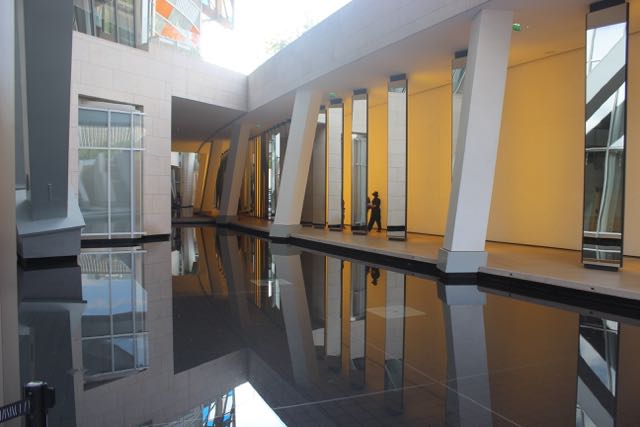
And then there was the Frank Geary designed Louis Vuitton Foundation museum yesterday.  So much to think about.  Main reactions, briefly - while I love Geary's work, the colors on the sails of this one set me off when I first saw it.  In many ways the building itself overpowers whatever is inside it, even though the exhibit rooms are huge and small and wonderful.

The building makes you question what a building is - the inside flows into outside, which was obvious because it was raining.  There was basically one exhibit - of contemporary, edgy Chinese artists including a tree by, perhaps, the most famous - Ai Wei Wei.  Enough said for now.


Such an incredible space to be in down inside/outside by the water.


Zhang Huan's Sudden Awakening.


Zhang Xiaogang's  My Ideal.


And my favorite part of the space, the sloping waterfall.  


Lots more to ponder, but there's a metro to catch.

Thursday, August 18, 2016

Eiffel Tower Pieces

We're in Paris, so naturally, I'm going to avoid the stereotypical things to do. Like go to the Eiffel Tower.  We spent our first morning wandering near our hotel - getting ten packs of public transportation tickets (carnets0 that are good on subways and busses and maybe something else.  We also got a sim card for J's new phone and walked the huge cementscapes at the  La Defense that our friends here in Paris and one of the books I'm reading  talked about with disdain.

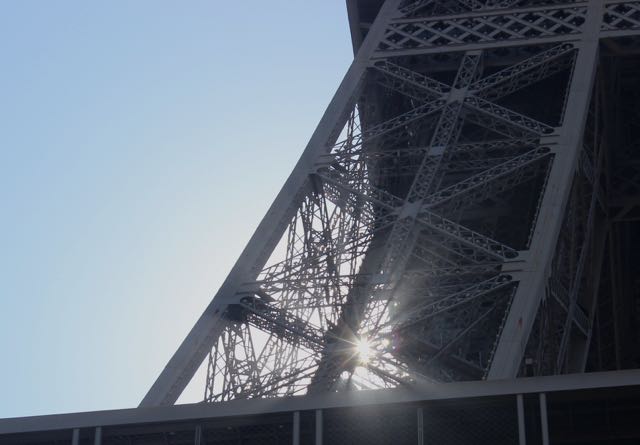
But the magnetic pull of the Eiffel tower was too much and we used two of our new tickets to take the metro to the Eiffel Tower.  Here are some shots I took as I walked round it.  And then there are some extra shots - like the view from the plane landing Monday night and from the rooftop dinner Tuesday night.


People lined up to buy tickets.  It didn't look too bad. 


This was the nicest view, from the north.


Look carefully and you can see a couple of people on their way down from a climb up the tower.   You may have to click on the image to focus it.


He saw me with the camera.  I signed could I take his picture.  He signed ok.  I took the picture.  He put his hand out for money.  I offered to delete the picture.  He nodded no, that was ok. (Yes, I'm assuming the clown was a he.  But we assume about everyone don't we?)


Security wears a lot more clothes today than the guy with the horse in the background


From across the Seine


There were lot and lots of towers for sale starting at 3 for a Euro to 5 Euros each for the smallest.


And in addition to towers, selfie-sticks were for sale in abundance too.  Here two young men take their picture with the tower in the background across the river.


This was our first view of the tower flying in Tuesday night.  It's a  little below and to the right of center.  Click to enlarge and focus.


We could see the tower and the rising moon again after a rooftop dinner with the people we're here to celebrate a significant birthday with.


When you look carefully through a lens, you see a lot more than when you just look.  Of course, if you paint something, you have to look even more carefully.  One of the things I noticed through the lens was the gallery of names on all four sides of the tower.  When I get a chance I'll do a post on them.


Wednesday, August 17, 2016

Another Election, Same Problem - State Gives Lindbeck 56% When He Really Got 68%


The Alaska Democrats agreed once to the ADL ballot (Alaskan Independence, Alaska Democratic and Alaska Libertarian (A-D-L)), which means that candidates from various parties all appear on the same ballot in the Alaska primary elections.

One rational is that it's more democratic, unlike the Republican ballot where only Republicans can vote.  But a primary originally was supposed to be where the parties chose the candidates that they preferred to run in the election.  You could almost say it was like letting your opponent pick what players you were going to have on your team against them.

The issue I have in particular showed up again in Tuesday's election.  In a primary, not only are candidates trying to win, but to win decisively enough to convince funders that they convince funders that they have a good chance of winning.

Here are the results for the ADL ballot for the Democratic primary Tuesday from GEMS (it's the third race down):
Hibler, William D. DEM        2578      9.40%
Hinz, Lynette         DEM        4445    16.21%
Lindbeck, Steve     DEM     15493     56.50%
McDermott, Jim C. LIB        3533     12.88%
Watts, Jon B.           LIB        1371       5.00%
The casual observer would go, "Oh, Lindbeck did pretty good.  He got 56.5% of the vote."  But compared to Don Young's (his November opponent)  89% in the Republican primary, that looks pretty weak.

The problem, as I see it, is that the ADL combines candidates who ARE NOT running against each other, and the state election office treats their percentages as though they were.  But the DEM's are running against the DEM's and the LIB's are running against the LIB's.

So against the other Democrats, Lindbeck actually got 68% of the vote, a pretty decent tally, a landslide in many people's minds.

I wrote about this issue at length after the 2008 primary.   Here's the summary of that post:

SUMMARY OF FINDINGS:  
  1. The Alaska Primary elections had ballots that combined candidates for the Democratic Party, Alaska Independent Party, and the Libertarian Party of Alaska. The Republicans had separate ballots.
  1. By combining two or more parties onto one ballot, the primary is no longer a contest between the two party candidates for the nomination of their party. The percentages of vote for candidates that are not running against each other makes no sense at all.
  1. The state law says "The director shall prepare and provide a primary election ballot for each political party." To me, that sounds like a separate ballot for each party.  [A document put out by the state says a blanket primary is legal.]
  1. The Division of Elections Media Guide says that "In Alaska, the political parties determine which candidates will have access to their ballot and which voters are eligible to vote their ballot."
  1. Both the Libertarian Party and Alaska Independent Party by-laws call for what is known as a 'blanket" ballot which lists all candidates for all offices. That makes sense since they don't have more than one candidate for any office. Between the two parties, I could only find a total of three candidates in only the US House and Senate races. They have provisions for other options if the other parties do not allow blanket ballots.
  1. I couldn't find the Democratic by-laws, but their Plan of Organization says, " The Alaska Democratic Party’s primary election is open to all registered voters." That doesn't say open to all other parties. 
It all seems to hinge on whether the Democratic Party by-laws call for an open primary or a blanket primary.


You can go there to see to see the details. (And since I'm on vacation in Paris right now, I haven't reread the original post carefully, so there may be some aspects I would change.  You can point them out.

At this point, though, I think the Democrats disadvantage themselves by letting the percentage reflect more than the candidates they are running against.