Showing posts with label women. Show all posts

Sunday, December 07, 2025

AiFF2025: Witty Youngman, Saturday Thoughts, It's Cold!

 Friday night (really went into Saturday morning) I was too tired to upload my video of Witty Youngman, especially knowing I was getting up early Saturday.  


Witty played after the movie Burt.  She'd been asked to play an original song from the movie Burt but said she got it fairly late and what she got wasn't too easy to listen to, so she made her own adaptation.  

But then she went on to play for another 40 minutes or more.  The combo of her exquisite voice and guitar work was enchanting.  I couldn't help but capturing some of it for you.  (And for me.)  So far, she has been the highlight of the festival for me.  


It's Sunday morning and I dropped our film maker houseguests off at the Alaska Experience Theater for bagels, networking, and the morning filmmaker panel (anyone can go to these.)  Yesterday I stayed because the panel was for first time feature makers and Nikolas and Katrine were on the panel for their
Katrine, Nikolas, Richie, Emelio

film The World Outside (Draußen die Welt) (the ß is a German letter for double ss).  The other two panelists were Richie James Rollin, whose film Crystal Cross plays tonight (Sunday) at 8:30pm at the Museum, and Emilio Miguel Torres, whose film The Ladder plays at the Museum at 6pm.  I think the moderator, on the left, was Joe Burke, who made Burt. 


I have a bit of time to reflect on the Festival so far before I head back downtown.  

1.  This is the coldest festival I remember.  While the temperature yesterday wasn't terribly low - around 14˚F (-9˚C), the strong and constant wind made it feel (according to my weather app) like -6˚F  (-21ºC).  But at one point we took a bus home and waiting in the wind was brutal.  Fortunately Katrine and Nikolas are much younger and enjoyed the adventure of being in Alaska cold.  But I have to say that -6˚F without a wind is not as cold for me as it was yesterday.

2.  So far I haven't seen a movie that blew me away.  I enjoyed  Brut  on opening night very much.  It's quirky, the characters are great. I liked a lot of the images.  Even though views of cars driving along highways are pretty common in movies, there was one shot of the car going along a winding road that was just exactly right.  

 SPOILER ALERT:  The story is one that happens to a lot of people, particularailly older people (not the specific details, but the idea of a scam).  A plot flaw, in my mind, was Sammy's car.  He was supposed to have come to LA for a few days from New York.  It's unlikely he would drive his own car to LA for a few days.  But if he did, he would have had a New York license plate.  And even Burt would have noticed that he had California plates.  

2.  In The Wake of Justice Delayed was a well-made and effective film focused on the impacts of violence against Native women in Alaska.  Survivors  talked about the impact on them  of losing someone this way.  We joined them in their own space to share that impact.  

Remaining Native was another important film that followed the great grandson of a survivor of Indian Boarding schools.  There were two related stories.  The first was about the boarding schools ("No school should have a cemetery.") and how his great grandfather had run away three times.  The third time he ran 50 miles home.  So Ku Stevens decides to set up a 50 mile run for people to remember their ancestors who had been in boarding schools.  The second story was Ku's own life as a long distance runner on his rural tribal land high school, and trying to get the attention of college recruiters.  While the two stories are clearly related, I would have liked to see them better integrated in the movie.  That said, I don't have suggestions so I don't know how to do it better.  

Both these are important movies.  But I'm waiting for the films about what motivated the school teachers and administrators to treat the Native American kids so badly.  And what causes the men to commit terrible violence on Native women?  Because I think those stories would help us understand what motivates people to join ICE, and a lot of the people who support Trump.  What happened at the boarding schools is happening today to immigrants, transgender folk, women,  and everyone else who doesn't support those in power.  And what kinds of childhoods did the men who torture women have that led them to their evil deeds?  

That isn't the responsibility of the filmmakers of In the Wake of Justice Delayed and Remaining Indian, but I'm hoping someone steps up to address those questions.  (Yeah, I know, I should do it.  I'll put it on my todo list.)

3. Drink And Be Merry:  I'm not a fan of movies that feature alcoholics and bars.  I don't drink more than a glass or two of wine and that not very often.  Watching alcoholics drinking and doing stupid things is like watching a kid playing much too close to a cliff or someone driving a car way too fast.  I'm uncomfortable the whole time.  But Nikolas and Katrine thought it would be better than most such films and so we went.  I could have skipped it. But if that topic is your thing, then you might well have enjoyed it.  My cynical self thought, "The Bear Tooth is playing it because people watching others drink will sell more wine and beer in the theater."

4.  Nikolas and I went to the Alaska Experience Theater to watch Fucktoys.  I'd looked it up and thought it might offer us some insights into people's sexual hangups, but I didn't catch any insights.  We didn't learn anything about the motivation of the men who were paying to be sexually hurt and humiliated, for example. And it seems the curse was never lifted.  But then she substituted a goat for a lamb and I'm not sure it was ever sacrificed.  

5.  Finally, the Thriller shorts.  Again, this is not my genre at all and I should have stayed home.  Most, if not all, appeared to be scenes of a future feature film.  None told a whole story.  The acting in Confidential Informant was strong, but I wasn't thrilled watching a female cop coercing a reluctant informant by threatening to place her child into foster care.  It seemed abusive and while that technique may yield some names (it didn't get that far in the short film), it causes a crisis for the child.  Do cops have the moral right to do that to mothers and their children?  Maybe getting people to ask that question will be the point of the feature film if it gets made.  I like Charon because as I was watching I remembered that Charon
 "is the boatman who ferries the souls of the dead across the waters of Hades to the judgement which will determine their final resting place." (From World History Encyclopedia)

6.  I got to talk to Tony Sheppard- the man who started the Anchorage International Film Festival 25 years ago.  He's here until Monday.  I should have taken a picture and if I see him again, I will.  

At film festivals you see so many movies and meet so many new people from all over that time warps.  Already yesterday (Saturday) the opening night movie seemed to have happened a week ago.  And so not having seen my favorite dilm yet isn't a big deal.  It's only been one day plus an evening show.  

But Witty Youngman's guitar and voice stand out as my highlight so far.  


Tuesday, November 11, 2025

The Museum of Innocence

“3 We don’t need more museums that try to construct the historical narratives of a society, community, team, nation, state, tribe, company, or species. We all know that the ordinary, everyday stories of individuals are richer, more humane, and much more joyful.​

4 Demonstrating the wealth of Chinese, Indian, Mexican, Iranian, or Turkish history and culture is not an issue—it must be done, of course, but it is not difficult to do. The real chal­lenge is to use museums to tell, with the same brilliance, depth, and power, the stories of the individual human beings living in these countries.

5 The measure of a museum’s success should not be its ability to represent a state, a nation or company, or a particular history. It should be its capacity to reveal the humanity of individuals.”        

    -Orphan Pamuk, Manifesto of the Museum of Innocence  


I started the book Istanbul by Turkish Nobel Prize winner Orphan Pamuk before we left for Turkey.  It was going to help me get a feel for the neighborhoods of Istanbul.  

But in Istanbul, I learned of another Pamuk book that people recommended. The Museum of Innocence. An intriguing aspect was the fact that there is a Museum of Innocence in Istanbul that is related to the book. More than that.  It’s part of the book.  So much so that if you have a copy of the book, you get in free.  Mine was an audio book from the library so I didn’t get in free.


The Museum of Innocence - The book

Kemal is part of the post Ottoman Empire 1970s elite.  Rich, educated, well travelled, and engaged to even richer Sibel. But one day he reconnects with Füsun, a cousin, part of a poorer side of the family,  he hasn’t seen since she was a child.  They begin a passionate love affair that takes over his life and the book.  

In telling this bizarre and tragically obsessive love story, Pamuk also reveals layers of socio-economic webs that capture and tie together the people of Istanbul. 

There’s the decaying legacy of the Ottoman Empire, which the elite try to cover with European fashion and culture, though the physical remnants of thousands of years of Byzantine and Ottoman engineering and architecture dominates people’s lives.   

A key theme, I’m guessing the theme of the book’s title, involves the difference between what’s allowed of men and women.  Virginity before marriage is daringly challenged by upper class women who flirt with European mores, but ultimately they live in Turkey and even the chic look down on marrying women who have slept with someone other than their fiancee.  

Kemal has taken the virginity of both his fiancée and his lover.  In the first instance it would not be a problem if they didn’t break off the engagement.  In the latter case, we learn late in the book, it does, very much matter to Füsun. 

There’s also a fair amount on Turkish cinemas and movies.  

I have to admit that at one point I was getting weary of Kemal’s over-the-top obsession with Füsun.  But I’m sure there are readers who can relate to that situation better.  And it all works - as a novel and as a museum - in the end.  

Listening to the book, means I got to hear how names and places were pronounced, but not how they were spelled.  So some neighborhoods challenged me as I tried to locate them on maps.  But overall, the book gave me a richer sense of Istanbul than I would have otherwise noticed, and also reminded me how Istanbul was wrapped in millennia of nuance that I would never come close to understanding.  

The Museum of Innocence - The Museum

It’s easier to do pictures from a museum, than from a book - especially an audio book.  

The Galata Tower is a major landmark in Istanbul. This first picture is from the Istanbul Modern (the modern art museum.). The tower is the one on the left.  The other one is a minaret from a mosque.  

Here we see the Tower from across the Golden Horn in Eminönü.  The Galata bridge is the black line that goes from the middle of the left side across the water.     Below you see it much closer up.  


The map should give map people a better sense of things.  The Galata Tower is pretty much in the middle of the map.  The Museum of Innocence is about where the red marker is.  Istanbul Modern is toward the water below the blue marker that says European side.  

The picture looking out over the water was taken a bit to the right of the southern side of the bridge, about where it says “Hamam.” 

(All the land here is on the European Side.  The waterway going up to the left is the Golden Horn which has a series of bridges and ferries crossing it.  The Asian side would be in the right, but isn’t shown.)

The hotel we stayed at when we were in Istanbul, was right near the mosque (Ayasofia) at the bottom. 

This is all pretty close.  From our hotel to the museum was maybe 4 or 5 km.  

The ‘start’ on the map is where we started up the hills to the Museum.  Though we went by the Galata Tower on the way. Not very direct.

The streets are cobblestone, steep, and narrow.  Sometimes cars come through.  More often motorcycles.  


The Museum of Innocence is in an old house in a neighborhood near where much of the book takes place.  All the cabinets are labeled by chapter and are filled with items which Kemal says he collected during the events of the book, but which the author, who is a minor character in the book, said came from various collections and from thrift shops,


Each cabinet (or larger display) is numbered with the corresponding chapter of the book.


The sign at the bottom of this one says:
“In those days [1970s], even in Istanbul’s most affluent Westernized circles, a young girl who ‘gave herself’ to a man before marriage could still expect to be judged harshly and face serious consequences:  If a man tried to avoid marrying the girl, and the girl in question was under eighteen years of age, an angry father might take the philanderer to court to force him to marry her.  It was the custom for newspapers to run photographs with black bands over the “violated” girls’ eyes.  Because the press used the same device in photographs of adulteresses, rape victims, and prostitutes, the photographs of women with black bands over their eyes were so numerous that reading a Turkish newspaper in those days was like wandering through a masquerade.”

On the fourth floor is the bed where Kemal and Füsun met.


Thursday, December 12, 2024

AIFF2024: The Stranger's Case Was Powerful - Thursday Schedule [Video Added]

 It was a full house at the E Street Theater Wednesday night for The Strangers' Case.  The film is packaged with five chapters:  The Doctor; The Soldier; The Smuggler; The Poet; and The Captain.  They all converge in this story that starts out (after an opening scene in a Chicago hospital) in a hospital in Aleppo, Syria.  The doctor goes home to a birthday party and a bomb blast.  The soldier is upset when ordered to shoot a group of men accused of being terrorists, because it include a boy who wrote graffiti.  The smuggler sells spots on a boat from Turkey to Greece, cash only, no guarantees.  The poet is a refugee who is trying to get his family to Greece.  The captain is in the Greek Coast Guard who goes out everyday to look for and rescue boat people.  You can see the trailer in the previous post.

The only actor I knew was Omar Sy, the great French actor who's played in television series and many movies.  It was particularly poignant given that Assad's regime in Syria was overthrown just this week.  A film you should look out for.  

At the film was Ash Avildsen, whose own film, Queens of the Ring, plays tomorrow night.  I asked him for a quick intro to his film at after the showing of The Strangers' Case.  It's below.  At the end you can see his demonstration of appreciation for The Strangers' Case.

[I'll add the video tomorrow morning.  It's still uploading to Youtube and I need some sleep.DONE!]

I've seen so many really good films.  The documentaries are particularly strong this year, though The Strangers' Case is a narrative feature.  I'm hoping that having Omar Sy in the film will help it get wide distribution.  

Thursday's Schedule

9:00 AM: Sonic Storytelling: Music Licensing and Artist Collaboration in Film  Alaska Experience Theater

Moving to the E Street Theater now

10:00 AM – 12:00 PM: Coffee Talk/Panel

12:00 PM – 2:00 PM: Doc Shorts #2

  • The Collector – 15:00
  • Tentsítewahkwe – 17:21
  • Designed by Disaster – 19:52
  • Broken Flight – 18:00
  • Signal Fire: Towards Reconciliation – 30:00

And now to the Museum

2:00 PM – 4:00 PM: Female Filmmaker Showcase Shorts 
A decade after high school, three old classmates reconnect and reevaluate their lives while hiking a mountain in Alaska.

  • Vessel – 17:44
  • Derive – 18:38
  • Yazidi Women: From Victims To Survivors – 7:06
  • The Icefield: An Expedition Memoir – 26:46
  • Sunflower Girl – 13:08
  • Julian – 6:53

4:30 PM – 6:30 PM: Alaska Teen Media Institute Presents After-School Special – Event Tickets

7:00 PM – 9:00 PM: Alaskan Feature: Uphill 

There's not a lot out there about this film.  It seems pretty new.  TMDB has the bare minimum - but it includes the image I'm using, the actors, and a budget ($15,000).

The DuckDuckGo search engine offers this under Plex.

"Uphill (2024) release date is Thursday, December 12 starring Adam D Boyer, Victoria Summer Felix, Matthew Rush and directed by Adam D Boyer. A decade after high school, three old classmates reconnect and reevaluate their lives while hiking a mountain in Alaska."
It doesn't actually say that if you go to the Plex link.  But if it's true, this is the world premier in Anchorage this evening.  

All this was still at the Museum.  

Now we move over to the Bear Tooth.

5:30pm  Diving Into Darkness

Screenshot from Press Page Photo
If you've gone to any of the AIFF films, you've seen Jill Heinerth swimming underwater in dark caves, and telling us it's the closest thing she can think of to being on another planet.  Wikipedia tells us:
"Jill Heinerth (born 1965) is a Canadian cave diver, underwater explorer, writer, photographer and film-maker.[4] She has made TV series for PBS, National Geographic Channel and the BBC, consulted on movies for directors including James Cameron, written several books and produced documentaries including We Are Water[5] and Ben's Vortex, about the disappearance of Ben McDaniel. . .

In 1998, Heinerth was part of the team that made the first 3D map of an underwater cave.[8]
Heinerth became the first person to dive the ice caves of Antarctica, penetrating further into an underwater cave system than any woman ever[5][dead link] In 2001, she was part of a team that explored ice caves of icebergs[9] where she and her then husband Paul Heinerth "discovered wondrous life and magical vistas" and experienced the calving of an iceberg, documented in the film Ice Island.[10]"
The AIFF2024 program tells us that the 2024 Explorer's Achievement Award goes to Diving into the Darkness.   This is a new award, but I heard tonight that Jill Heinerth is in Anchorage and will be at the screening to receive the award.  
I'm conflicted over whether I should post the trailer here, just because it's been played before every single film/program I've been to at this festival.  Instead, here's a link to the film's website and you can go watch it yourself.  If you haven't seen the trailer, you should.  


As our friendship deepened, I discovered that Jill's story was profoundly deep, both literally and figuratively, and how the personal side of her story was immensely captivating. Yet, this remarkable story had largely remained confined to short video formats. Given my unique position at the intersection of the filmmaking and diving realms, I found the call to tell her story irresistible. What followed was a year of intense collaboration, a creative partnership that would prove invaluable as we tackled the herculean challenges of principal photography.

I had no intention of being a passive observer while my colleagues risked their lives to capture the story on film, especially when it came to the underwater sequences. So I undertook the gruelling journey of
becoming a certified cave diver on a rebreather, something which had never been done before amongst
film directors. I descended alongside the cast and crew into the depths of the caves, well beyond the reach of recreational divers. It was an arduous yet exhilarating experience to dive, work, and learn alongside some of the world's most renowned cave divers. Despite the monumental difficulties and inherent risks in directing a crew of cave divers, I would embark on this adventure again without hesitation.


8:00 pm (still at the Bear Tooth)  Queen of the Ring 

From Collider:

"From writer/director Ash Avildsen and based on the book by Jeff Leen, Queen of the Ring tells the incredible true story of Mildred Burke (Emily Bett Rickards), a single mother from a small town who went on to become the first million-dollar female athlete in world history. Mildred was a woman determined to make a name for herself as a female wrestler at a time when it was illegal across most of the United States, becoming a three-time women’s world champion from the 1930s through the 1950s despite all the challenges. At the same time, her personal life was not without its challenges, especially once she meets promoter Billy Wolfe (Josh Lucas), with whom she falls in love, gets married, becomes aware that he’s cheating on her with several of the other female wrestlers on his roster, and decides to stay married as a business arrangement, so that she doesn’t get screwed out of her own money. Through everything, she perseveres, becoming a pioneer in the sport that she loved. . .

"How did this project come your way? Was this just an audition that came up?

RICKARDS: I received the script in my inbox. There was no audition, just a talk with (writer/director) Ash [Avildsen] and questions about whether I had wrestled. The answer was no. And how comfortable I was with physicality, which was very comfortable. I felt very capable of this woman. I’m really grateful that Ash sent me and gave me this opportunity because I wouldn’t have known who this woman was. And I had never gotten to go under such a physical transformation for a character before, one that was not only energetic, but had to have the body structure to find the energy. It has really opened up my eyes, in terms of my process and acting. It just makes me hungry for more. It’s a cycle."


 Grammar note:  I wasn't sure where the apostrophe should go in The Strangers' Case.  Before or after the final s?  I checked the program and put it before the final s.  But that makes it singular, which, after seeing the movie didn't make sense.  There were a lot of 'strangers.'  And I see now that the trailer spells it Strangers'.  So I've fixed it.

The program also misled me on this last film.  The title in the program is Queen of the Ring.  But the title on the trailer is Queens of the Ring.  Colider also has it singular. So I've changed it where I can find it, but it takes too long for me to upload video to YouTube to change it on the video tonight. 

[Update: Dec. 12, 2024, 11:52pm:  I saw Queen of the Ring tonight, and the title on the film was QUEEN, no S.  So I've changed what I could. Editing the video and uploading it again will take a bit more time.  Also, I left an 'l' out of Ash Avildsen's name.  But I've fixed that too.]

 [ACS has been promising fiber optic for two years now, but until then I'm stuck with painfully slow internet.]

Friday, December 01, 2023

AIFF2023: Saturday Dec. 2: Lots of Shorts, Trip to Argentina

 SATURDAY - December 2, 2023  - Anchorage International Film Festival


BEAR TOOTH  - NOON

4  Shorts - Made in Alaska - view list here.


BEAR TOOTH - 3pm

Documentary Narrative:  Citizen Sleuth

SlashFilm says:

"'Citizen Sleuth' is a darkly funny, engaging, and thrilling documentary about a true crime podcast that has all the fascinating twists and turns of true crime, while flipping the script and focusing on the voice behind the podcast. The documentary chronicles not a tragic death, but the rise and fall of a podcast dedicated to it, and the complicated ways its host became trapped in her own narrative."

This is 82 minutes, so there should be plenty of time to get to the Museum for the rest of the films starting at 5pm.


ANCHORAGE MUSEUM - 5pm

7 Shorts - "Love Me" Program   See the list here.


ANCHORAGE MUSEUM - 7pm  *This program has a warning:  18 and over only.

6 Shorts - "Do We Still Need Feminism" Program  See the list here.


ANCHORAGE MUSEUM - 9pm  

Feature Narrative - Ariel Back To Buenos Aires 


From the film's website: 

"ARIEL BACK TO BUENOS AIRES follows the tumultuous siblings Davie and Diana Vega as they return to Argentina, country of their birth and learn to dance tango. They uncover secrets about their family history that call into question everything they hold to be true, but that free Davie from his existential misery. A story of how the past holds us in its embrace – only by engaging with it can we find freedom. A lacerating love letter to the city of Buenos Aires."

The website says it is also streaming on Apple TV.  It's won a number of awards at film festivals this year.  


Saturday, June 25, 2022

Anchorage Rallies In Protest of Supreme Court Election Decision

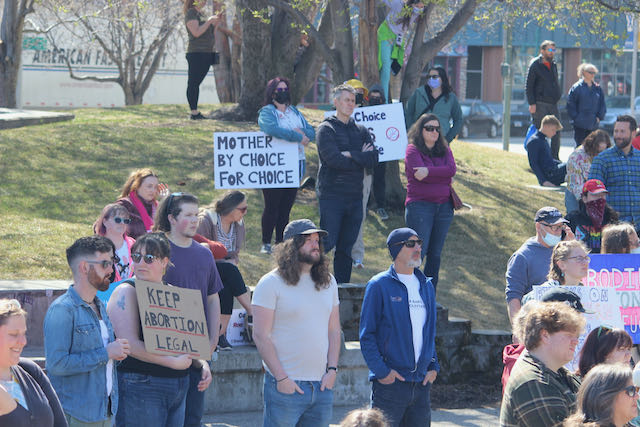
This afternoon, people gathered at the Parkstrip and marched to the Anchorage Town Square to protest Friday's Supreme Court decision on abortion.  My rough estimate of the crowd is 400-600.  

Observations:  The crowd was younger than the demonstration on May 8, 2022 when the decision was leaked.  The organizers also talked a lot about voting this time, which was missing at the previous demonstration.  Including voting no on whether Alaska should have a constitutional convention.  (The constitution requires such a vote every ten years.)  Conservatives want such a convention to do (at least) two things:

  1. Remove the right to privacy in the constitution 
  2. Change how judges are selected in Alaska (by a non-partisan commission which evaluates people applying for judgeships by reviewing surveys of judges, attorneys, juries, court employees, and court watchers.  Top candidates are passed on to the Governor to choose from.

During the 1960's the protesting against the Vietnam war was invigorated by the fact that all 18 year old men had to register for the draft and stood a decent chance of being sent to Vietnam to fight.  All their friends and family had a very personal interest in the war ending.  

Today's young folks have been give an equally important stake in fighting Dobbs v. Jackson's Women's Health Organization.  This time it's all women of child bearing age who are on the line, but since women don't need an abortion unless a man has been involved, men too have a vital stake.  And if the Vietnam War protests are any predictor, the people fighting to make abortions legal again aren't going away. 

Here are some photos from today's protest.


Facts of the case
Carrie Buck was a "feeble minded woman" who was committed to a state mental institution. Her condition had been present in her family for the last three generations. A Virginia law allowed for the sexual sterilization of inmates of institutions to promote the "health of the patient and the welfare of society." Before the procedure could be performed, however, a hearing was required to determine whether or not the operation was a wise thing to do.

Question
Did the Virginia statute which authorized sterilization deny Buck the right to due process of the law and the equal protection of the laws as protected by the Fourteenth Amendment?

Conclusion
The Court found that the statute did not violate the Constitution. Justice Holmes made clear that Buck's challenge was not upon the medical procedure involved but on the process of the substantive law. Since sterilization could not occur until a proper hearing had occurred (at which the patient and a guardian could be present) and after the Circuit Court of the County and the Supreme Court of Appeals had reviewed the case, if so requested by the patient. Only after "months of observation" could the operation take place. That was enough to satisfy the Court that there was no Constitutional violation. Citing the best interests of the state, Justice Holmes affirmed the value of a law like Virginia's in order to prevent the nation from "being swamped with incompetence . . . Three generations of imbeciles are enough."


Griswold v. Connecticut, 381 U.S. 479 (1965)

Argued March 29-30, 1965

Decided June 7, 1965

Syllabus

Appellants, the Executive Director of the Planned Parenthood League of Connecticut, and its medical director, a licensed physician, were convicted as accessories for giving married persons information and medical advice on how to prevent conception and, following examination, prescribing a contraceptive device or material for the wife's use. A Connecticut statute makes it a crime for any person to use any drug or article to prevent conception. Appellants claimed that the accessory statute, as applied, violated the Fourteenth Amendment. An intermediate appellate court and the State's highest court affirmed the judgment.

Held:

1. Appellants have standing to assert the constitutional rights of the married people. Tileston v. Ullman, 318 U. S. 44, distinguished. P. 381 U. S. 481.

2. The Connecticut statute forbidding use of contraceptives violates the right of marital privacy which is within the penumbra of specific guarantees of the Bill of Rights. Pp. 381 U. S. 481-486.

Eisenstadt v. Baird

DECIDED  Mar 22, 1972

Facts of the case

William Baird gave away Emko Vaginal Foam to a woman following his Boston University lecture on birth control and over-population. Massachusetts charged Baird with a felony, to distribute contraceptives to unmarried men or women. Under the law, only married couples could obtain contraceptives; only registered doctors or pharmacists could provide them. Baird was not an authorized distributor of contraceptives.

Question

Did the Massachusetts law violate the right to privacy acknowledged in Griswold v. Connecticut and protected from state intrusion by the Fourteenth Amendment?

Conclusion

6–1 DECISION 

MAJORITY OPINION BY WILLIAM J. BRENNAN, JR.

In a 6-to-1 decision, the Court struck down the Massachusetts law but not on privacy grounds. The Court held that the law's distinction between single and married individuals failed to satisfy the "rational basis test" of the Fourteenth Amendment's Equal Protection Clause. Married couples were entitled to contraception under the Court's Griswold decision. Withholding that right to single persons without a rational basis proved the fatal flaw. Thus, the Court did not have to rely on Griswold to invalidate the Massachusetts statute. "If the right of privacy means anything, wrote Justice William J. Brennan, Jr. for the majority, "it is the right of the individual, married or single, to be free from unwarranted governmental intrusion into matters so fundamentally affecting a person as the decision whether to bear or beget a child."


Sunday, May 08, 2022

Pro Roe Rally In Anchorage

 Some photos of the Anchorage rally this afternoon.  If there were any candidates there, they weren't on stage and I didn't see/recognize them in the crowd.   There were lots of expressions of anger, but I didn't hear any of the speakers urging the crowd to vote for candidates who support women's rights, letting people know that the people who have given up voting are the people who can make a difference in the next election.  You want to keep the Court from getting even more misogynists?  Vote.  And get others who don't normally vote to vote.  More people didn't vote in the mayoral election last year than did.  10% more people voting for the right candidates would make all the difference.  


Monday, December 06, 2021

AIFF 2021: Captive and Tall Tales [Updated]

My Favorite Doc and Most Powerful Film So Far:


The film Captive is why I like film festivals.  This is not an easy film.  The journalist/film maker, Melissa Fung, is in Nigeria interviewing young girls who have been kidnapped and forced to marry Boko Haram soldiers.  She looks in on them over a couple of years as she reveals to the audience that she too has been captured and raped.  The screenshot gives a sense of the rapport that Fung has with her subject, which is part of why this is such a powerful film.  Given the stories we hear everyday about the US, we have many similar survivors.  And, given the Texas legislature, the rape statistics in the US in general, and the naked power lust of January 6,  we have many men in the U who have no empathy or understanding of women or other human beings.  And while these young women live in comparative poverty, their clothing and beauty are exquisite.  

[UPDATE Dec. 7, 2021 4:13 pm


I couldn't resist this link which showed up today.  The abduction of women is a global and local problem.]


My Favorite Feature So Far                 


Tall Tales.  Hungarian film maker Attila Szasz has had the best film at the Anchorage International Film Festival twice already.  He makes beautiful, tight, thought provoking films. This one takes place at the end of WWII.  Men have been scattered all over the war zone and wives and parents are desperate for word about their husbands and sons who haven't returned.  The main character reads the classified ads seeking information and goes to visit the desperate families and tells them what they want to hear.  But things get complicated.  He's not the only one telling Tall Tales.  The credits and the noirish color add to the that post war period feel.  


Sunday, September 05, 2021

Texas Abortion Law Part II: What To Do Next

Part I was a look at parts of the law itself and the Supreme Court dissents.   

I was hoping here to start a list of things to do in response to the Texas abortion law ("The Texas Heartbeat Act"), but I still had questions that reading the law itself doesn't clarify. Articles and comments offer conflicting interpretations. So let me list some of my original questions:

  1. What's a fetal heartbeat? 
  2. What's the difference between a fetus and an unborn child?
  3. Who may be sued?
  4. Who may sue/prosecute someone for performing an illegal abortion?
  5.  Can people be sued for helping Texas women get abortions outside of Texas?
  6. What are the penalties for performing or aiding and abetting an illegal abortion?

Question #1 Since the law makes hearing a fetal heartbeat the point when abortion may not be performed,  medical opinions (which differ from what the law makers apparently intended) on when the fetal heartbeat can be heard may well be significant.  

#2 probably does not have significant legal consequences, though people will argue about this endlessly.

#3  The answer appears to be people who help people get abortions and doctors who perform them, but not the women who get abortions.  Though 'help' is pretty vague.

#s 4 and 5 are key issues.  #4 because the law was designed to avoid being blocked by courts because governmental entities can't prosecute.  #4 because the law doesn't seem clear on this.  

#6 I'm still having trouble figuring out.

Finally, I suspect that they threw all kinds of crap into this law to:

  • See what would stick
  • Jam up the courts
  • Scare people out of seeking and offering abortions
  • Because they could


What's a fetal heartbeat?

This piece From NPR says sonogram 'heartbeats' are really noises generated by the machine and aren't real heartbeats.

"The Texas abortion law that went into effect this week reads: "A physician may not knowingly perform or induce an abortion on a pregnant woman if the physician detected a fetal heartbeat for the unborn child."

"When I use a stethoscope to listen to an [adult] patient's heart, the sound that I'm hearing is caused by the opening and closing of the cardiac valves," says Dr. Nisha Verma, an OB-GYN who specializes in abortion care and works at the American College of Obstetricians and Gynecologists.

The sound generated by an ultrasound in very early pregnancy is quite different, she says.

"At six weeks of gestation, those valves don't exist," she explains. "The flickering that we're seeing on the ultrasound that early in the development of the pregnancy is actually electrical activity, and the sound that you 'hear' is actually manufactured by the ultrasound machine."  [emphasis added]

So, will the time frame be challenged to when an actual heart beat and not a synthetic sonogram machine heart beat is heard?


What's the difference between a fetus and an unborn child?

The Texas law definitions include:

"(7)AA"Unborn child" means a human fetus or embryo in any stage of gestation from fertilization until birth."

But (again from NPR):

"In fact, "fetus" isn't technically accurate at six weeks of gestation either, says Kerns, since "embryo" is the scientific term for that stage of development. Obstetricians don't usually start using the term "fetus" until at least eight weeks into the pregnancy."

But, I guess legislatures can create legal definitions that differ from scientific definitions.  All you need is a majority.  


Who may be sued?

It's clear from the law that the physician performing the abortion and anyone aiding or abetting someone getting an abortion, including paying for the abortion may be sued.  But some people think the woman herself can't be prosecuted.  The law says:

("b)AA This subchapter may not be construed to:

(1)AA authorize the initiation of a cause of action against or the prosecution of a woman on whom an abortion is performed or induced or attempted to be performed or induced in violation of this subchapter;"

But is that only for that subsection of the law?   This AP article agrees that abortion patients can't be sued:

"It allows any private citizen to sue Texas abortion providers who violate the law, as well as anyone who “aids or abets” a woman getting the procedure. Abortion patients themselves, however, cannot be sued."

The following passage from a Texas Planned Parenthood site also suggests the woman herself is exempt:

"This provision lets anyone sue an abortion provider and anyone else who helps a patient access abortion care that is prohibited by SB 8. Anyone who successfully sues an abortion provider will be entitled to at least $10,000 and a court order preventing them from providing abortions in the future."

But what exactly does 'aid and abet' or 'help' mean?  If I tell someone where they can get an abortion, is that against the law?  Presumably not because the law states:

"(g)AA This section may not be construed to impose liability on any speech or conduct protected by the First Amendment of the United States Constitution, as made applicable to the states through the United States Supreme Court’s interpretation of the Fourteenth Amendment of the United States Constitution, or by Section 8 Article I,TexasConstitution."

Using the logic of Citizens United, people could argue that giving a woman money or an airplane ticket is a form of free speech.  (Of course you can argue anything.  But it has to persuade the judges.)

There are also some issues that arise because an abortion before the heartbeat is still legal in Texas.  What if aid is given earlier but the eventual abortion is later?


Who can sue someone for performing an illegal abortion?

[An attorney friend pointed out, when I used the word 'prosecute' that citizens can sue, but not prosecute.  Only governmental units can do that.  And probably, but I'm not sure, agencies like Departments of Justice or Legal Departments.] 

I think this is relatively clear.  No governmental entities can prosecute.  Only private individuals anywhere can sue.  From Planned Parenthood again:

"That means anyone, anywhere in the country — from anti-abortion protesters to out-of-state lobbyists — can sue an abortion provider, abortion funds, or anyone who “aids and abets” someone seeking an abortion that is prohibited by SB 8, regardless of whether they are directly involved or even know the patient."

Here's the law:

"shall be enforced exclusively through the private civil actions described in Section 171.208. No enforcement of this subchapter, and no enforcement of Chapters 19 and 22, Penal Code, in response to violations of this subchapter, may be taken or threatened by this state, a political subdivision, a district or county attorney, or an executive or administrative officer or employee of this state or a political subdivision against any person, except as provided in Section171.208. 

Preventing the state or state subdivisions from prosecuting was done to avoid the law from being blocked by the courts.

However, although they can't prosecute:

(h)AANotwithstanding any other law, this state, a state official, or a district or county attorney may not intervene in an action brought under this section. This subsection does not prohibit a person described by this subsection from filing an amicus curiae brief in the action.

  I don't completely understand this, but my understanding is a court could block a government entity from taking action.  But it can't block all potential people who might sue, before the fact.  That's the logic argued by the five member majority of the Supreme Court.  

Can people be sued for helping Texas women get abortions outside of Texas?

My assumption has been 'no.'  How could they forbid Texans to do something that's legal in another state?  That would be like saying gambling and smoking marijuana are illegal in Texas and Texans can't do those things in states where they are legal. I've searched the new law for the word "Texas" and it shows up 16 times - mainly before Constitution and various Codes.  Since women having abortions can't be sued by this statute.  They could do this.  And since the doctors and clinics aren't in Texas, it doesn't seem likely Texas would have jurisdiction over them.  That leaves people who might help pregnant women get out of Texas for an abortion.  I'm guessing they just left it vague and are leaving it up to their vigilantes to test this in court.  I haven't been able to find this exact question addressed online.  

If an attorney or two can clarify this that would be helpful.


What are the penalties for performing or aiding and abetting a women to get an abortion? 

There's a minimum $10,000 per abortion performed by doctors for the doctors.  And for people who aided and abetted.

(2) statutory damages in an amount of not less than $10,000 for each abortion that the defendant performed or induced in violation of this chapter, and for each abortion performed or induced in violation of this chapter that the defendant aided or abetted

It gets even stickier:

(2) knowingly engages in conduct that aids or abets the performance or inducement of an abortion, including paying for or reimbursing the costs of an abortion through insurance or otherwise, if the abortion is performed or induced in violation of this chapter, regardless of whether the person knew or should have known that the abortion would be performed or induced in violation of this chapter;

So, first we get "knowingly engages in conduct" but at the end we get "regardless of whether the person knew."   Perhaps they mean if you knew you were taking someone to get an abortion, but even if you didn't know it would be an illegal one.  So, if you take someone to get a legal abortion, but it turns out there's a fetal heartbeat and the abortion is performed anyway, you would be liable.  There is language that says it's "an affirmative defense" if the defendant can prove they conducted research that led them to believe that the doctor would comply with the law.  But the proof "with a preponderance of evidence" of that the research is on the defendant.  

That can only be intended to stop people from getting legal abortions as well as illegal abortions.    

Defendants who win their cases cannot be awarded legal fees.

(i)  Notwithstanding any other law, a court may not award costs or attorney’s fees under the Texas Rules of Civil Procedure or any other rule adopted by the supreme court under Section 22.004, Government Code, to a defendant in an action brought under this section.

So if you're wrongfully accused, you still have to pay all your attorney fees.  I don't think, though, that if an organization provides free attorneys, they could be sued for 'aiding and abetting.'  But maybe only because the legislators didn't think of it.  

Conclusions 

  • The intent of this law was to make it as difficult as possible for women to get abortions in Texas by making it illegal
    • to perform an abortion after a fetal heart beat can detected
    • to assist anyone trying to get an abortion
  • The law was written so that Governmental entities couldn't prosecutors and allowing ordinary citizens to sue.  This was done to avoid having the law blocked by a court. (It worked with the Supreme Court's initial ruling.)
  • The penalties $10,000 per abortion are high enough to discourage most doctors from performing proscribed abortions and to scare most people from helping women to get an abortion
  • Unclear to me is whether the legislators think this will also prevent Texas women from getting abortions outside of Texas
    • They probably don't have jurisdiction, but since ordinary citizens will file the lawsuits, there's a good chance that many will even for abortions outside of Texas
  • We can only start imagining some of the consequences:
    • I've already seen one Tweet where a guy was going to get women pregnant and then claim the $10,000 award for turning them in.  (He didn't realize you can't sue the women.) 
    • This adds to the encouragement of vigilantes that Trump began and we can see predators pursue pregnant women and the people around them
    • There will be a surge of revenge law suits filed against people whether they've been involved in a legal abortion, illegal abortion, or no abortion at all
    • Planned Parenthood's income will rise steeply
    • Rape and incest are not excepted in this legislation.  Any man who wants to father as many children as possible will be tempted.  
    • Relations between sexual partners will change
      • perhaps birth control use will go up for women and some men
      • men could sue or threaten to sue anyone they think might help their pregnant girl friend or spouse get an abortion, including her parents
    • Underground abortions will increase and more women will die from them
    • There will be a market for bogus, but profitable, abortion potions/techniques that 
      • probably won't work
      • could harm the mother and/or fetus
    • There will be political consequences because a fairly large majority of US citizens approve of abortion.  They will become more active running for office and voting
That's just a couple minutes of conjuring up ideas.  I'm sure you can think of many I've missed.  The next step is determine the most effective ways to fight this law and to help Texas women who need an abortion to get one.  

[NOTE:  I'm not an attorney.  I'm trying to glean from the law itself and from what reputable reporters have to say about the law.  I understand that statues are complicated and may seem clear in one section, but there may be another section that voids it.   Don't base any medical or legal action on this blog post.  It's just my way of sorting out some of the issues.]

Thursday, September 24, 2020

Two Netflix Series - Borgen and Away - Feature Mothers In Critically Important Jobs. Plus Rached

I'll try to keep this short.  Trying to write on something a little lighter than the elections. Think of it as notes to readers about Netflix offerings they might want to watch or avoid.  

BORGEN and AWAY

The ten year old Danish series BORGEN features a woman propelled into the position of prime minister of Denmark.  The new Netflix series AWAY features a woman as the commander of a mission to Mars.  

Both have to deal with sexism in the job (though not all that much) along with the work demands that make  it hard to pay adequate attention to their children - each has a teenage daughter, the Danish prime minister also has a younger son.  

Birgitte Nyborg's constant task is keeping together a coalition of parties with different priorities.  Emma Green, Captain of the Atlas, has an astronaut from India, China (the other woman and mother), England/Ghana, and Russia to keep together.  But there's also her former astronaut husband who has a stroke after liftoff and anxious daughter back on earth to distract her.  

I was struck by how we were watching these two series at the same time and how each treated the difficulties of a married woman in a traditionally male position.   BORGEN flows quickly from crisis to crisis fairly organically while with AWAY the crises - both technical and interpersonal - seem more contrived, and like Indiana Jones, Emma always seems to narrowly escape disaster.   

BORGEN has three seasons and we're near the end of season two.  I thought in the trip to negotiate between the northern Islamic area and the Christian south of a fictional African country, Brigitta's preparation for such a difficult diplomatic trip seemed woefully inadequate.  We only saw the first part of this adventure and if the upcoming summit in Copenhagen falls apart, I won't be surprised.  But the show has a way of giving Brigitta lots of narrow victories.

I think BORGAN is well worth watching.  AWAY is certainly not must see tv, but not a total waste of time.  


RATCHED  

This Netflix series is like the most exquisite and decadent dessert in the bakery display case.  The colors are rich, the costumes and sets delicious, the actors arch,  and the camera makes love to it all.    It's noir in technicolor with the appropriate campy creepy music.  There's very little nutrition in this evil concoction. And there's lots of gratuitous gore.  But it's visually pretty spectacular.

It's the back story of Nurse Ratchet from One Flew Over the Cuckoo's Nest (which Netflix is also pushing right now.)  

That Cuckoo's Nest connection is probably what made me watch the first episode.  I read Cuckoo's Nest at the end of my Peace Corps time in Thailand and was possessed with the question "Who wrote this?  Why?  How did he know all this stuff?"  And soon after I was working at a Peace Corps training program in Hilo when a new trainee had the book Electric Kool-Aid Acid Test.  I read the blurb on the back that said it was about the author of Cuckoo's Nest.  It's not cool to use your position to get favors, but I was so obsessed I asked the trainee if I could borrow the book right then.  I consumed it that night and gave the book back the next day with my curiosity satisfied.  

RACHED really has nothing to do with Cuckoo's Nest.  It's just a gimmick to play off the name recognition of Nurse Rached to produce a highly stylized and visually beautiful, but empty, confection of a series.  It's a wicked distraction from today's COVID and Trump nightmare.